Name/Title
1971 Rare pewter "pint pot"Entry/Object ID
000552Tags
William Bull and Sarah Wells Stone House AssociationScope and Content
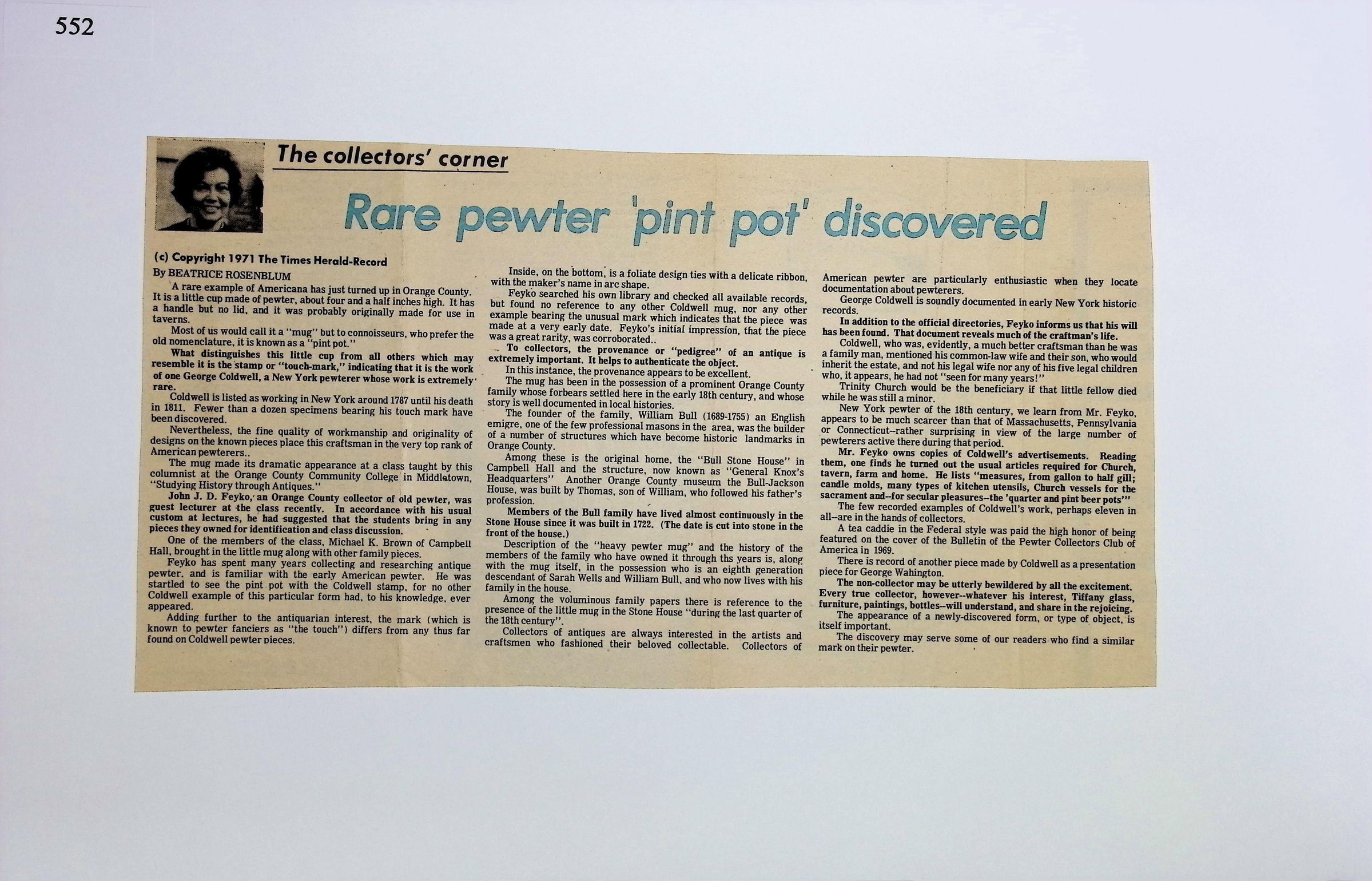
Rare pewter 'pint pot' discovered
(c) Copyright 1971 The Times Herald-Record
By BEATRICE ROSENBLUM
A rare example of Americana has just turned up in Orange County. It is a little cup made of pewter, about four and a half inches high. It has a handle but no lid, and it was probably originally made for use in taverns. Most of us would call it a "mug" but to connoisseurs, who prefer the old nomenclature, it is known as a "pint pot." What distinguishes this little cup from all others which may resemble it is the stamp or "touch-mark," indicating that it is the work of one George Coldwell, a New York pewterer whose work is extremely rare. Coldwell is listed as working in New York around 1787 until his death in 1811. Fewer than a dozen specimens bearing his touch mark have been discovered. Nevertheless, the fine quality of workmanship and originality of designs on the known pieces place this craftsman in the very top rank of American pewterers. The mug made its dramatic appearance at a class taught by this columnist at the Orange County Community College in Middletown, "Studying History through Antiques." John J. D. Feyko, an Orange County collector of old pewter, was guest lecturer at the class recently. In accordance with his usual custom at lectures, he had suggested that the students bring in any pieces they owned for identification and class discussion. One of the members of the class, Michael K. Brown of Campbell Hall, brought in the little mug along with other family pieces. Feyko has spent many years collecting and researching antique pewter, and is familiar with the early American pewter. He was startled to see the pint pot with the Coldwell stamp, for no other Coldwell example of this particular form had, to his knowledge, ever appeared. Adding further to the antiquarian interest, the mark (which is known to pewter fanciers as "the touch") differs from any thus far found on Coldwell pewter pieces.
Inside, on the bottom, is a foliate design ties with a delicate ribbon, with the maker's name in arc shape. Feyko searched his own library and checked all available records, but found no reference to any other Coldwell mug, nor any other example bearing the unusual mark which indicates that the piece was made at a very early date. Feyko's initial impression, that the piece was a great rarity, was corroborated.. To collectors, the provenance or "pedigree" of an antique is extremely important. It helps to authenticate the object. In this instance, the provenance appears to be excellent. The mug has been in the possession of a prominent Orange County family whose forbears settled here in the early 18th century, and whose story is well documented in local histories. The founder of the family, William Bull (1689-1755) an English emigre, one of the few professional masons in the area, was the builder of a number of structures which have become historic landmarks in Orange County. Among these is the original home, the "Bull Stone House" in Campbell Hall and the structure, now known as "General Knox's Headquarters" Another Orange County museum the Bull-Jackson House, was built by Thomas, son of William, who followed his father's profession. Members of the Bull family have lived almost continuously in the Stone House since it was built in 1722. (The date is cut into stone in the front of the house.) Description of the "heavy pewter mug" and the history of the members of the family who have owned it through ths years is, along with the mug itself, in the possession who is an eighth generation descendant of Sarah Wells and William Bull, and who now lives with his family in the house. Among the voluminous family papers there is reference to the presence of the little mug in the Stone House "during the last quarter of the 18th century". Collectors of antiques are always interested in the artists and craftsmen who fashioned their beloved collectable. Collectors of
American pewter are particularly enthusiastic when they locate documentation about pewterers. George Coldwell is soundly documented in early New York historic records. In addition to the official directories, Feyko informs us that his will has been found. That document reveals much of the craftman's life. Coldwell, who was, evidently, a much better craftsman than he was a family man, mentioned his common-law wife and their son, who would inherit the estate, and not his legal wife nor any of his five legal children who, it appears, he had not "seen for many years!" Trinity Church would be the beneficiary if that little fellow died while he was still a minor. New York pewter of the 18th century, we learn from Mr. Feyko, appears to be much scarcer than that of Massachusetts, Pennsylvania or Connecticut-rather surprising in view of the large number of pewterers active there during that period. Mr. Feyko owns copies of Coldwell's advertisements. Reading them, one finds he turned out the usual articles required for Church, tavern, farm and home. He lists "measures, from gallon to half gill; candle molds, many types of kitchen utensils, Church vessels for the sacrament and-for secular pleasures-the 'quarter and pint beer pots'" The few recorded examples of Coldwell's work, perhaps eleven in all-are in the hands of collectors. A tea caddie in the Federal style was paid the high honor of being featured on the cover of the Bulletin of the Pewter Collectors Club of America in 1969. There is record of another piece made by Coldwell as a presentation piece for George Wahington. The non-collector may be utterly bewildered by all the excitement. Every true collector, however-whatever his interest, Tiffany glass, furniture, paintings, bottles-will understand, and share in the rejoicing. The appearance of a newly-discovered form, or type of object, is itself important. The discovery may serve some of our readers who find a similar mark on their pewter.