Name/Title
Early Orange Co, NY copied from History of Orange County NYEntry/Object ID
000047Tags
Orange County HistoryScope and Content
HISTORY OF ORANGE COUNTY, NEW YORK.
Page 26
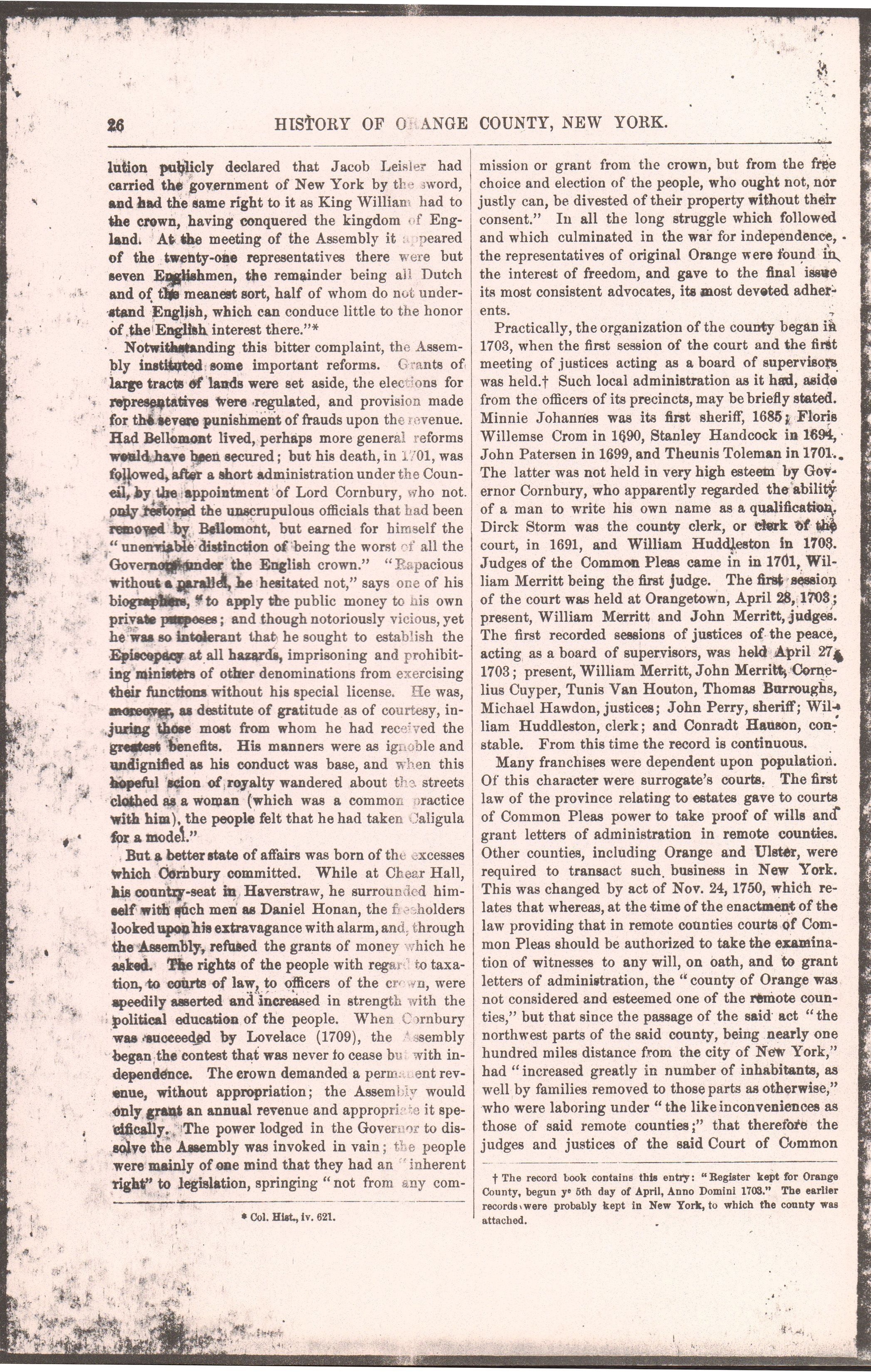
…lution publicly declared that Jacob Leisler had carried the government of New York by the sword, and had the same right to it as King William had to the crown, having conquered the kingdom of England. At the meeting of the Assembly it appeared of the twenty-one representatives there were but seven Englishmen, the remainder being all Dutch and of the meanest sort, half of whom do not understand English, which can conduce little to the honor of the English interest there.”
Notwithstanding this bitter complaint, the Assembly instituted some important reforms. Grants of large tracts of lands were set aside, the elections for representatives were regulated, and provision made for the severe punishment of frauds upon the revenue. Had Bellomont lived, perhaps more general reforms would have been secured; but his death, in 1701, was followed, after a short administration under the Council, by the appointment of Lord Cornbury, who not only honored the unscrupulous officials that had been removed by Bellomont, but earned for himself the “unenviable distinction of being the worst of all the Governors under the English crown.” “Rapacious without a parallel, he hesitated not,” says one of his biographers, “to apply the public money to his own private purposes; and though notoriously vicious, yet he was so intolerant that he sought to establish the Episcopacy at all hazards, imprisoning and prohibiting ministers of other denominations from exercising their functions without his special license. He was, moreover, as destitute of gratitude as of courtesy, injuring those most from whom he had received the greatest benefits. His manners were as ignoble and undignified as his conduct was base; and when this hopeful scion of royalty wandered about the streets clothed as a woman (which was a common practice with him), the people felt that he had taken Caligula for a model.”
But a better state of affairs was born of the excesses which Cornbury committed. While at Chear Hall, his country-seat in Haverstraw, he surrounded himself with such men as Daniel Honan, the freeholders looked upon his extravagance with alarm, and, through the Assembly, refused the grants of money which he asked. The rights of the people with regard to taxation, to courts of law, to officers of the crown, were speedily asserted and increased in strength with the political education of the people. When Cornbury was succeeded by Lovelace (1709), the Assembly began the contest that was never to cease but with independence. The crown demanded a permanent revenue, without appropriation; the Assembly would only grant an annual revenue and appropriate it specifically. The power lodged in the Governor to dissolve the Assembly was invoked in vain; the people were mainly of one mind that they had an “inherent right” to legislation, springing “not from any commission or grant from the crown, but from the free choice and election of the people, who ought not, for justly can, be divested of their property without their consent.” In all the long struggle which followed and which culminated in the war for independence, the representatives of original Orange were found in the interest of freedom, and gave to the final issue the most consistent advocates, its most devoted adherents.
Practically, the organization of the county began in 1703, when the first session of the court and the first meeting of justices acting as a board of supervisors was held.* Such local administration as it had, aside from the officers of its precincts, may be briefly stated. Minnie Johannes was its first sheriff, 1685; Floris Willemse Cron in 1690, Stanley Handcock in 1694, John Paterson in 1699, and Theunis Toleman in 1701.
The latter was not held in very high esteem by Governor Cornbury, who apparently regarded the ability of a man to write his own name as a qualification. Dirk Storm was the county clerk, or clerk of the court, in 1691, and William Huddleston in 1703. Judges of the Common Pleas came in in 1701, William Merritt being the first judge. The first session of the court was held at Orangetown, April 28, 1703; present, William Merritt and John Merritt, judges. The first recorded sessions of justices of the peace, acting as a board of supervisors, was held April 27, 1703; present, William Merritt, John Merritt, Cornelius Cuyper, Tunis Van Houton, Thomas Burroughs, Michael Hawdon, Justices; John Perry, sheriff; William Huddleston, clerk; and Conrad Hatton, constable. From this time the record is continuous.
Many franchises were dependent upon population. Of this character were surrogate’s courts. The first law of the province relating to estates gave to courts of Common Pleas power to take proof of wills and grant letters of administration in remote counties. Other counties, including Orange and Ulster, were required to transact such business in New York. This was changed by act of Nov. 24, 1750, which relates that whereas, at the time of the enactment of the law providing that in remote counties of Common Pleas should be authorized to take the examination of witnesses to any will, on oath, and to grant letters of administration, the “county of Orange was not considered and esteemed one of the remote counties,” but that since the passage of the said act “the northwest parts of the said county, being nearly one hundred miles distance from the city of New York,” had “increased greatly in number of inhabitants, as well by families removed to those parts as otherwise,” who were laboring under “the like inconveniences as those of said remote counties,” that therefore the judges and justices of the said Court of Common…
*The record book contains this entry: “Register kept for Orange County, begun the 5th day of April, Anno Domini 1750.” The earliest records were probably kept in New York, to which the county was attached.Relationships
Related Person or Organization
Person or Organization
Orange County History