Name/Title
Page 27 Courts, Public Bldgs copied from History of Orange County NYEntry/Object ID
000048Tags
Orange County HistoryScope and Content
COURTS, PUBLIC BUILDINGS, ETC.
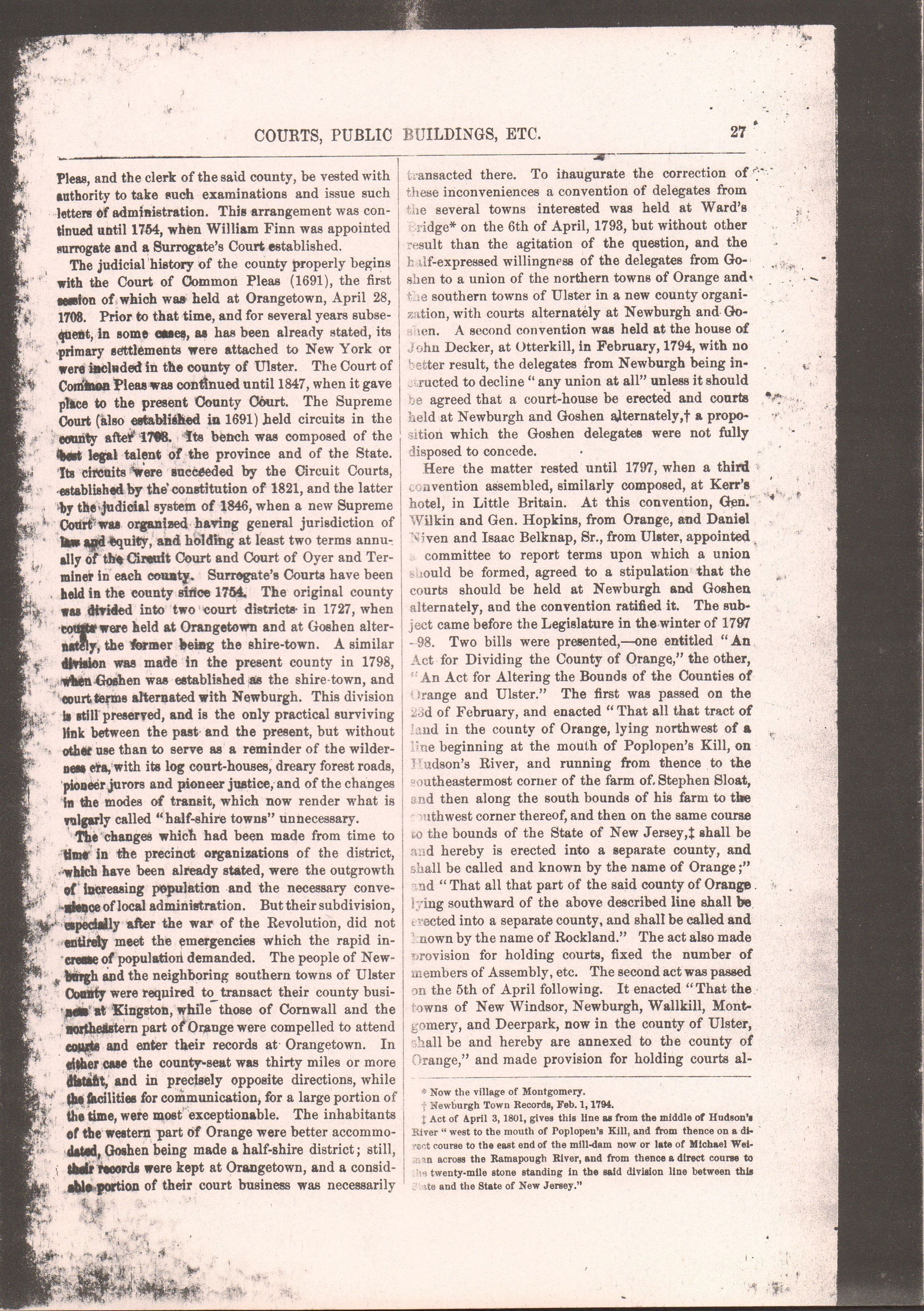
Pleas, and the clerk of the said county, be vested with authority to take such examinations and issue such letters of administration. This arrangement was continued until 1796, when William Finn was appointed surrogate and a Surrogate’s Court established.
The judicial history of the county properly begins with the Court of Common Pleas (1691), the first session of which was held at Orangetown, April 28, 1708. Prior to that time, and for several years subsequent, in some cases, as has been already stated, the primary settlements were attached to New York or were included in the county of Ulster. The Court of Common Pleas was continued until 1847, when it gave place to the present County Court. The Supreme Court (also established in 1691) held circuits in the county after 1708. Its bench was composed of the most legal talent of the province and of the State. Its circuits were succeeded by the Circuit Courts, established by the constitution of 1821, and the latter by the judicial system of 1846, when a new Supreme Court was organized having general jurisdiction in law and equity, and holding at least two terms annually of the Circuit Court and Court of Oyer and Terminer in each county. Surrogate’s Courts have been held in the county since 1796. The original county was divided into two court districts in 1727, when courts were held at Orangetown and at Goshen alternately, the former being the shire-town. A similar division was made in the present county in 1798, when Goshen was established as the shire-town, and court terms alternated with Newburgh. This division is still preserved, and is the only practical surviving link between the past and the present, probably due to the want to serve as a reminder of the wilderness, with its log court-houses, dreary forest roads, pioneer juries and pioneer justice, and of the changes in the modes of transit, which now render the regularly called “half-shire towns” unnecessary.
The changes which had been made from time to time in the precinct organizations of the district, which have been already stated, were the outgrowth of increasing population and the necessary convenience of local administration. But their subdivision, especially after the war of the Revolution, did not entirely meet the emergencies which the rapid increase of population demanded. The people of Newburgh and the neighboring southern towns of Ulster County were required to transact their county business at Kingston, while those of Cornwall and the northeastern part of Orange were compelled to attend court and enter their records at Orangetown. The distance and the county-seat was thirty miles or more distant, and in precisely opposite directions, while the facilities for communication, for a large portion of the time, were most exceptionable. The inhabitants of the western part of Orange were better accommodated, Goshen being made a half-shire district; still, their records were kept at Orangetown, and a considerable portion of their court business was necessarily transacted there. To inaugurate the correction of these inconveniences a convention of delegates from the several towns interested was held at Ward’s Bridge* on the 6th of April, 1793, but without other result than the agitation of the question, and the half-expressed willingness of the delegates from Goshen to a union of the northern towns of Orange and the southern towns of Ulster in a new county organization, with courts alternately at Newburgh and Goshen. A second convention was held at the house of John Dekker, at Otterkill, in February, 1794, with no better result, the delegates from Newburgh being instructed to decline “any union at all” unless it should be agreed that a court-house be erected and courts held at Newburgh and Goshen alternately, a proposition which the Goshen delegates were not fully disposed to concede.
Here the matter rested until 1797, when a third convention assembled, similarly composed, at Kerr’s hotel, in Little Britain. At this convention, Gen. Wilkin and Gen. Hopkins, from Orange, and Daniel Niven and Isaac Belknap, Sr., from Ulster, appointed a committee to report terms upon which a union could be formed, agreed to a stipulation that the courts should be held at Newburgh and Goshen alternately, and the convention ratified it. The subject came before the Legislature in the winter of 1797–98. Two bills were presented,—one entitled “An Act for Dividing the County of Orange,” the other, “An Act for Altering the Bounds of the Counties of Orange and Ulster.” The first was passed on the 23d of February, and enacted “That all that tract of land in the county of Orange, lying northwest of a line beginning at the mouth of Poplopen’s Kill, on Hudson’s River, and running from thence to the southeasternmost corner of the farm of Stephen Sloat, and then along the south bounds of his farm to the southwest corner thereof, and then on the same course to the bounds of the State of New Jersey, shall be and hereby is erected into a separate county, and shall be called and known by the name of Orange.”
“II That all that part of the said county of Orange lying southward of the above described line shall be erected into a separate county, and shall be called and known by the name of Rockland.” The act also made provision for holding courts, fixed the number of members of Assembly, etc. The second act was passed on the 5th of April following. It enacted “That the towns of New Windsor, Newburgh, Wallkill, Montgomery, and Deerpark, now in the county of Ulster, shall be and hereby are annexed to the county of Orange,” and made provision for holding courts al—
*Now the village of Montgomery.
†Newburgh Town, New York, Feb. 1, 1794.
‡Act of April 3, 1801, gives the line from the middle of Hudson’s River to the mouth of Poplopen’s Kill, and from thence on a direct line to the east end of the dam of the race of Michael W. Sloat, on the Ramapo River, and from thence on a direct twenty-mile station according to the said division line between this State and the State of New Jersey.Relationships
Related Person or Organization
Person or Organization
Orange County History