Name/Title
Passengers and Others is called to the Following Act of March 3, 1865Entry/Object ID
100355Scope and Content
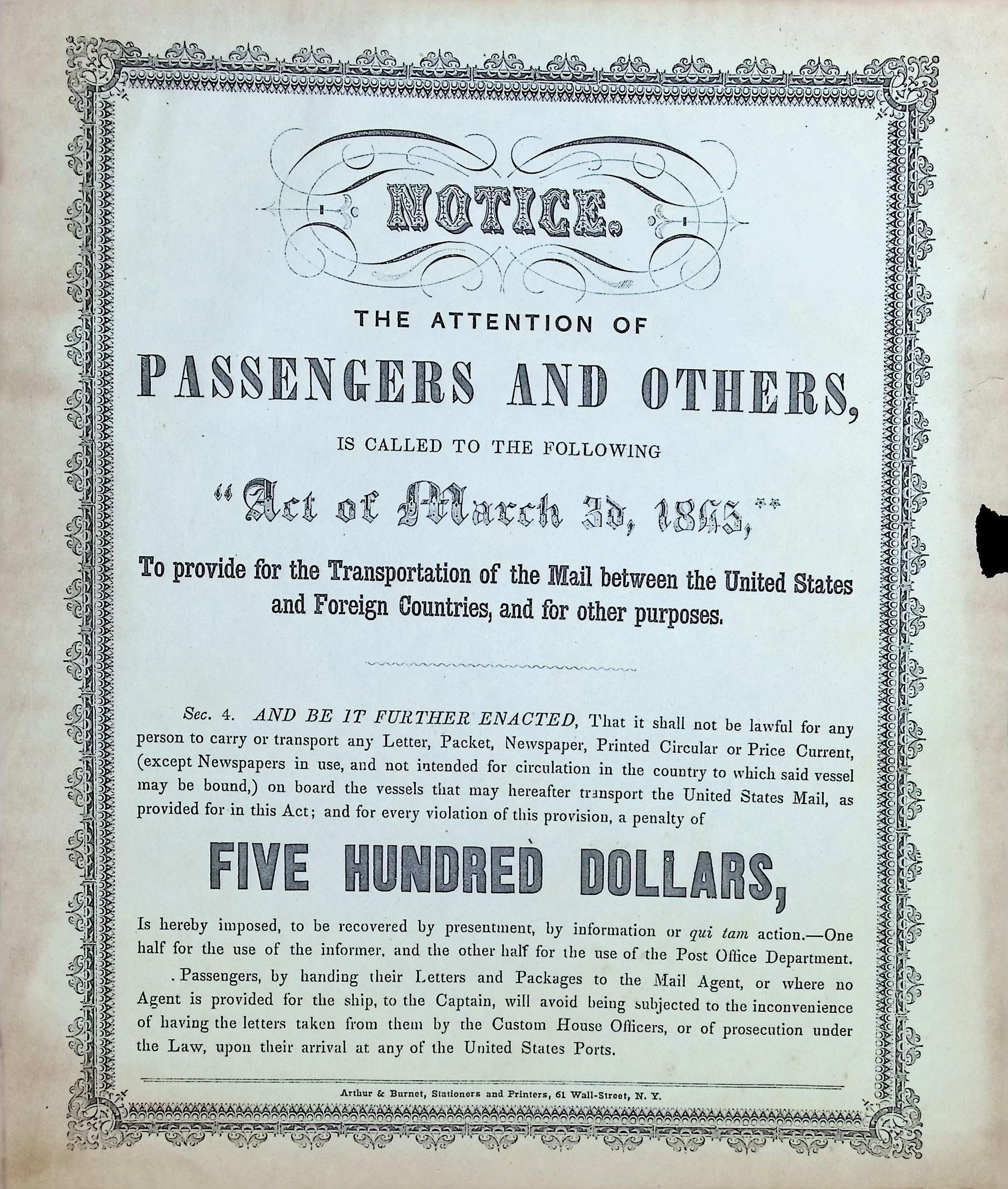
(AI) THE ATTENTION OF
PASSENGERS AND OTHERS,
IS CALLED TO THE FOLLOWING
“Act of March 3d, 1865,”
To provide for the Transportation of the Mail between the United States and Foreign Countries, and for other purposes.
Sec. 4. AND BE IT FURTHER ENACTED, That it shall not be lawful for any person to carry or transport any Letter, Packet, Newspaper, Printed Circular or Price Current, (except Newspapers in use, and not intended for circulation in the country to which said vessel may be bound,) on board the vessels that may hereafter transport the United States Mail, as provided for in this Act; and for every violation of this provision, a penalty of
FIVE HUNDRED DOLLARS,
Is hereby imposed, to be recovered by presentment, by information or qui tam action.—One half for the use of the informer, and the other half for the use of the Post Office Department.
. Passengers, by handing their Letters and Packages to the Mail Agent, or where no Agent is provided for the ship, to the Captain, will avoid being subjected to the inconvenience of having the letters taken from them by the Custom House Officers, or of prosecution under the Law, upon their arrival at any of the United States Ports.
Arthur & Burnet, Stationers and Printers, 61 Wall-Street, N. Y.
Key Summary
Rule: Passengers cannot transport unauthorized letters, packets, newspapers, or printed circulars on mail-carrying ships.
Penalty: A fine of $500 for each violation (a substantial sum in 1865).
Reward Structure: The penalty fine is split 50/50 between the informant who reported the violation and the Post Office Department.
Proper Procedure: To avoid seizure by Custom House Officers or legal prosecution, passengers must hand all mail directly over to the designated Mail Agent or the Ship Captain.