Name/Title
Pgs 506 -507 copied from History of Orange County NYEntry/Object ID
000054Tags
Orange County HistoryScope and Content
Page 506 – TOWNS OF GOSHEN
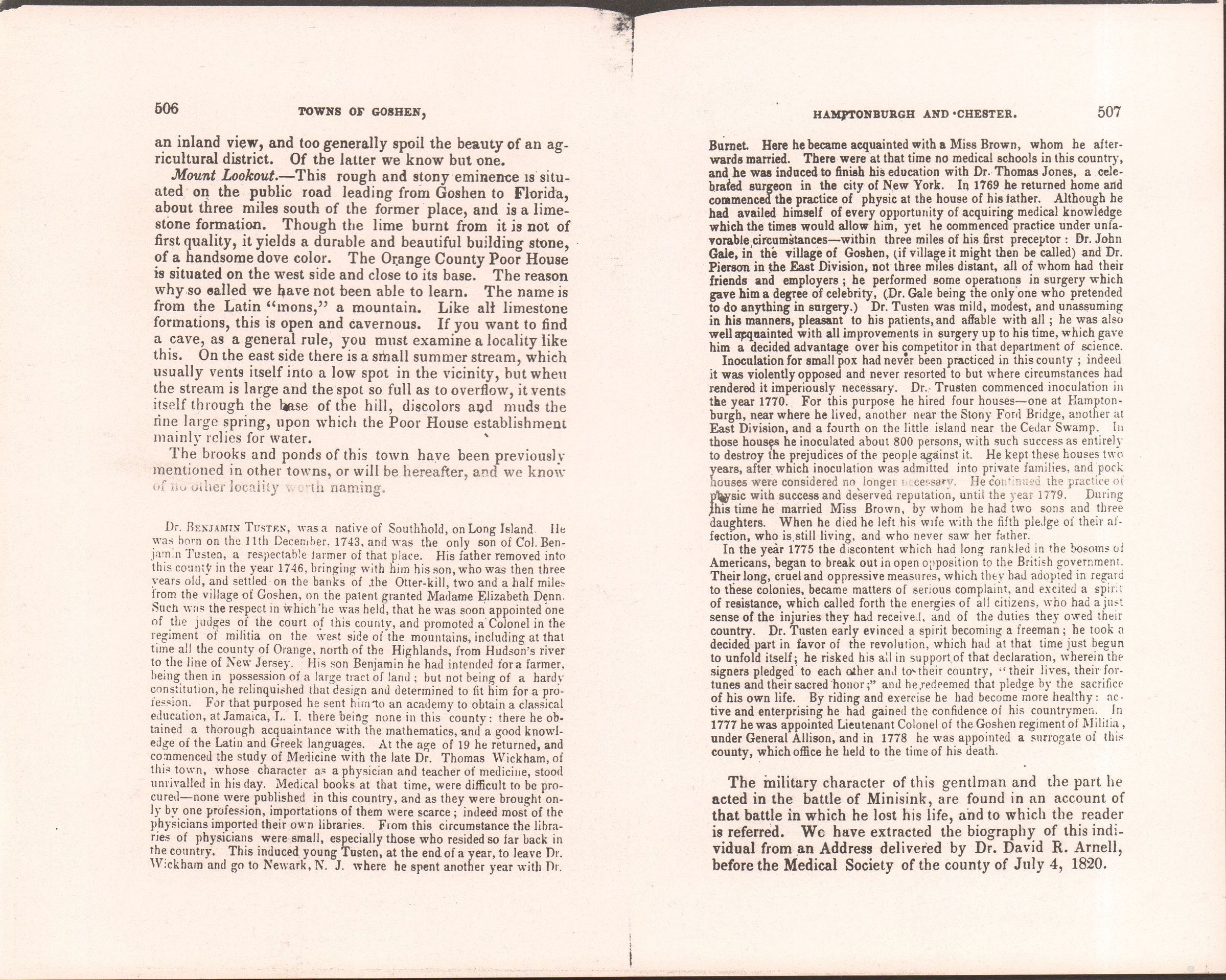
An inland view, and too generally spoil the beauty of an agricultural district. Of the latter we know but one.
Mount Lookout.—This rough and stony eminence is situated on the public road leading from Goshen to Florida, about three miles south of the former place, and is a limestone formation. Though the lime burned from it is not of first quality, it yields a durable and beautiful building stone, of a handsome dove color. The Orange County Poor House is situated on the west side and close to its base. The reason why so called we have not been able to learn. The name is from the Latin “Mons,” a mountain. Like all limestone formations, this is open and cavernous. If you want to find a cave, as a general rule, you must examine a locality like this. On the east side there is a small summer stream, which usually vents itself into a low spot in the vicinity, but when the stream is large and the spot so full as to overflow, it vents itself through the base of the hill, discolors and muds the fine large spring, upon which the Poor House establishment mainly relies for water.
The brooks and ponds of this town have been previously mentioned in other towns, or will be hereafter, and we know of no other locality worth naming.
Dr. Benjamin Tusten, was a native of Southold, on Long Island. He was born on the 11th December, 1743, and was the only son of Col. Benjamin Tusten, a respectable farmer of that place. His father removed into this county in the year 1764, bringing with him his son who was then twenty years old, and settled on the banks of the Otter-kill, two and a half miles from the village of Goshen on the road leading to Campbell Den. With the view of educating the young man, he was appointed one of the judges of the court of this county, and promoted to Colonel in the 1st regiment of the Orange, which included the counties of Orange and Sussex, and the townships of Wantage and Hardiston, in the county of New Jersey. His son Benjamin had received a good education, and possessed a good share of ambition. He was sent to Jamaica, L. I., to learn the profession of a surgeon, and after remaining there a year or two, he was sent to New York, and placed under the care of Dr. Thomas Wickham, a celebrated physician and surgeon of that city. He remained with him about two years, and then returned to Goshen, and commenced the practice of physic and surgery. He was a man of quick and active genius, and he improved and cultivated his mind with great diligence. He had a taste for the study of the natural sciences, and particularly for anatomy, in which he excelled. From the location of the county, the number of physicians were small, especially those educated for a lack in this profession. Young Tusten, after leaving Jamaica, went to Dr. Wickham and go to Newark, N. J. where he spent another year with Dr.
---
Page 507 – HAMPTONBURGH AND CHESTER
Barnet. Here he became acquainted with a Miss Brown, whom he afterwards married. There were at that time no medical schools in this country, and he was induced to finish his education with Dr. Thomas Jones, a celebrated surgeon in the city of New York. In 1769 he returned home and commenced the practice of physic at the house of his father. Although he had availed himself of every opportunity of acquiring medical knowledge which the times would allow him, yet he commenced practice under disadvantageous circumstances. The village of his residence then called the East Division, in the village of Goshen (if village it might be called,) and Dr. Friend in the East Division, not formed as an able practitioner, had been previously employed to perform the duties of the only one who pretended to give him a degree of celebrity. Dr. Gale was the only one who was supposed to do anything in surgery; Dr. Tusten, wanting credit, and having well acquainted with all improvements in surgery up to his time, which gave him a decided advantage over his competitor in that department of science.
Inoculation for small pox had never been practiced in this county; indeed it was violently opposed and never resorted to but where circumstances had rendered it imperiously necessary. Dr. Tusten however—once inoculation in the year 1770, more for the purpose he hired four houses—one situated in the barge, near where he lived, another near the Bonny Brook Bridge, another East Division, and a fourth on the little island near the Cedar Swamp. In those four, he inoculated about 800 persons with great success; entirely to destroy the prejudices of the people against it, to inspire them with confidence, after which inoculation was admitted into private families, and took its place among the common remedies of the day. He was opposed to quackery, and his humane and devoted temperament, with his faith and practice, gave him success. He married Miss Brown, by whom he had five sons and three daughters. When he died he left his wife with the fifth child, and died in the action in 1777 the division of which he was part fell before the boom of American guns, being dead from the exposure. He was one of the earliest of the region who called forth the energies of the citizens, and brought them to their resistance, which gained matters of serious consequence in the county. Dr. Tusten early received a commission, and at that time; he took a special part in the battle of Minisink, where he fell. The enemy had retreated across the Delaware, and the militia were in pursuit. The enemy took a stand at the mouth of the Lackawaxen, and the militia were defeated. In 1777 he was appointed Brigadier General of the Orange County militia. In 1779 he was elected to the land grant legislature, and in 1780 he was appointed a surgeon of the hospital. He held the rank of Brigadier General of Militia, and was a surgeon of the county. When office he held to the time of his death.
The military character of this gentleman and the part he acted in the battle of Minisink, are found in an account of that battle in which he lost his life, and to which the reader is referred. We have extracted the biography of this individual from an Address delivered by Dr. David R. Arnell, before the Medical Society of the county of July 4, 1820.Relationships
Related Person or Organization
Person or Organization
Orange County History