Name/Title
Quack Medicine Electro-Therapy MachineEntry/Object ID
100081Scope and Content
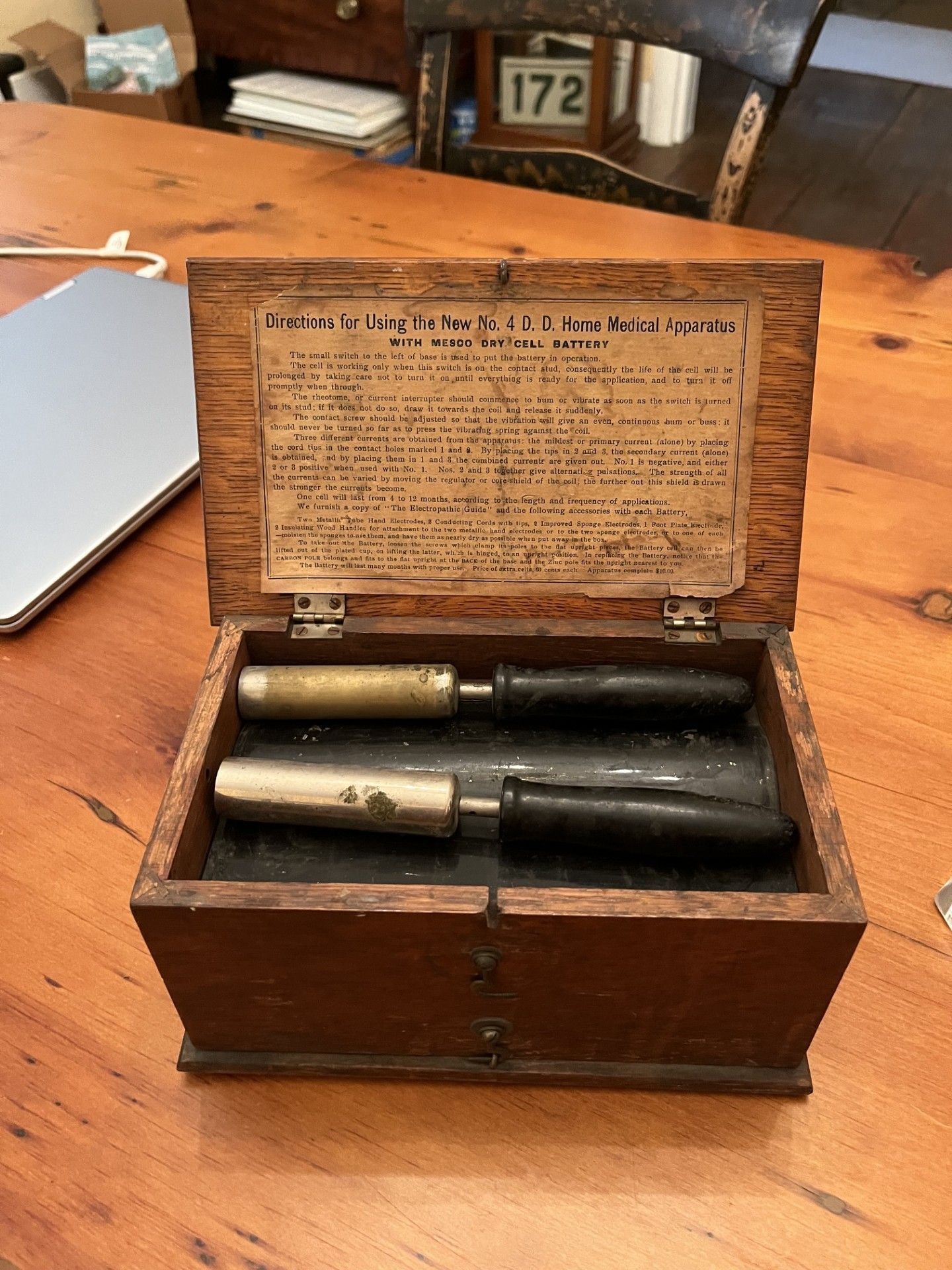
(AI) This is an absolute goldmine of turn-of-the-century medical history! You have captured an antique late 19th or early 20th-century "Quack Medicine" Electro-Therapy Machine. Specifically, according to the original label pasted inside the lid, this is the "New No. 4 D. D. Home Medical Apparatus with MESCO Dry Cell Battery."
During the late Victorian era and the early 1900s, electricity was the hot new frontier of science. Because the public didn't fully understand it, smooth-talking manufacturers convinced people that low-voltage electrical shocks could cure practically any ailment under the sun—from nervous exhaustion and headaches to arthritis and paralysis.
Here is how this incredible device actually functioned:
How It Worked
The entire kit is self-contained within a handsome wooden box, featuring two distinct sections:
The Power Source (The Base): Hidden underneath the metal cylinders is a MESCO Dry Cell Battery linked to an induction coil. When switched on, the coil would rapidly interrupt the electrical current, causing a distinct buzzing sound (referred to on the label as a "hum or vibrate").
The Electrodes (The Handles): The two metal cylinders with black wooden handles are the electrodes. The patient would hold one handle in each hand, completing the electrical circuit.
The Experience: Once the circuit was live, a mild, tingling electric shock would pulse directly through the patient's hands and arms. The strength of the current could be adjusted by sliding a metal shield over the induction coil—the further out the shield was drawn, the stronger the shock!
The Fine Print: Historical Clues
The paper instruction label glued to the inside lid is incredibly well-preserved and offers fantastic historical context:
The Manufacturer: "MESCO" stands for the Manhattan Electrical Supply Company, a major manufacturer founded in 1881 that produced telegraph equipment, batteries, and popular electrical novelties.
The Price Tag: Look at the very bottom right corner of the label. It notes: "Price of extra cells, 40 cents each - Apparatus complete $10.00." Ten dollars was a significant investment for a household in the 1890s/1900s—the equivalent of several hundred dollars today! value ?