Name/Title
Math equationsEntry/Object ID
002855Scope and Content
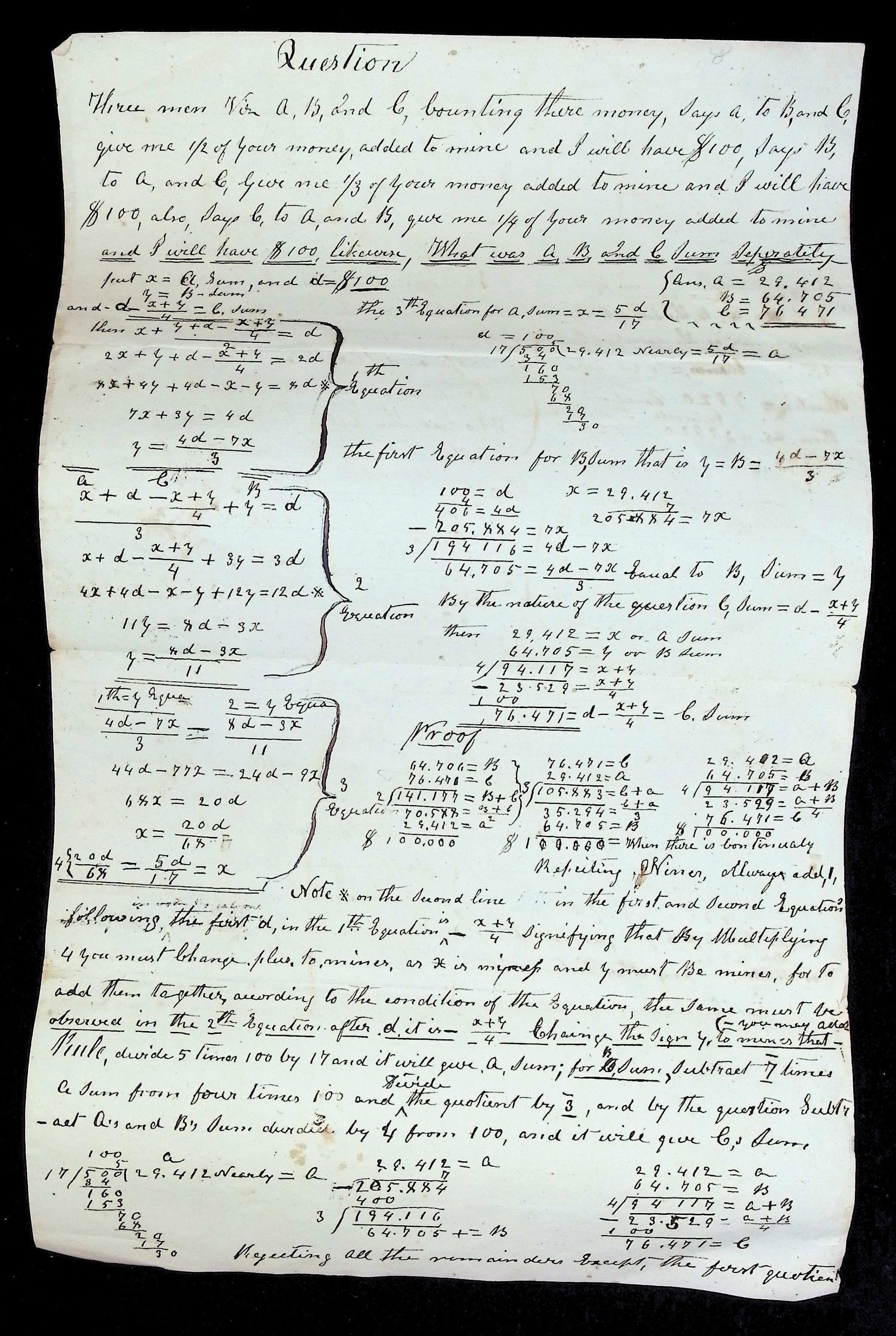
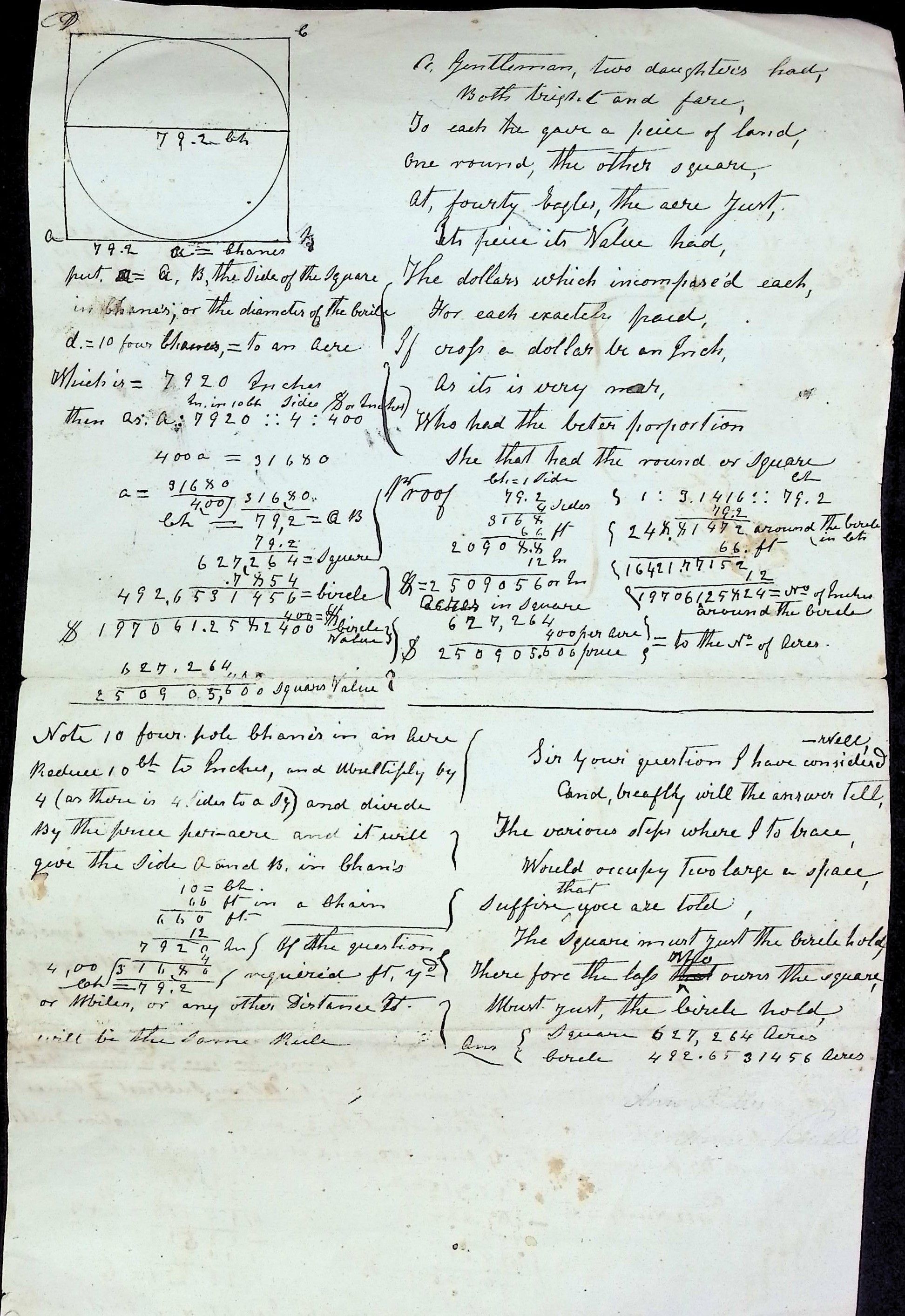
These documents consist of two separate complex mathematical problems dating to the early-to-mid 19th century, rendered in handwritten prose, algebraic script, and poetry.
Pg 1 ("Three Men Word Problem"): This page is an extensive algebraic breakdown of a classic riddle featuring three individuals ($A$, $B$, and $C$) discussing their shared wealth. Each person states that if they receive a fraction of the other two men's money ($\frac{1}{2}$, $\frac{1}{3}$, and $\frac{1}{4}$ respectively) added to their own, they will have exactly $100. The manuscript systematically derives three separate linear equations to find the distinct holdings of each man, arriving at the non-integer solutions: $A \approx \$29.412$, $B \approx \$64.705$, and $C \approx \$76.471$. Long division steps and a verification proof are detailed at the bottom.
Pg 2 ("The Gentleman's Two Daughters"): This page presents a mathematical puzzle written partly in rhyming verse about a father giving one daughter a circular plot of land and the other a square plot. The value/price of each plot is defined by laying silver dollars end-to-end around its perimeter (where 1 dollar equals roughly 1 inch in width, and land is valued at "fourty Eagles" or $400 per acre). The document includes a geometric diagram showing a circle perfectly inscribed within a square with a diameter/side length of 79.2 chains. Through chain-to-inch conversions and geometric calculations using $\pi \approx 3.1416$, the text computes the acreage and values, concluding in verse that the square plot inherently encompasses the circle.