Name/Title
Story of Sarah WellsEntry/Object ID
001962Tags
Sarah Wells, William BullSubject
Missing pg 1 (unknown author or date)
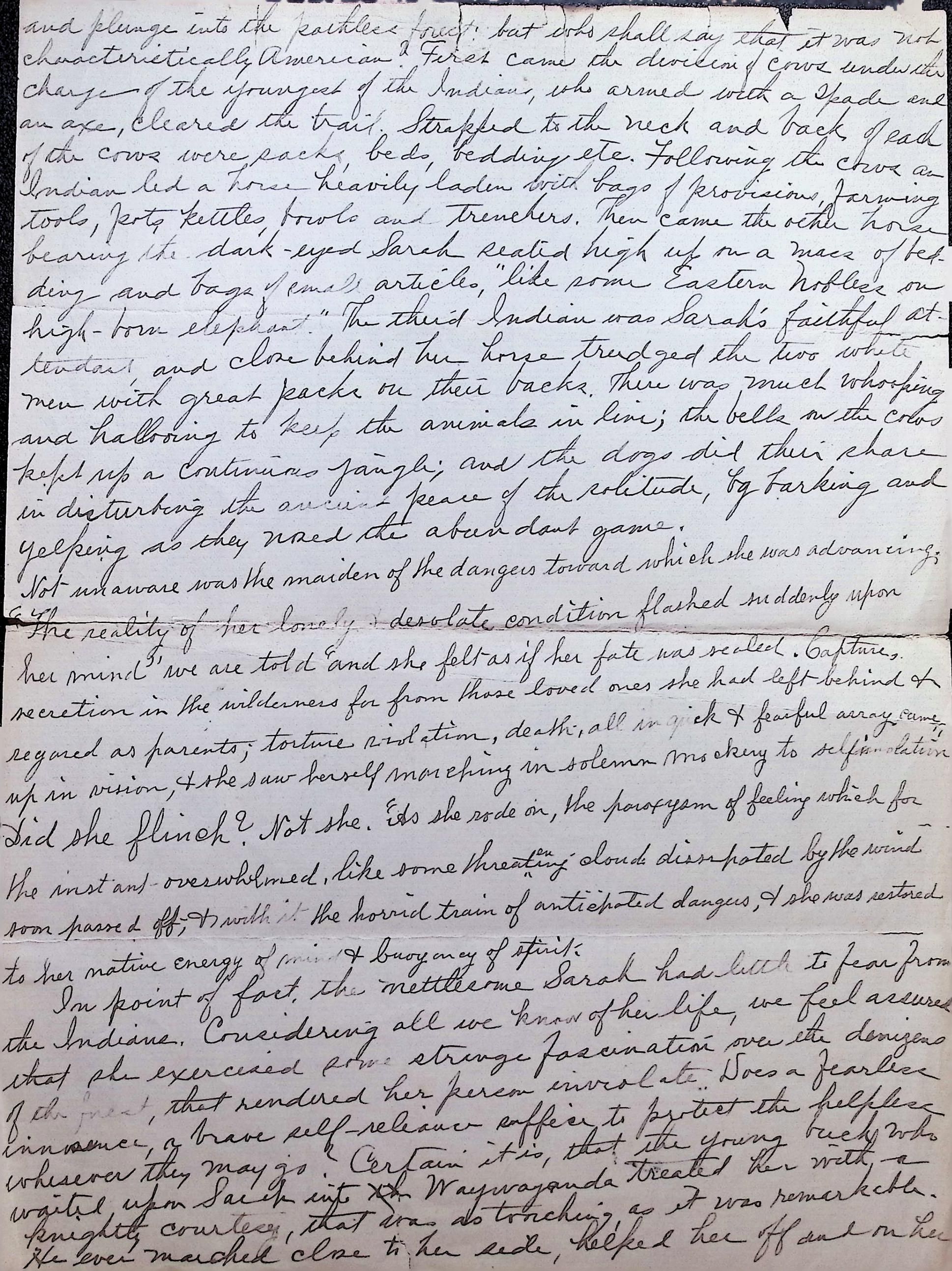
and plunge into the pathless forest: but who shall say that it was not characteristically American? First came the division of cows under the charge of the youngest of the Indians, who armed with a spade and an axe, cleared the trail. Strapped to the neck and back of each of the cows were packs, beds, bedding etc. Following the cows an Indian led a horse heavily laden with bags of provisions, farming tools, pots kettles bowls and trenchers. Then came the other horse bearing the dark-eyed Sarah seated high up on a mass of bedding and bags of small articles, "like some Eastern noble on high-born elephant." The third Indian was Sarah's faithful attendant and close behind her horse trudged the two white men with great packs on their backs. There was much whooping and hallooing to keep the animals in line; the bells on the cows kept up a continuous jangle; and the dogs did their share in disturbing the ancient peace of the solitude, by barking and yelping as they used the abundant game. Not unaware was the maiden of the dangers toward which she was advancing; the reality of her lonely & desolate condition flashed suddenly upon her mind, we are told & she felt as if her fate was sealed. Capture, secretion in the wilderness far from those loved ones she had left behind & regard as parents; torture violation, death, all in quick & fearful array came up in vision, & she saw herself marching in solemn mockery to self-immolation Did she flinch? Not she. As she rode on, the paroxysm of feeling which for the instant overwhelmed, like some threatening cloud dissipated by the wind soon passed off, & with it the horrid train of anticipated dangers, & she was restored to her native energy of mind & buoyancy of spirit. In point of fact, the mettlesome Sarah had little to fear from the Indians. Considering all we know of her life, we feel assured that she exercised some strange fascination over the denizens of the forest, that rendered her person inviolate. Does a fearless innocence, or brave self-reliance suffice to protect the helpless wherever they may go? Certain it is, that the young bucks who waited upon Sarah into the Waywayanda treated her with a knightly courtesy, that was as touching as it was remarkable. He ever marched close to her side, helped her off and on her
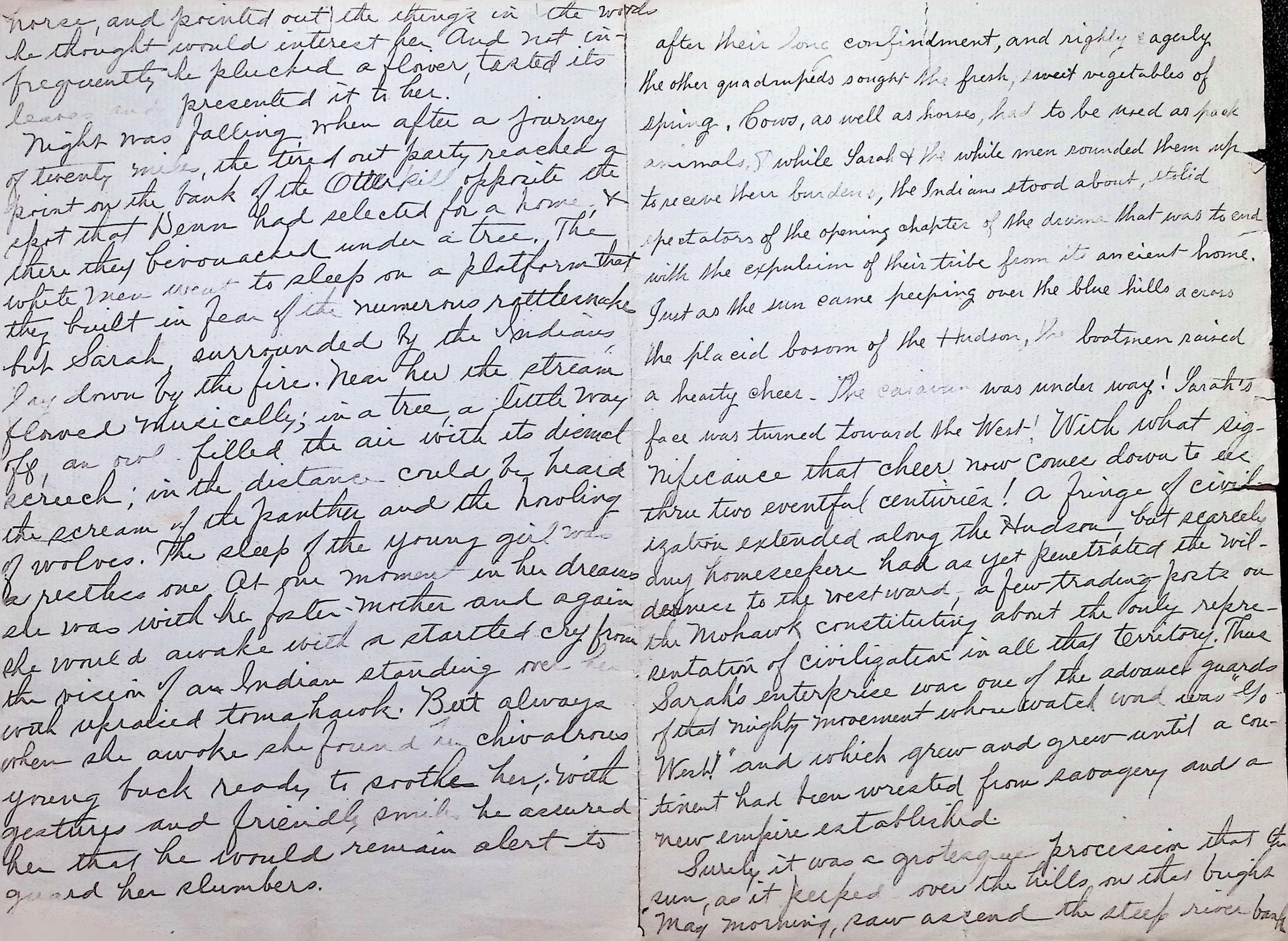
horse, and pointed out the things in the wood he thought would interest her. And not in- frequently he plucked a flower, tasted its leaves and presented it to her. Night was falling when after a journey of twenty miles, the tired out party reached a point on the bank of the Otterkill opposite the spot that Denn had selected for a home. there they bivouacked under a tree. The white men went to sleep on a platform that they built in fear of the numerous rattlesnakes but Sarah, surrounded by the Indians lay down by the fire. Near her the stream flowed musically; in a tree a little way off, an owl filled the air with its dismal screech; in the distance could be heard the scream of the panther and the howling of wolves. The sleep of the young girl was a restless one. At one moment in her dreams she was with her foster-mother and again she would awake with a startled cry from the vision of an Indian standing over her with uplifted tomahawk. But always when she awoke she found a chivalrous young buck ready to soothe her, with gestures and friendly smile he assured her that he could remain alert to guard her slumbers.
after their lone confinement, and rightly, eagerly the other quadrupeds sought the fresh, sweet vegetables of spring, cows, as well as horses, had to be used as pack animals, & while Sarah & the white men rounded them up to receive their burdens, the Indians stood about, stolid spectators of the opening chapter of the drama that was to end with the expulsion of their tribe from its ancient home. Just as the sun came peeping over the blue hills across the placid bosom of the Hudson, the boatmen raised a hearty cheer. The caravan was under way! Sarah’s face was turned toward the West! With what significance that cheer now comes down to us thru two eventful centuries! A fringe of civilization extended along the Hudson - but scarcely any home seekers had as yet penetrated the wilderness to the westward, a few trading-posts on the Mohawk constituting about the only representation of civilization in all that territory. Thus Sarah’s enterprise was one of the advance guards of that mighty movement whose watch word was "Go West!" and which grew and grew until a continent had been wrested from savagery and a new empire established. Surely it was a grotesque procession that the sun, as it peeped over the hills on that bright May morning, saw ascend the steep river bank.
________________________________________
On the following day the Otterkill was crossed & a log cabin built. Sarah prepared the meals for the workmen & the Indians. In the evening she was treated to a surprise that overwhelmed her with joy. Horses were heard approaching, & the Indians hastening off to investigate returned with - Christopher & Madam Denn. Their first words Where is Sarah, & is she well? It appears that when they returned to their home after Sarah's departure, they were impressed by its loneliness, now that "the only cricket that played upon the hearth-stone was gone" &, from thinking of the dangers to which they had exposed her, the conscience-stricken couple must needs make arrangements for their immediate departure to join her. In truth, they were off at daybreak the very next morning pushing their way up through the settlements on the west bank of the Hudson. And Sarah, beholding her foster-mother fell upon her neck and wept - Denn felled the trees & let in the light of the sun upon the virgin soil. He plowed, planted & reaped, Sarah toiled in house & field, & the wilderness for her came to have no terrors. With a faithful dog she would often wander ~~for for hours~~, a light-footed child of the forest whom the redmen knew & respected as a familiar friend. At regular intervals she would arise at midnight, when the wildcat & wolf were still abroad &, attended only by her dog take 2 horses loaded with grain over the footpath leading the 20 miles through the woods to the riverside at New Windsor, there to load the grain in a boat- & row it over to the mill at the mouth of the Fishkill in ~~the~~ Dutchess County. While returning from one of these trips, she was once chased all night by wolves - Her fame as the Maid of Wawayanda spread to the community of Manhattan. To a large extent attracted by it, others came to settle on the patent. Then did the woods ring & crash with the sturdy stroke of the axe. Civilization took a firm foothold, & the Indians fell back. 4 years after Sarah led her caravan into the wilderness, there appeared in Wawayanda a young Englishman named William Bull, who after a disastrous attempt to follow
his trade of mason & stone cutter in Dublin, had been employed, upon his arrival in New York, by Daniel Cromline a purchaser of an interest - in the patent. The stone house that Bull helped to build for Cromline
• it long afterwards became famous as the Greycourt Inn - was within - 5 miles of the Denns' log cabin. Bull continued to live with Cromline after the erection of the house, & of course met the fair Maid of Wawayanda. 2 years after he came to the conclusion, that she would make a good wife. Sarah was willing & affected no coyness. Those were serious days. There was too much work to do, to permit of a prolonged love-making: the young couple could not even wait for the banns to be proclaimed in 3 successive weeks in accordance with the canons of the Church of England - So they went to the local magistrate - there was no minister available - & asked him if it would not do just as well to proclaim ~~the banns 3 times on the same day~~ - The magistrate was equal to the occasion. We are told, that contracting parties & the witnesses being duly assembled in Denn new log cabin, he, with a solemnity demanded by the occasion, took up the Book of Common Prayer, proceeded to the front door of the house & there proclaimed the banns to the trees of the forest; that he then strode through the halls to the back door & made a second proclamation to the cattle & outbuildings & that, again at the front door, he made a third proclamation to the wilderness at large - It is with pleasure that we record that the trees of the forest made no objection, that the cattle didn't forbid the banns, that the wilderness seemed to echo back its approbation, and that there -
• upon the marriage ceremony was immediately performed -
And it is with still more pleasure that we cite our historian as authority for the statement that, "though this was a new & hazardous experiment on a delicate subject," its legality was never questioned, "not even" says that naive gentleman, by those who were most personally interested in the matter. Sarah was 24 years old and her husband 29 when they were married. At that period "race suicide" had not yet been invented. Sarah in truth, was a lady after Mr. Roosevelt's own heart. The wild, free life she had lived in the open enabled her to give birth to children with the frequency & facility of her savage red sisters. In the first 25 years or so of her married life a child was forthcoming at least every 2 years. She was a Spartan as well as a prolific mother. If a baby had to be kept out of mischief while she did her work, she tied him to a bedpost. This she did once for several hours while she went out to search for & bring in her husband who had been delayed in returning from the mill across the Hudson. 4 years after his marriage, Bull built for his rapidly growing family a stone house of 2 stories. It was situated a little way from Denn's log cabin & he called the place Hamptonburgh, after Wolverhampton his native town in England. It is a remarkable fact that the Hamptonburgh house was never molested by the Indians, even when their aggressions on the other white settlers were the most frequent. Sarah lived there, and she & hers were sacred in the eyes of the children of the wildwood. During the French & Indian wars which lasted from 1756 to 1763, the Bull house was a place of refuge at night- for the inhabitants of the neighborhood from miles around. Time passed, & along the streams of Wawayanda the campfires of the red men were extinguished forever. Back into the mountain fastnesses of Sullivan County the Indians retreated before an incursion of the toughest & most vigorous stocks
that the world has ever known- came the liberty-loving English, the hardy, & stubborn- Scotch-Irish, the freeborn Scots of the Highlands, grave Dutchmen, serious-minded German Protestants & Huguenots of French extraction. They formed a like-minded, did these various races, a people who toiled terribly in the fear of God, & the fires of hell. All lived lives of rude, strenuous muscular effort, for the most part in the open air, & even their pleasures savoured of work- It was with these people that the children of William Bull & Sarah Wells intermarried; & their children's children, growing up, knew only one ambition, namely; to have better farms & raise more crops than parents or neighbors, & they waxed exceedingly prosperous, and multiplied, as the sands of the sea. William Bull died in 1755 at the age of 66. His widow buried him in the family graveyard at Hamptonburgh & went on living. Childbirth pains, the cares of a numerous family; hard, incessant toil in house & field- these could age her not; she lived to see the country aflame with revolution, to be present at the birth of the new nation & witness it well started on the road to its present greatness. She lived long beyond the allotted time of man- lived to see 12 of her children grow up & marry & lived to have surrounding her at her death 98 grandchildren 212 great-grand children & 13 great-great-grand children or the grand total of 335 descendants. She, Sarah Wells the pioneer maid of Wawayanda, died on April 21, 1796 aged 102 years and 15 days- They buried her beside her husband near the stone house that was her home for 74 years. Times have changed & are changing, but her memory is still kept green Once a year her descendants picnic near the old home which after the lapse of 185 years at this writing, still is standing in excellent condition, being the residence of a Bull of the fifth generation. Thus the old traditions are kept living, the old ideals preserved. Eventually they put up a monument to Sarah Wells, their ever-beloved Mother. [illegible stamp/writing] Ann Oliver, Elizabeth Watkins Miller Forbes. Wells, Bull, Eager, Watkins. 325 Cherry St Elizabeth N. J. Ann Elizabeth Miller Forbes 1927 Thanksgiving 1909 [caret] 1904