Name/Title
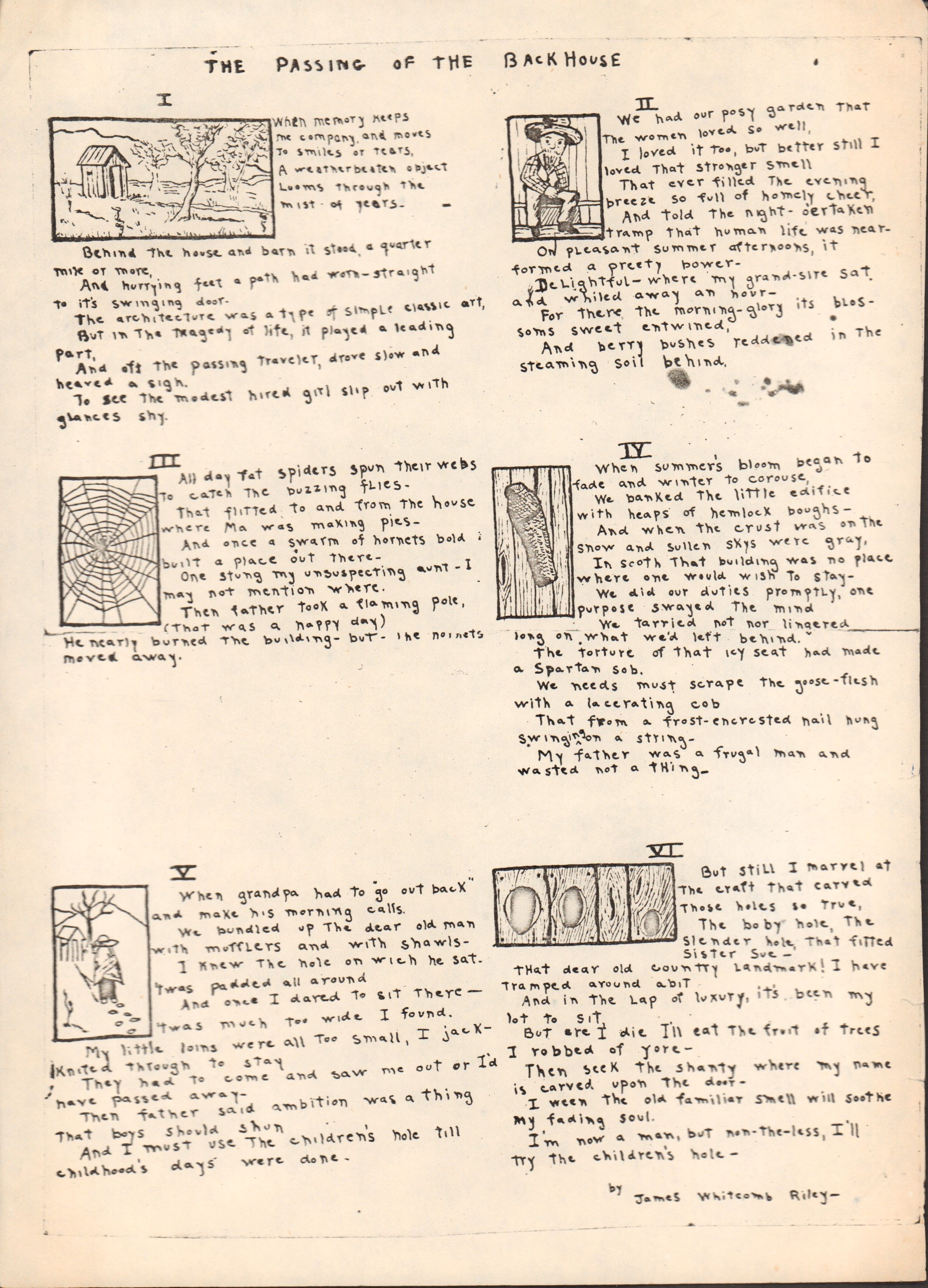
The passing of the Backhouse (outhouse) Poem by James Whitcomb RileyEntry/Object ID
000025Tags
James Whitcomb RileyScope and Content
THE PASSING OF THE BACK HOUSE
I
[Illustration: A small wooden outhouse in a field near a tree.]
When memory keeps me company, and moves to smiles or tears, A weatherbeaten object looms through the mist of years.
Behind the house and barn it stood, a quarter mile or more, And hurrying feet a path had worn—straight to its swinging door.
The architecture was a type of simple classic art, But in the tragedy of life, it played a leading part,
And oft the passing traveler, drove slow and heaved a sigh, To see the modest hired girl slip out with glances shy.
II
[Illustration: A man sitting on a porch or bench.]
We had our posy garden that the women loved so well, I loved it too, but better still I loved that stronger smell
That ever filled the evening breeze so full of homely cheer, And told the night-oertaken tramp that human life was near.
On pleasant summer afternoons, it formed a pretty bower— Delightful—where my grand-sire sat and whiled away an hour—
For there the morning-glory its blossoms sweet entwined, And berry bushes reddened in the steaming soil behind.
III
[Illustration: A large, detailed spider web.]
All day fat spiders spun their webs to catch the buzzing flies, That flitted to and from the house where Ma was making pies—
And once a swarm of hornets bold built a place out there— One stung my unsuspecting aunt—I may not mention where.
Then father took a flaming pole, (that was a happy day) He nearly burned the building—but the hornets moved away.
IV
[Illustration: A dried corn cob.]
When summer’s bloom began to fade and winter to carouse, We banked the little edifice with heaps of hemlock boughs—
And when the crust was on the snow and sullen skys were gray, In sooth that building was no place where one would wish to stay—
We did our duties promptly, one purpose swayed the mind We tarried not nor lingered long on what we’d left behind.
The torture of that icy seat had made a Spartan sob, We needs must scrape the goose-flesh with a lacerating cob
That from a frost-encrested nail hung swinging on a string— My father was a frugal man and wasted not a thing—
V
[Illustration: A person bundled in a coat walking through snow toward the outhouse.]
When grandpa had to “go out back” and make his morning calls, We bundled up the dear old man with mufflers and with shawls—
I knew the hole on which he sat, ‘twas padded all around And once I dared to sit there—‘twas much too wide I found.
My little loins were all too small, I jack-knifed through to stay They had to come and saw me out or I’d have passed away—
Then father said ambition was a thing that boys should shun And I must use the children’s hole till childhood’s days were done.
VI
[Illustration: A wooden seat with three different sized holes.]
But still I marvel at the craft that carved those holes so true, The baby hole, the slender hole, that fitted sister Sue—
That dear old country landmark! I have tramped around a bit And in the lap of luxury, it’s been my lot to sit,
But ere I die I’ll eat the fruit of trees I robbed of yore— Then seek the shanty where my name is carved upon the door—
I ween the old familiar smell will soothe my fading soul, I’m now a man, but non-the-less, I’ll try the children’s hole—
by James Whitcomb RileyRelationships
Related Person or Organization
Person or Organization
James Whitcomb Riley