Name/Title
The Wedding DressEntry/Object ID
10287Tags
Sarah Wells, William Bull and Sarah Wells Stone House Association, Wedding dressScope and Content
Overview of the Legacies
The document highlights the extreme dedication, hard work, and skill required of pioneers in colonial America. Two major surviving artifacts created by William Bull and Sarah Wells demonstrate their immense craftsmanship:
The Stone House: The ancestral homestead at Hamptonburgh, built by William Bull. It took him seventeen years of part-time work—while also running his farm and working paying jobs—to carefully fit and mortar each stone. Today, it serves as a historic symbol of family solidarity.
The Wedding Dress: A historic, heavily embroidered homespun linen wedding dress made by Sarah Wells, which has been preserved for over two centuries.
The Journey of the Wedding Dress
The linen wedding dress has a rich, complex history of ownership, separation, and eventual reunion:
1. Creation and Embroidery
Production: Sarah Wells spun the flax into thread, wove the linen cloth, and cut and sewed the dress himself.
Details: It is made of coarse homespun linen and richly embroidered with red, yellow, green, and blue crewel work featuring thistles, roses, and lilies.
Debate over Origin: While family tradition first recorded at the 1869 Bull Picnic claims Sarah made and wore the dress for her own 1718 wedding, historians believe she likely lacked the time and resources for such luxury during her early log cabin years. Instead, it is highly probable she made it for her daughter Margaret's wedding in 1756, when the family had achieved more affluence.
2. The Theft of the Sleeves
Margaret passed the dress to her daughter Sarah Hawkins, who then passed it to Margaret Rumsey.
While at Mrs. Rumsey's house, a visiting dressmaker secretly cut out one of the sleeves. The stolen sleeve was later seen framed and hanging on the wall of the dressmaker’s home in Middletown.
At some point, the second sleeve was also snipped out, but its whereabouts remain unknown.
3. Separation and Reunion of the Dress
Later, the dress was split in two: the skirt went to Julia Rumsey Newman, while the waist became lost.
Aunt Julia Newman eventually heard of an old lady in Middletown who had the waist, cared nothing for it, and sold it back to her for two or three dollars, reuniting the top and bottom of the dress.
4. Preservation and Display
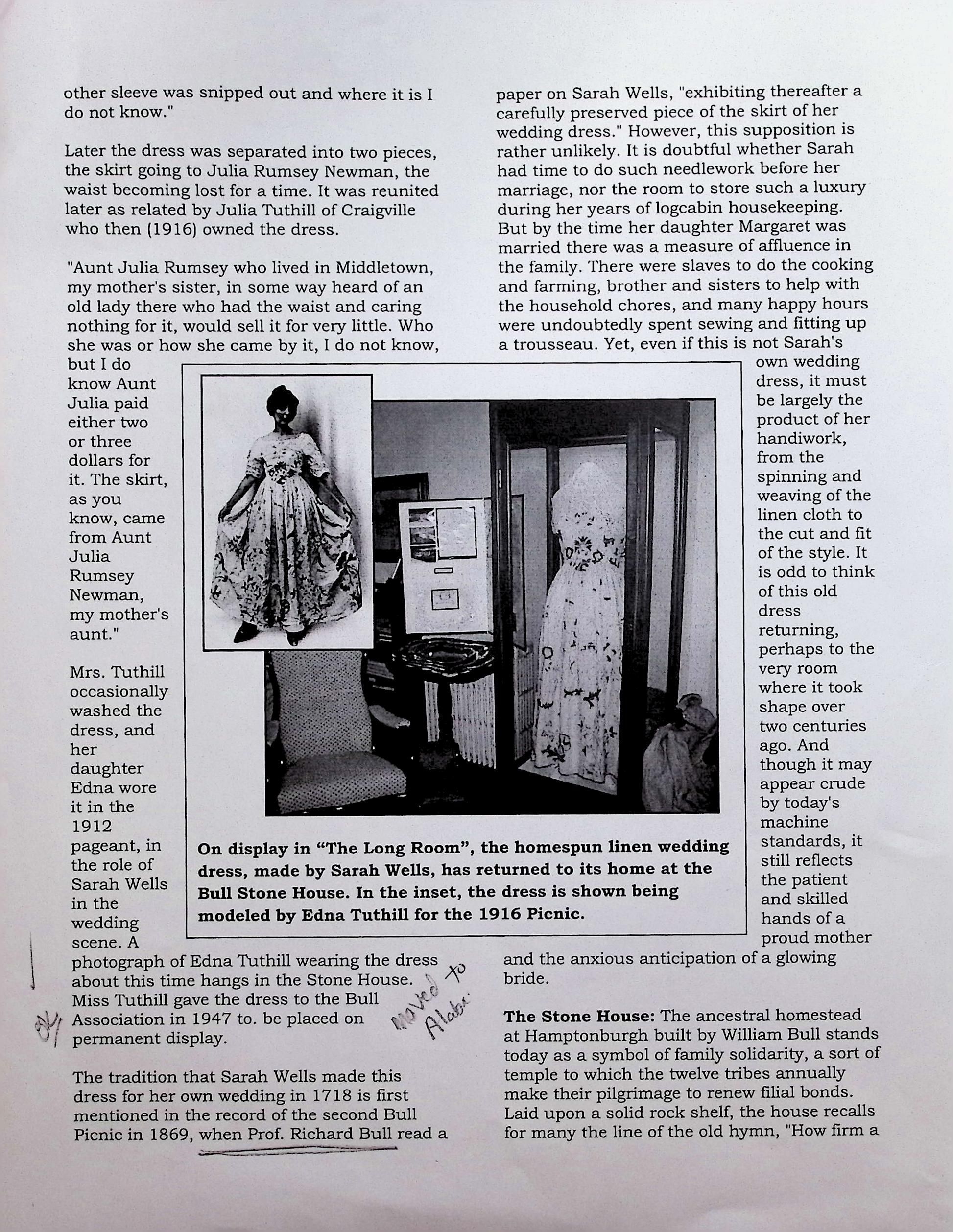
By 1916, Julia Tuthill owned the dress. Her daughter, Edna Tuthill, wore and modeled the dress during a 1912 historical pageant and again for the 1916 Bull Family Picnic.
In 1947, Miss Tuthill gifted the historic dress to the Bull Association for permanent display.
Today, the dress resides in a glass display case in "The Long Room" at the historic Bull Stone House.