Name/Title
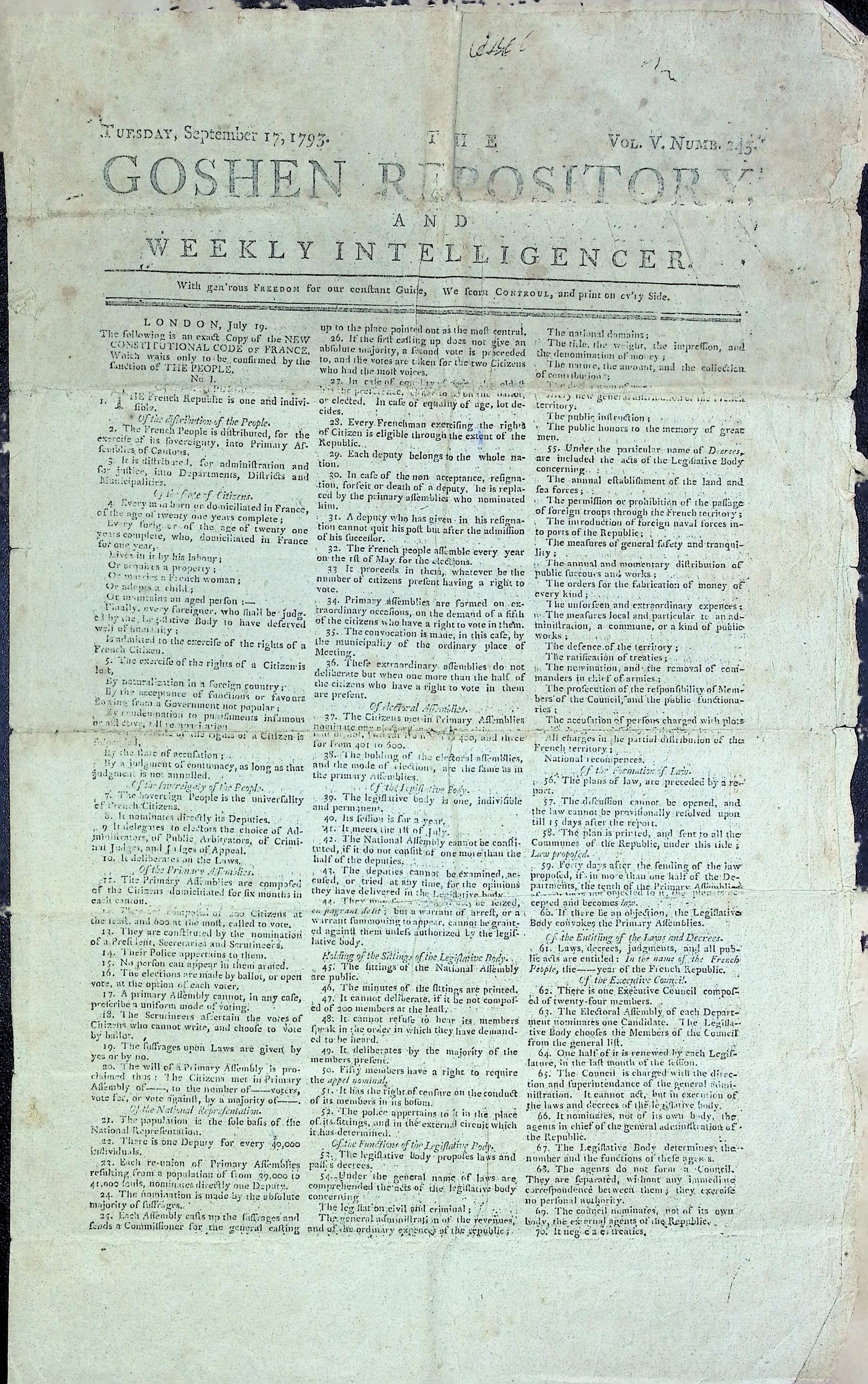
Tuesday Sept. 17, 1793 Goshen Repository (Newspaper)Entry/Object ID
002265Tags
GoshenScope and Content
This is a transcription of the Goshen Repository and Weekly Intelligencer, Volume V, Number 243, published on Tuesday, September 17, 1793. This historical newspaper was printed in Goshen, New York (Orange County) and provides a window into the local, national, and international concerns of the post-Revolutionary era.
TUESDAY, September 17, 1793. [ VOL. V. NUMB. 243. ]
GOSHEN REPOSITORY
A N D
WEEKLY INTELLIGENCER.
With gen'rous FREEDOM for our constant Guide, We scorn CONTROUL, and print on ev'ry Side.
L O N D O N, July 19.
The following is an exact COPY of the NEW
CONSTITUTIONAL CODE of FRANCE,
Which waits only to be confirmed by the
sanction of THE PEOPLE.
No. I.
THE French Republic is one and indivisible.
Of the distribution of the People.
The French People is distributed, for the
exercise of its sovereignty, into Primary Assemblies of Cantons.
It is distributed, for administration and
for justice, into Departments, Districts and
Municipalities.
Of the state of Citizens.
Every man born or domiciliated in France,
of the age of twenty one years complete;
Every foreigner of the age of twenty one
years complete, who, domiciliated in France
for one year,
Lives in it by his labour;
Or acquires a property;
Or marries a French woman;
Or adopts a child;
Or maintains an aged person;—
Finally, every foreigner, who shall be judged by the Legislative body to have deserved
well of humanity;
Is admitted to the exercise of the rights of a
French Citizen.
The exercise of the rights of a Citizen is
lost,
By naturalization in a foreign country;
By the acceptance of functions or favours
flowing from a Government not popular;
By condemnation to punishments infamous
or afflictive, till rehabilitation.
[The transcription continues down the columns following the numbering of the French Constitution clauses 7 through 70.]
...
up to the place pointed out as the most central.
If the first casting up does not give an
absolute majority, a second vote is proceeded
to, and the votes are taken for the two Citizens
who had the most voices.
In case of equality of [cut off]
...
The national domains;
The title, the weight, the impression, and
the denomination of money;
The nature, the amount, and the collection
of contributions;
...
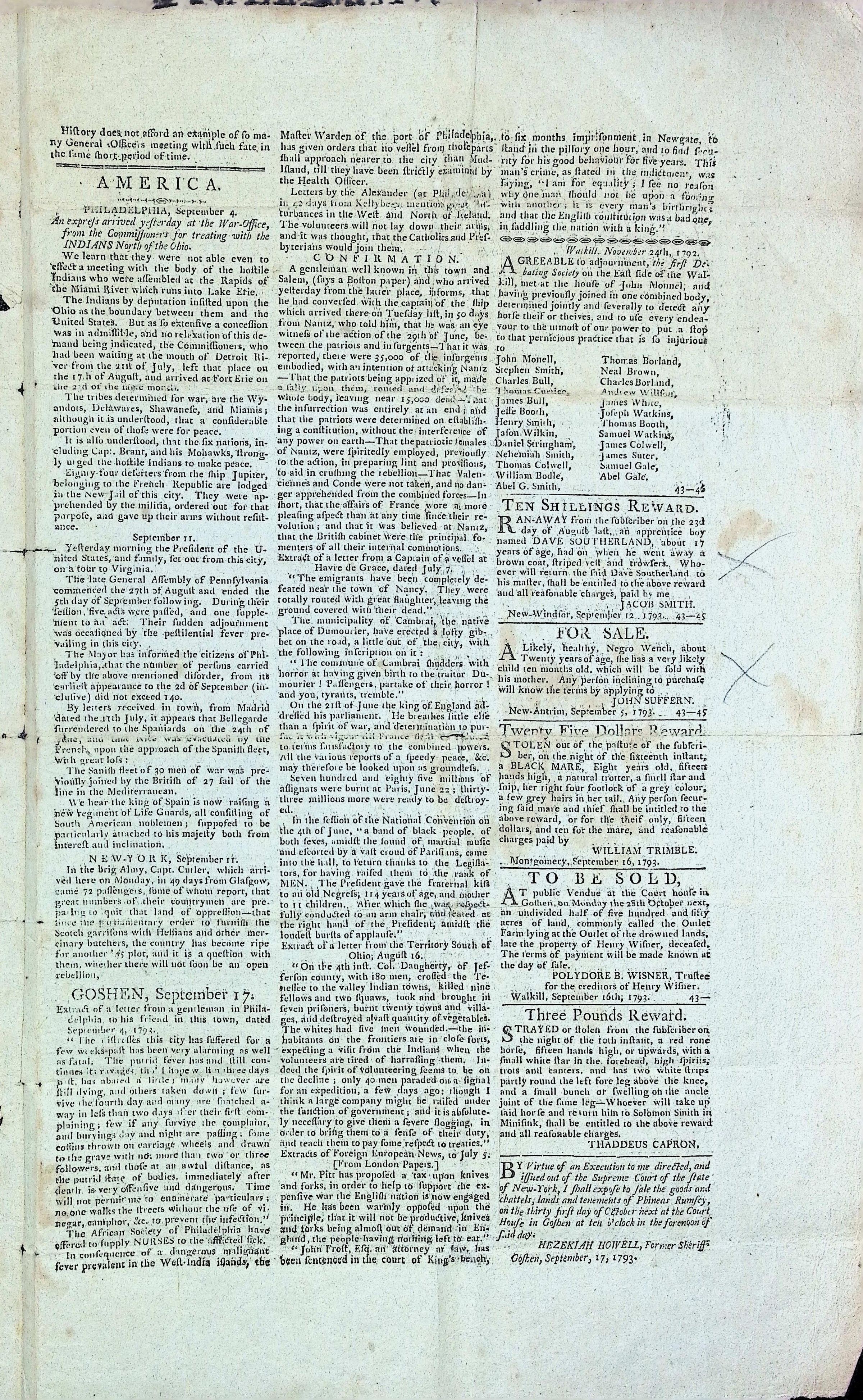
A M E R I C A PHILADELPHIA, September 4.
An express arrived yesterday at the War-Office,
from the Commissioners for treating with the
INDIANS North of the Ohio.
We learn that they were not able even to
effect a meeting with the body of the hostile
Indians who were assembled at the Rapids of
the Miami River which runs into Lake Erie.
...
September 11.
Yesterday morning the President of the United States, and family, set out from this city,
on a tour to Virginia.
The late General Assembly of Pennsylvania
commenced the 27th of August and ended the
5th day of September following. During their
session, five acts were passed, and one supplement to an act. Their sudden adjournment
was occasioned by the pestilential fever prevailing in this city.
...
GOSHEN, September 17.
Extract of a letter from a gentleman in Philadelphia to his friend in this town, dated
September 4, 1793.
"The distresses this city has suffered for a
few weeks past has been very alarming as well
as fatal. The putrid fever has and still continues its ravages..."
...
TEN SHILLINGS REWARD.
RAN-AWAY from the subscriber on the 23d
day of August last, an apprentice boy
named DAVE SOUTHERLAND, about 17
years of age, had on when he went away a
brown coat, striped vest and trowsers. Whoever will return the said Dave Southerland to
his master, shall be entitled to the above reward
and all reasonable charges, paid by me.
JACOB SMITH.
New-Windsor, September 12, 1793.
FOR SALE.
A Likely, healthy, Negro Wench, about
Twenty years of age, she has a very likely
child ten months old, which will be sold with
his mother. Any person inclining to purchase
will know the terms by applying to
JOHN SUFFERN.
New-Antrim, September 5, 1793.
Twenty Five Dollars Reward.
STOLEN out of the pasture of the subscriber, on the night of the sixteenth instant,
a BLACK MARE, Eight years old, fifteen
hands high, a natural trotter, a small star and
snip, her right four footlock of a grey colour,
a few grey hairs in her tail. Any person securing said mare and thief shall be entitled to the
above reward...
WILLIAM TRIMBLE.
Montgomery, September 16, 1793.
T O B E S O L D,
AT public Vendue at the Court house in
Goshen, on Monday the 25th October next,
an undivided half of five hundred and fifty
acres of land, commonly called the Outlet
Farm lying at the Outlet of the drowned lands,
late the property of Henry Wisner, deceased.
...
POLYDORE B. WISNER, Trustee
for the creditors of Henry Wisner.
Wallkill, September 16th, 1793.
This is a transcription and summary of two pages from an 18th-century newspaper, likely the Goshen Repository or a similar regional publication from Orange County, New York, printed by David M. Westcott. These pages reflect the intense local interest in the French Revolution and the burgeoning land and agricultural commerce in New York and Virginia.
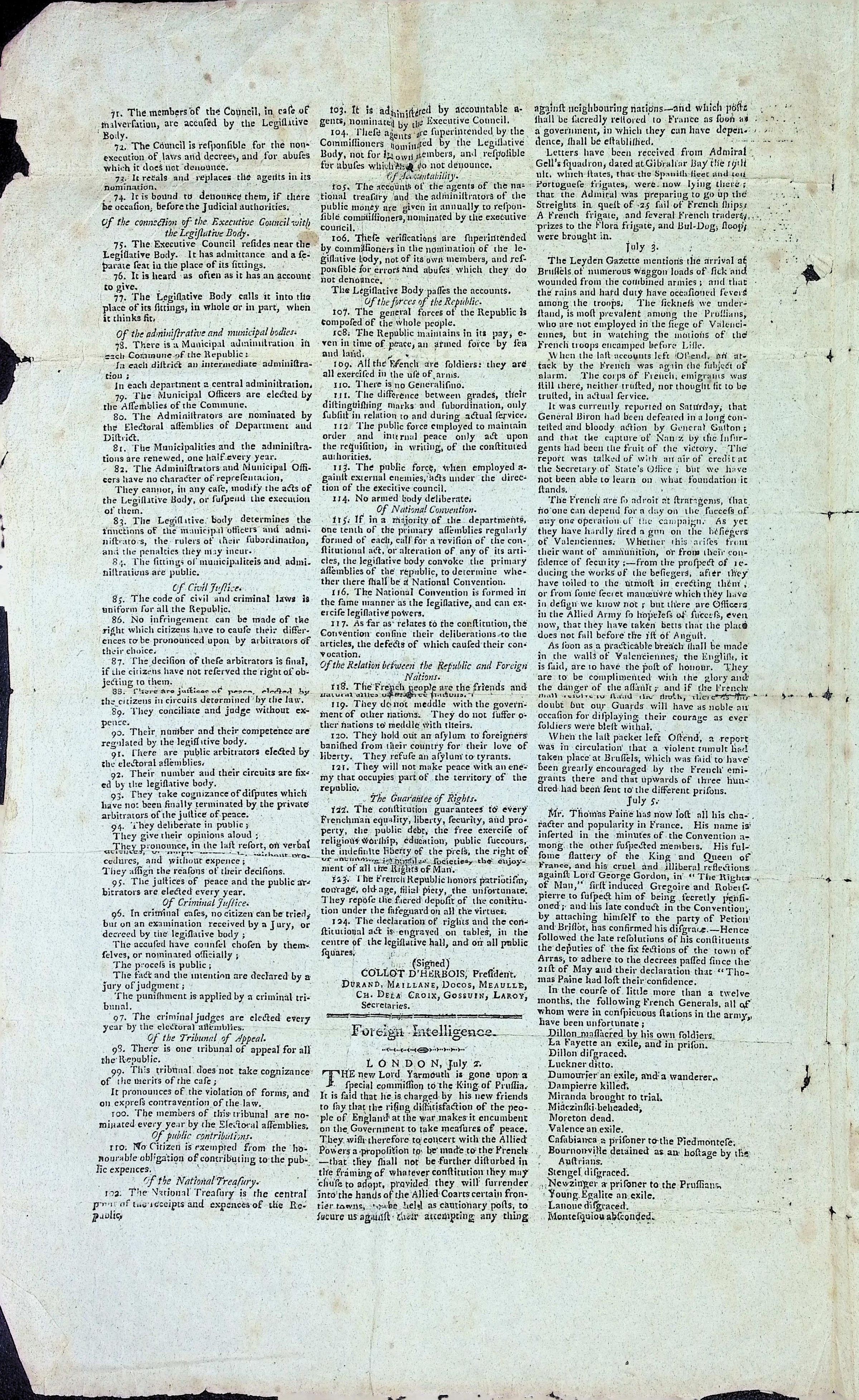
This page contains a detailed legalistic outline of the French Constitutional articles (71-124) regarding the Council, the Executive, administrative bodies, and civil/criminal justice. It emphasizes the "Guarantee of Rights" and the "Relation between the Republic and Foreign Nations." The bottom half features "Foreign Intelligence" from London (July 1793), reporting on the Siege of Valenciennes and the political downfall of Thomas Paine, who is described as having "lost all his character and popularity in France." It concludes with a list of disgraced or executed French Generals.
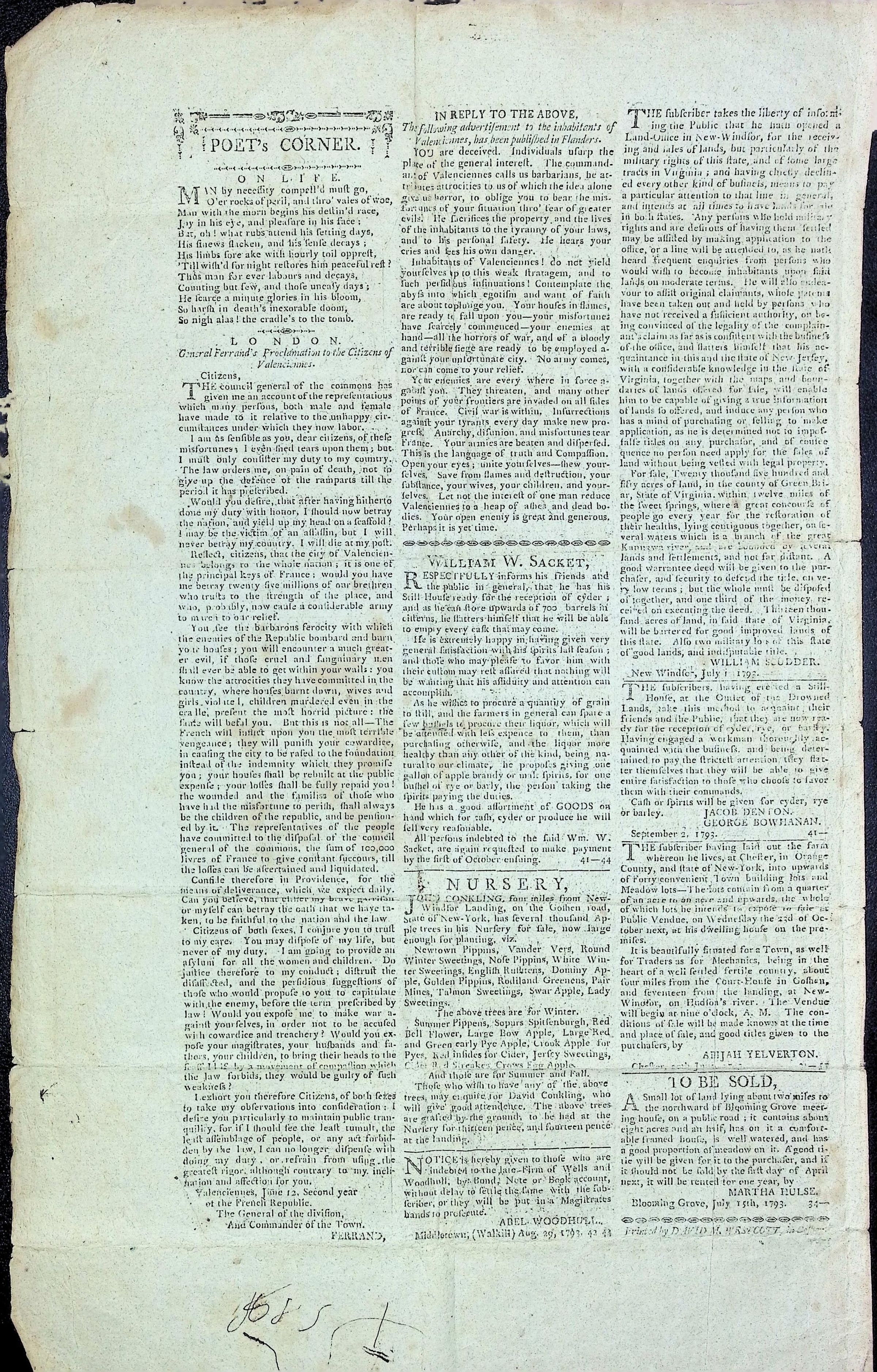
This page transitions to local New York life and international rhetoric. It features:
Poet’s Corner: A somber poem titled "On Life."
War Rhetoric: A proclamation by General Ferrand to the citizens of Valenciennes, and a rebuttal.
Local Commerce: Advertisements for a cider mill (William Sacket), a tree nursery (David Conkling), and land sales in New-Windsor, Orange County, and Virginia.
Orange County History: Notable names such as Abijah Yelverton (advertising lots in Chester) and Martha Pulse appear, providing a snapshot of the real estate and agrarian economy of the Hudson Valley in 1793.
The members of the Council, in case of
malversation, are accused by the Legislative
Body.
The Council is responsible for the non-
execution of laws and decrees, and for abuses
which it does not denounce.
It recalls and replaces the agents in its
nomination.
It is bound to denounce them, if there
be occasion, before the Judicial authorities.
Of the connection of the Executive Council with
the Legislative Body.
The Executive Council resides near the
Legislative Body. It has admittance and a separate seat in the place of its sittings.
It is heard as often as it has an account
to give.
The Legislative Body calls it into the
place of its sittings, in whole or in part, when
it thinks fit.
Of the administrative and municipal bodies.
There is a Municipal administration in
each Commune of the Republic:
In each district an intermediate administration;
In each department a central administration.
The Municipal Officers are elected by
the Assemblies of the Commune.
The Administrators are nominated by
the Electoral assemblies of Department and
District.
The Municipalities and the administrations are renewed, one half every year.
The Administrators and Municipal Officers have no character of representation. They cannot, in any case, modify the acts of
the Legislative Body, or suspend the execution
of them.
The Legislative Body determines the
functions of the municipal officers and administrators, the rulers of their subordination, and the penalties they may incur.
The sittings of municipalities and administrations are public.
Of Civil Justice.
The code of civil and criminal laws is
uniform for all the Republic.
No infringement can be made of the
right which citizens have to cause their differences to be pronounced upon by arbitrators of their choice.
The decision of these arbitrators is final,
if the citizens have not reserved the right of objecting to them.
There are justices of peace, elected by
the citizens in circuits determined by the law.
They conciliate and judge without expense.
Their number and their competence are
regulated by the legislative body.
There are public arbitrators elected by
the electoral assemblies.
Their number and their circuits are fix-
ed by the legislative body.
They take cognizance of disputes which
have not been finally terminated by the private
arbitrators or the justice of peace.
They deliberate in public;
They give their opinions aloud;
They pronounce, in the last resort, on verbal
actions, or on memorial, without procedures, and without expense;
They assign the reasons of their decisions.
The justices of peace and the public arbitrators are elected every year.
Of Criminal Justice.
In criminal cases, no citizen can be tried,
but on an examination received by a Jury, or
decreed by the legislative body;
The accused have counsel chosen by them-
selves, or nominated officially;
The process is public;
The fact and the intention are declared by a
jury of judgment;
The punishment is applied by a criminal tribunal.
The criminal judges are elected every
year by the electoral assemblies.
Of the Tribunal of Appeal.
There is one tribunal of appeal for all
the Republic.
This tribunal does not take cognizance
of the merits of the case;
It pronounces on the violation of forms, and
on express contravention of the law.
The members of this tribunal are nominated every year by the Electoral assemblies. Of public contributions.
No Citizen is exempted from the honourable obligation of contributing to the public expences. Of the National Treasury.
The National Treasury is the central
point of the receipts and expences of the Re-
public.
It is administered by accountable a-
gents, nominated by the Executive Council.
These agents are superintended by the
Commissioners nominated by the Legislative
Body, not for their own members, and resposible
for abuses which they do not denounce.
Of Accountability.
The accounts of the agents of the national treasury and the administrators of the public money are given in annually to responsible commissioners, nominated by the executive council.
These verifications are superintended
by commissioners in the nomination of the legislative body, not of its own members, and responsible for errors and abuses which they do
not denounce.
The Legislative Body passes the accounts.
Of the forces of the Republic.
The general forces of the Republic is
composed of the whole people.
The Republic maintains in its pay, even in time of peace, an armed force by sea and land.
All the French are soldiers: they are
all exercised in the use of arms.
There is no Generalissimo.
The difference between grades, their
distinguishing marks and subordination, only
subsist in relation to and during actual service.
The public force employed to maintain
order and internal peace only act upon
the requisition, in writing, of the constituted
authorities.
The public force, when employed against external enemies, acts under the direction of the executive council.
No armed body deliberate.
Of National Convention.
If in a majority of the departments,
one tenth of the primary assemblies regularly
formed of each, call for a revision of the con-
stitutional act, or alteration of any of its arti-
cles, the legislative body convoke the primary
assemblies of the republic, to determine whether there shall be a National Convention.
The National Convention is formed in
the same manner as the legislative, and can exercise legislative powers.
As far as relates to the constitution, the
Convention confine their deliberations to the
articles, the defects of which caused their con-
vocation.
Of the Relation between the Republic and Foreign
Nations.
The French people are the friends and
natural allies of free nations.
They do not meddle with the government of other nations. They do not suffer other nations to meddle with theirs.
They hold out an asylum to foreigners
banished from their country for their love of
liberty. They refuse an asylum to tyrants.
They will not make peace with an enemy that occupies part of the territory of the
republic.
The Guarantee of Rights.
The constitution guarantees to every
Frenchman equality, liberty, security, and property, the public debt, the free exercise of
religious worship, education, public succours,
the indefinite liberty of the press, the right of
petition, the right of holding popular societies, the enjoyment of all the Rights of Man.
The French Republic honors patriotism,
courage, old age, filial piety, the unfortunate.
They repose the sacred deposit of the constitution under the safeguard of all the virtues.
The declaration of rights and the constitutional act is engraved on tables, in the
centre of the legislative hall, and on all public
squares.
(Signed)
COLLOT D'HERBOIS, President.
DURAND, MAILLANE, DOCOS, MEAULLE,
CH. DELA CROIX, GOSSUIN, LAROY,
Secretaries.
Foreign Intelligence.
LONDON, July 2.
THE new Lord Yarmouth is gone upon a
special commission to the King of Prussia.
It is said that he is charged by his new friends
to say that the rising dissatisfaction of the people of England at the war makes it encumbent
on the Government to take measures of peace.
They wish therefore to concert with the Allied
Powers a proposition to be made to the French
-that they shall not be further disturbed in
the framing of whatever constitution they may
chuse to adopt, provided they will surrender
into the hands of the Allied Courts certain frontier towns, to be held as cautionary posts, to
secure us against their attempting any thing
against neighbouring nations-and which posts
shall be sacredly restored to France as soon as
a government, in which they can have dependence, shall be established.
Letters have been received from Admiral
Gell's squadron, dated at Gibraltar May the 19th
ult. which states, that the Spanish fleet and ten
Portuguese frigates, were now lying there;
that the Admiral was preparing to go up the
Streights in quest of 25 sail of French ships.
A French frigate, and several French traders,
prizes to the Flora frigate, and Bul-dog, sloop,
were brought in.
July 3.
The Leyden Gazette mentions the arrival at
Brussels of numerous waggon loads of sick and
wounded from the combined armies; and that
the rains and hard duty have occasioned fevers
among the troops. The sickness we under-
stand, is most prevalent among the Prussians,
who are not employed in the siege of Valenciennes, but in watching the motions of the
French troops encamped before Lille.
When the last accounts left Ostend, an attack by the French was expected, on the subject of
alarm. The corps of French emigrants was
still there, neither trusted, nor thought fit to be
trusted, in actual service.
It was currently reported on Saturday, that
General Biron had been defeated in a long con-
tested and bloody action by General Gaston;
and that the capture of Nantz by the Insur-
gents had been the fruit of the victory. The
report was talked of with an air of credit at
the Secretary of State's office; but we have
not been able to learn on what foundation it
stands.
The French are so adroit at stratagems, that
no one can depend for a day on the success of
any one operation of the campaign. As yet
they have hardly fired a gun on the besiegers
of Valenciennes. Whether this arises from
their want of ammunition, or from their confidence of security;-from the prospect of reducing the works of the besiegers, after they
have toiled to the utmost in erecting them,
or from some secret manoeuvre which they have
in design we know not; but there are Officers
in the Allied Army so hopeless of success, even
now, that they have taken betts that the place
does not fall before the 1st of August.
As soon as a practicable breach shall be made
in the walls of Valenciennes, the English, it
is said, are to have the post of honour. They
are to be complimented with the glory and
the danger of the assault; and if the French
make resistance to stand the shock, there is no
doubt but our Guards will have as noble an
occasion for displaying their courage as ever
soldiers were blest withal.
When the last packet left Ostend, a report
was in circulation that a violent tumult had
taken place at Brussels, which was said to have
been greatly encouraged by the French emi-
grants there and that upwards of three hun-
dred had been sent to the different prisons.
July 5.
Mr. Thomas Paine has now lost all his cha-
racter and popularity in France. His name is
inserted in the minutes of the Convention a-
mong the other suspected members. His ful-
some flattery of the King and Queen of
France, and his cruel and illiberal reflections
against Lord George Gordon, in "The Rights
of Man," first induced Gregoire and Robers-
pierre to suspect him of being secretly pensi-
oned; and his late conduct in the Convention,
by attaching himself to the party of Petion
and Brissot, has confirmed his disgrace.-Hence
followed the late resolutions of his constituents
the deputies of the six sections of the town of
Arras, to adhere to the decrees passed since the
31st of May and their declaration that "Tho-
mas Paine had lost their confidence."
In the course of little more than a twelve
months, the following French Generals, all of
whom were in conspicuous stations in the army,
have been unfortunate;
Dillon massacred by his own soldiers.
La Fayette an exile, and in prison.
Dillon disgraced.
Luckner ditto.
Dumourier an exile, and a wanderer.
Dampierre killed.
Miranda brought to trial.
Midezinski beheaded.
Moreton dead.
Valence an exile.
Casabianca a prisoner to the Piedmontese.
Bournonville detained as an hostage by the
Austrians.
Stengel disgraced.
Newzinger a prisoner to the Prussians.
Young Egalite an exile.
Lanoue disgraced.
Montesquiou absconded.
Transcription: 2265c.jpg
POET'S CORNER.
ON LIFE.
MAN by necessity compell'd must go,
O'er rocks of peril, and thro' vales of woe,
Man with the morn begins his destin'd race,
Joy in his eye, and pleasure in his face:
But, oh! what rubs attend his setting days,
His sinews slacken, and his sense decays;
His limbs sore ake with hourly toil opprest,
'Till with'd for night restores him peaceful rest?
Thus man for ever labours and decays,
Counting but few, and those uneasy days;
He scarce a minute glories in his bloom,
So harsh is death's inexorable doom,
So nigh alas! the cradle's to the tomb.
LONDON.
General Ferrand's Proclamation to the Citizens of
Valenciennes.
Citizens,
THE council general of the commons has
given me an account of the representations
which many persons, both male and female
have made to it relative to the unhappy cir-
cumstances under which they now labor.
I am as sensible as you, dear citizens, of these
misfortunes; I even shed tears upon them; but
I must only consider my duty to my country.
The law orders me, on pain of death, not to
give up the defence of the ramparts till the
period it has prescribed.
Would you desire, that after having hitherto
done my duty with honor, I should now betray
the nation, and yield up my head on a scaffold?
I may be the victim of an assassin, but I will
never betray my country. I will die at my post.
Reflect, citizens, that the city of Valencien-
nes belongs to the whole nation; it is one of
the principal keys of France; would you have
me betray twenty five millions of our brethren
who trust to the strength of the place, and
who, probably, now cause a considerable army
to move to our relief.
You see the barbarous ferocity with which
the enemies of the Republic bombard and burn
your houses; you will encounter a much great-
er evil, if those cruel and sanguinary men
shall ever be able to get within your walls: you
know the atrocities they have committed in the
country, where houses burnt down, wives and
girls violated, children murdered even in the
cradle, present the most horrid picture: the
same will befal you. But this is not all-The
French will inflict upon you the most terrible
vengeance; they will punish your cowardice,
in causing the city to be rased to the foundation
instead of the indemnity which they promise
you; your houses shall be rebuilt at the public
expense; your losses shall be fully repaid you!
the wounded and the families of those who
have had the misfortune to perish, shall always
be the children of the republic, and be pension-
ed by it. The representatives of the people
have committed to the disposal of the council
general of the commons, the sum of 100,000
livres, of French money, to grant succours, till
the losses can be ascertained and liquidated.
Confide therefore in Providence, for the
means of deliverance, which we expect daily.
Can you believe, that either my brave garrison
or myself can betray the oath that we have ta-
ken, to be faithful to the nation and the law.
Citizens of both sexes, I conjure you to trust
to my care. You may dispose of my life, but
never of my duty. I am going to provide an
asylum for all the women and children. Do
justice therefore to my conduct; distrust the
disaffected, and the perfidious suggestions of
those who would propose to you to capitulate
with the enemy, before the term prescribed by
law! Would you expose me to make war a-
gainst yourselves, in order not to be accused
with cowardice and treachery? Would you ex-
pose your magistrates, your husbands and fa-
thers, your children, to bring their heads to the
scaffold? If by a movement of compassion which
the law forbids, they would be guilty of such
weakness?
I exhort you therefore Citizens, of both sexes
to take my observations into consideration: I
desire you particularly to maintain public tran-
quility, for if I should see the least tumult, the
least assemblage of people, or any act forbid-
den by the law, I can no longer dispense with
doing my duty, or refrain from using the
greatest rigor, although contrary to my incli-
nation and affection for you.
Valenciennes, June 12, Second year
of the French Republic.
The General of the division,
And Commander of the Town.
FERRAND.
IN REPLY TO THE ABOVE,
The following advertisement to the inhabitants of
Valenciennes, has been published in Flanders.
YOU are deceived. Individuals usurp the
place of the general interest. The command-
ant of Valenciennes calls us barbarians, he at-
tributes atrocities to us of which the idea alone
gives us horror, to oblige you to bear the mis-
fortunes of your situation thro' fear of greater
evils. He sacrifices the property, and the lives
of the inhabitants to the tyranny of your laws,
and to his personal safety. He fears your
cries and sees his own danger.
Inhabitants of Valenciennes! do not yield
yourselves up to this weak stratagem, and to
such perfidious insinuations! Contemplate the
abyss into which egotism and want of faith
are about to plunge you. Your houses in flames,
are ready to fall upon you-your misfortunes
have scarcely commenced-your enemies at
hand-all the horrors of war, and of a bloody
and terrible siege are ready to be employed a-
gainst your unfortunate city. No army comes,
nor can come to your relief.
Your enemies are every where in force a-
gainst you. They threaten, and many other
points of your frontiers are invaded on all sides
of France. Civil war is within. Insurrections
against your tyrants every day make new pro-
gress. Anarchy, division, and misfortunes tear
France. Your armies are beaten and dispersed.
This is the language of truth and Compassion.
Open your eyes; unite yourselves-shew your-
selves. Save from flames and destruction, your
substance, your wives, your children, and your-
selves. Let not the interest of one man reduce
Valenciennes to a heap of ashes and dead bo-
dies. Your open enemy is great and generous.
Perhaps it is yet time.
WILLIAM W. SACKET,
RESPECTFULLY informs his friends and
the public in general, that he has his
Still-House ready for the reception of cyder;
and as he can store upwards of 700 barrels in
cisterns, he flatters himself that he will be able
to empty every cask that may come.
He is extremely happy in having given very
general satisfaction with his spirits last season;
and those who may please to favor him with
their custom may rest assured that nothing will
be wanting that his assiduity and attention can
accomplish.
As he wishes to procure a quantity of grain
to still, and the farmers in general can spare a
few bushels to procure their liquor, which will
be attended with less expense to them, than
purchasing otherwise, and the liquor more
healthy than any other of the kind, being na-
tural to our climate, he proposes giving one
gallon of apple brandy or malt spirits, for one
bushel of rye or barley, the person taking the
spirits paying the duties.
He has a good assortment of GOODS on
hand which for cash, cyder or produce he will
sell very reasonable.
All persons indebted to the said Wm. W.
Sacket, are again requested to make payment
by the first of October ensuing. 41-4w
NURSERY,
DAVID CONKLING, four miles from New-
Windsor landing, on the Goshen road,
State of New-York, has several thousand Ap-
ple trees in his Nursery for sale, now large
enough for planting, viz.
Newtown Pippins, Vander Vere, Round
Winter Sweetings, Nose Pippins, White Win-
ter Sweetings, English Russetts, Dominy Ap-
ple, Golden Pippins, Rodland Greenens, Pair
Mines, Talman Sweetings, Swar Apple, Lady
Sweetings.
The above trees are for Winter.
Summer Pippins, Sopurs Spitzenburgh, Red
Bell Flower, Large Bow Apple, Large Red
and Green early Pye Apple, Crook Apple for
Pyes, Red insides for Cider, Jersey Sweetings,
Cider Red Streakes, Cows Egg Apple.
And those are for Summer and Fall.
Those who wish to have any of the above
trees, may enquire for David Conkling, who
will give good attendance. The above trees
are grafted by the ground, to be had at the
Nursery for thirteen pence, and fourteen pence
at the landing.
NOTICE is hereby given to those who are
indebted to the late Firm of Wells and
Woodhull, by Bond, Note or Book account,
without delay to settle the same with the sub-
scriber, or they will be put into a Magistrates
hands to prosecute.
ABEL WOODHULL.
Middletown, (Wallkill) Aug. 29, 1793. 42-43
THE subscriber takes the liberty of inform-
ing the Public that he hath opened a
Land-Office in New-Windsor, for the receiv-
ing and sales of lands, but particularly of the
military rights of this state, and of some large
tracts in Virginia; and having chiefly declin-
ed every other kind of business, means to pay
a particular attention to that line in general,
and intends at all times to have lands for sale
in both states. Any persons who hold military
rights and are desirous of having them settled
may be assisted by making application to the
office, or a line will be attended to, as he hath
heard frequent enquiries from persons who
would wish to become inhabitants upon said
lands on moderate terms. He will also endea-
vour to assist original claimants, whose patents
have been taken out and held by persons who
have not received a sufficient authority, on be-
ing convinced of the legality of the complain-
ants claim as far as is consistent with the business
of the office, and flatters himself that his ac-
quaintance in this and the state of New Jersey,
with a considerable knowledge in the state of
Virginia, together with the maps and boun-
daries of lands offered for sale, will enable
him to be capable of giving a true information
of lands so offered, and induce any person who
has a mind of purchasing or selling to make
application, as he is determined not to impof-
fasse titles on any purchaser, and of course
quence no person need apply for the sales of
land without being vested with legal property.
For sale, Twenty thousand five hundred and
fifty acres of land, in the county of Green Bri-
ar, State of Virginia, within twelve miles of
the sweet springs, where a great concourse of
people go every year for the restoration of
their healths, lying contiguous together, on se-
veral waters which is a branch of the great
Kanawha river, and are bounded by several
lands and settlements, and not far distant. A
good warrantee deed will be given to the pur-
chaser, and security to defend the title, on ve-
ry low terms; but the whole must be disposed
of together, and one third of the money re-
ceived on executing the deed. Thirteen thou-
sand acres of land, in said state of Virginia,
will be bartered for good improved lands of
this state. Also two military lots of this state
of good lands, and indisputable title.
WILLIAM SCUDDER.
New-Windsor, July 1, 1793.
THE subscribers, having erected a Still-
House, at the outlet of the Drowned
Lands, take this method to acquaint their
friends and the Public, that they are now rea-
dy for the reception of cyder, rye, or barley.
Having engaged a workman thoroughly ac-
quainted with the business, and being deter-
mined to pay the strictest attention they flat-
ter themselves that they will be able to give
entire satisfaction to those who choose to favor
them with their commands.
Cash or spirits will be given for cyder, rye
or barley.
JACOB DENTON.
GEORGE BOWHANAN.
September 2, 1793. 41-
THE subscriber having laid out the farm
whereon he lives, at Chester, in Orange
County, and state of New-York, into upwards
of Forty convenient Town building lots and
Meadow lots-The lots contain from a quarter
of an acre to an acre and upwards, the whole
of which lots he intends to expose to sale at
Public Vendue, on Wednesday the 23d of Oc-
tober next, at his dwelling house on the pre-
mises.
It is beautifully situated for a Town, as well
for Traders as for Mechanics, being in the
heart of a well settled fertile country, about
four miles from the Court-House in Goshen,
and seventeen from the landing, at New-
Windsor, on Hudson's river. The Vendue
will begin at nine o'clock, A. M. Th... [truncated due to length]