Name/Title
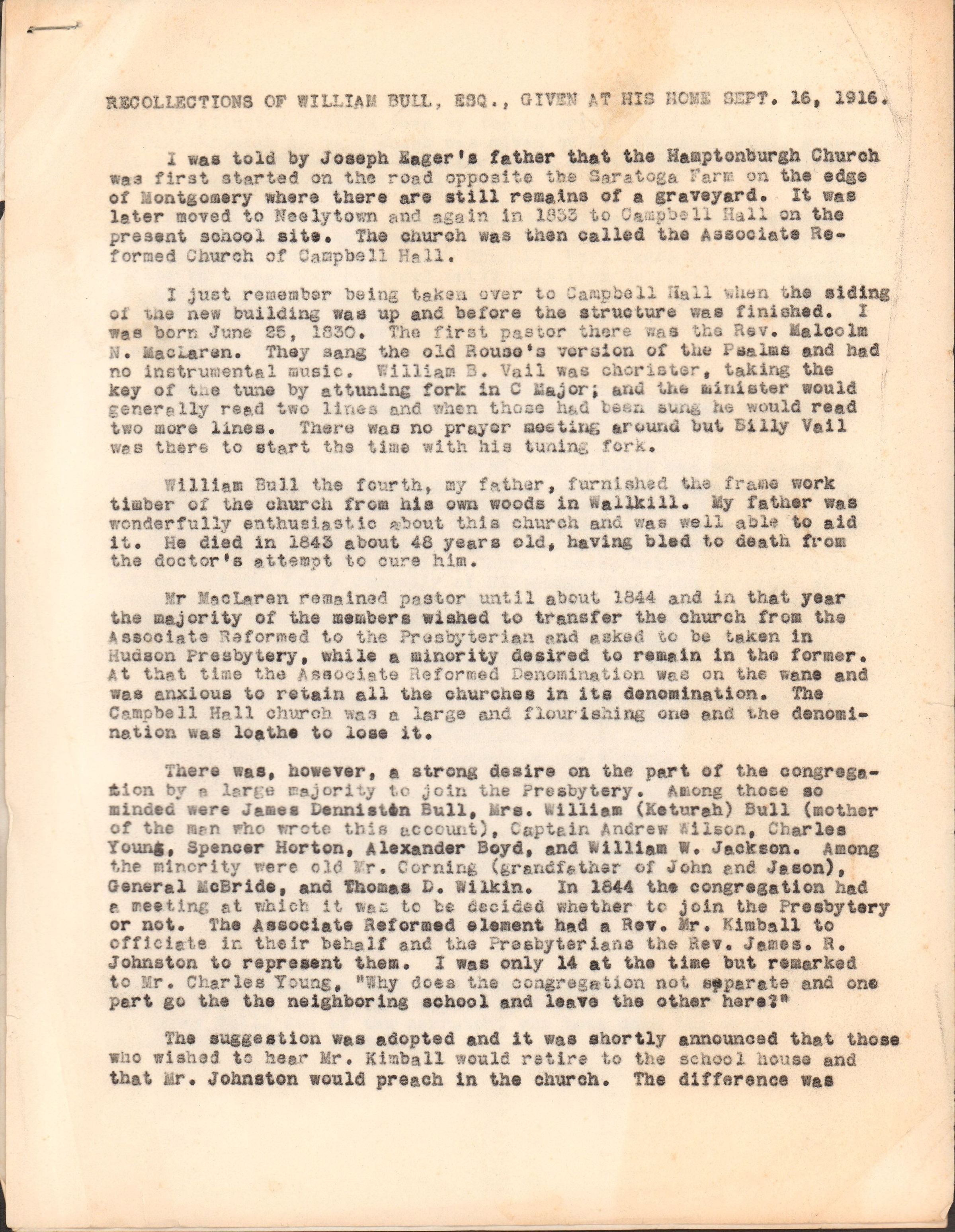
Typed recollection of William Bull Sept 16, 1916Entry/Object ID
000112Tags
William BullSubject
I was told by Joseph Eager's father that the Hamptonburgh Church was first started on the road opposite the Saratoga Farm on the edge of Montgomery where there are still remains of a graveyard. It was later moved to Neelytown and again in 1833 to Campbell Hall on the present school site. The church was then called the Associate Reformed Church of Campbell Hall.
I just remember being taken over to Campbell Hall when the siding of the new building was up and before the structure was finished. I was born June 25, 1830. The first pastor there was the Rev. Malcolm N. MacLaren. They sang the old Rouse's version of the Psalms and had no instrumental music. William B. Vail was chorister, taking the key of the tune by attuning fork in C Major; and the minister would generally read two lines and when those had been sung he would read two more lines. There was no prayer meeting around but Billy Vail was there to start the time with his tuning fork.
William Bull the fourth, my father, furnished the frame work timber of the church from his own woods in Wallkill. My father was wonderfully enthusiastic about this church and was well able to aid it. He died in 1843 about 48 years old, having bled to death from the doctor's attempt to cure him.
Mr MacLaren remained pastor until about 1844 and in that year the majority of the members wished to transfer the church from the Associate Reformed to the Presbyterian and asked to be taken in Hudson Presbytery, while a minority desired to remain in the former. At that time the Associate Reformed Denomination was on the wane and was anxious to retain all the churches in its denomination. The Campbell Hall church was a large and flourishing one and the denomination was loathe to lose it.
There was, however, a strong desire on the part of the congregation by a large majority to join the Presbytery. Among those so minded were James Denniston Bull, Mrs. William (Keturah) Bull (mother of the man who wrote this account), Captain Andrew Wilson, Charles Young, Spencer Horton, Alexander Boyd, and William W. Jackson. Among the minority were old Mr. Corning (grandfather of John and Jason), General McBride, and Thomas D. Wilkin. In 1844 the congregation had a meeting at which it was to be decided whether to join the Presbytery or not. The Associate Reformed element had a Rev. Mr. Kimball to officiate in their behalf and the Presbyterians the Rev. James R. Johnston to represent them. I was only 14 at the time but remarked to Mr. Charles Young, "Why does the congregation not separate and one part go the the neighboring school and leave the other here?"
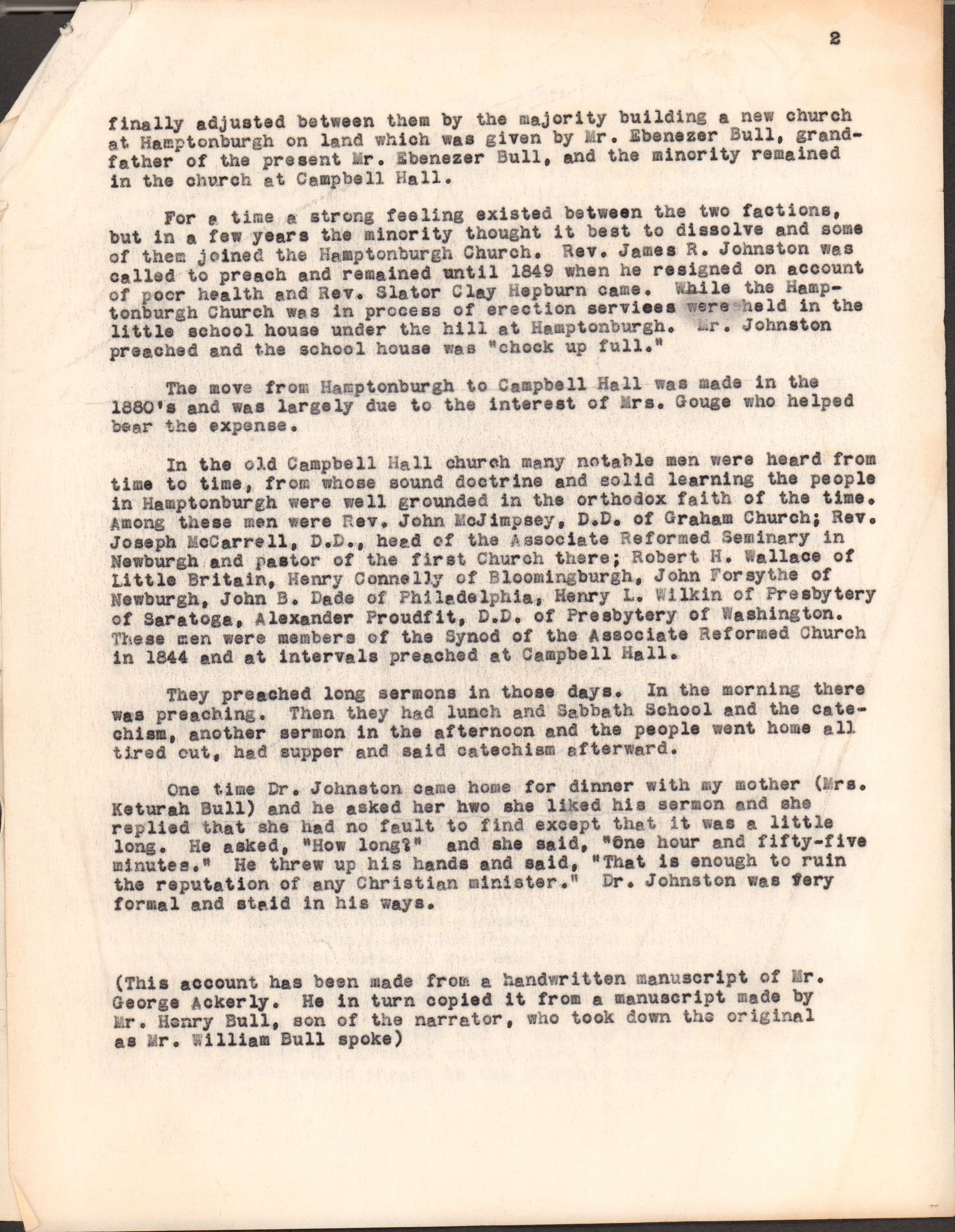
The suggestion was adopted and it was shortly announced that those who wished to hear Mr. Kimball would retire to the school house and that Mr. Johnston would preach in the church. The difference was finally adjusted between them by the majority building a new church at Hamptonburgh on land which was given by Mr. Ebenezer Bull, grandfather of the present Mr. Ebenezer Bull, and the minority remained in the church at Campbell Hall.
For a time a strong feeling existed between the two factions, but in a few years the minority thought it best to dissolve and some of them joined the Hamptonburgh Church. Rev. James R. Johnston was called to preach and remained until 1849 when he resigned on account of poor health and Rev. Slator Clay Hepburn came. While the Hamptonburgh Church was in process of erection services were held in the little school house under the hill at Hamptonburgh. Mr. Johnston preached and the school house was "chock up full."
The move from Hamptonburgh to Campbell Hall was made in the 1880's and was largely due to the interest of Mrs. Gouge who helped bear the expense.
In the old Campbell Hall church many notable men were heard from time to time, from whose sound doctrine and solid learning the people in Hamptonburgh were well grounded in the orthodox faith of the time. Among these men were Rev. John McJimpsey, D.D. of Graham Church; Rev. Joseph McCarrell, D.D., head of the Associate Reformed Seminary in Newburgh and pastor of the first Church there; Robert H. Wallace of Little Britain, Henry Connelly of Bloomingburgh, John Forsythe of Newburgh, John B. Dade of Philadelphia, Henry L. Wilkin of Presbytery of Saratoga, Alexander Proudfit, D.D. of Presbytery of Washington. These men were members of the Synod of the Associate Reformed Church in 1844 and at intervals preached at Campbell Hall.
They preached long sermons in those days. In the morning there was preaching. Then they had lunch and Sabbath School and the catechism, another sermon in the afternoon and the people went home all tired out, had supper and said catechism afterward.
One time Dr. Johnston came home for dinner with my mother (Mrs. Keturah Bull) and he asked her hwo she liked his sermon and she replied that she had no fault to find except that it was a little long. He asked, "How long?" and she said, "One hour and fifty-five minutes." He threw up his hands and said, "That is enough to ruin the reputation of any Christian minister." Dr. Johnston was very formal and staid in his ways.
(This account has been made from a handwritten manuscript of Mr. George Ackerly. He in turn copied it from a manuscript made by Mr. Henry Bull, son of the narrator, who took down the original as Mr. William Bull spoke)Relationships
Related Person or Organization
Person or Organization
William Bull