Name/Title
Connecticut Chair WheelEntry/Object ID
2017.01.21Description
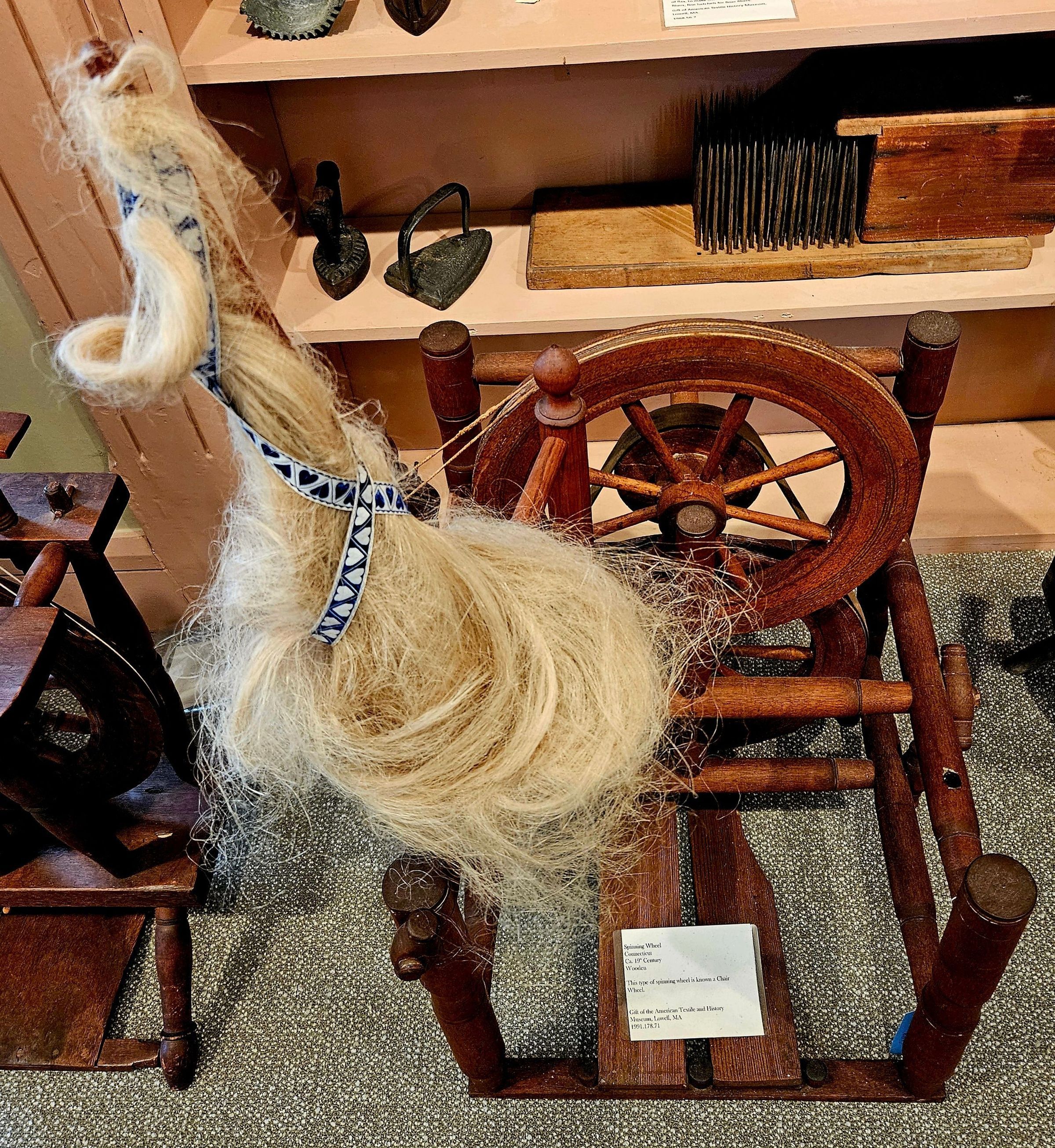
Spinning wheel. Connecticut chair linen wheel. Horizontal, bobbin/flyer, two wheels, two treadles, chair frame. Chair frame has two high posts in back and two shorter posts in front, connected by two parallel stretchers on each side. Two parallel stretchers connect the back posts; two parallel horizontal rods are threaded through side stretchers, secured by wooden nuts. A fixed flat board between the front posts holds three small uprights. Each of the two treadles pivots on a metal rod between them. Each footman connects to a z-shaped drive wheel axle extension, which fits into the lower rear stretcher. The front wheel post fits through the lower horizontal rod. The drive wheel has six spokes; the rim is constructed in four sections. The wheel post for the accelerating wheel is set into the top horizontal rod. The accelerating wheel, attached to the wheel post and the upper back stretcher, has six spokes; the rim, with two grooves, is constructed in four sections, A solid disk, with a single groove, is attached to the accelerating wheel hb extension. A cloth belt connects the drive wheel to this disk. A doubled drive-band connects the accelerating wheel to the whorls. The mother-of-all is set between the front and back posts on the spinner's left. A tension knob on the front post adjusts its position. The bobbin/flyer is complete and connected by a doubled drive-band to the accelerating wheel. Conical-shaped distaff assembly set into upper horizontal rod. Turnings on legs.Use
Spinning flax into linen.Context
Joan Whittaker Cummer, "A Book of Spinning Wheels" (Portsmouth, NH: Peter E. Randall, 1993), 156-157: "These wheels, known as 'Connecticut Chair Wheels,' are an American invention of the early nineteenth century, supposedly first made in Connecticut by a chair maker. The double treadle and the action of the accelerating wheel allow a slow, easy treadling rhythm while spinning." Wheel no. 71.Collection
American Textile History Museum CollectionMade/Created
Date made
circa 1800 - circa 1850Time Period
19th CenturyLexicon
Nomenclature 4.0
Nomenclature Primary Object Term
Wheel, SpinningNomenclature Sub-Class
Textile Manufacturing EquipmentNomenclature Class
Textileworking T&ENomenclature Category
Category 04: Tools & Equipment for MaterialsOther Names and Numbers
Other Numbers
Number Type
ATHMOther Number
1991.178.71Dimensions
Height
29 inDepth
19 inLength
17-1/2 inMaterial
Wood, Ferrous metalLocation
Location
Exhibit Room
Thread City Exhibit, Bev York Room* Untyped Location
Main Museum BuildingCategory
ExhibitDate
April 11, 2026Provenance
Provenance Detail
Donated by American Textile History Museum in 2017.Create Date
April 11, 2026Update Date
April 11, 2026