Name/Title
Parlor WheelEntry/Object ID
2017.01.22Description
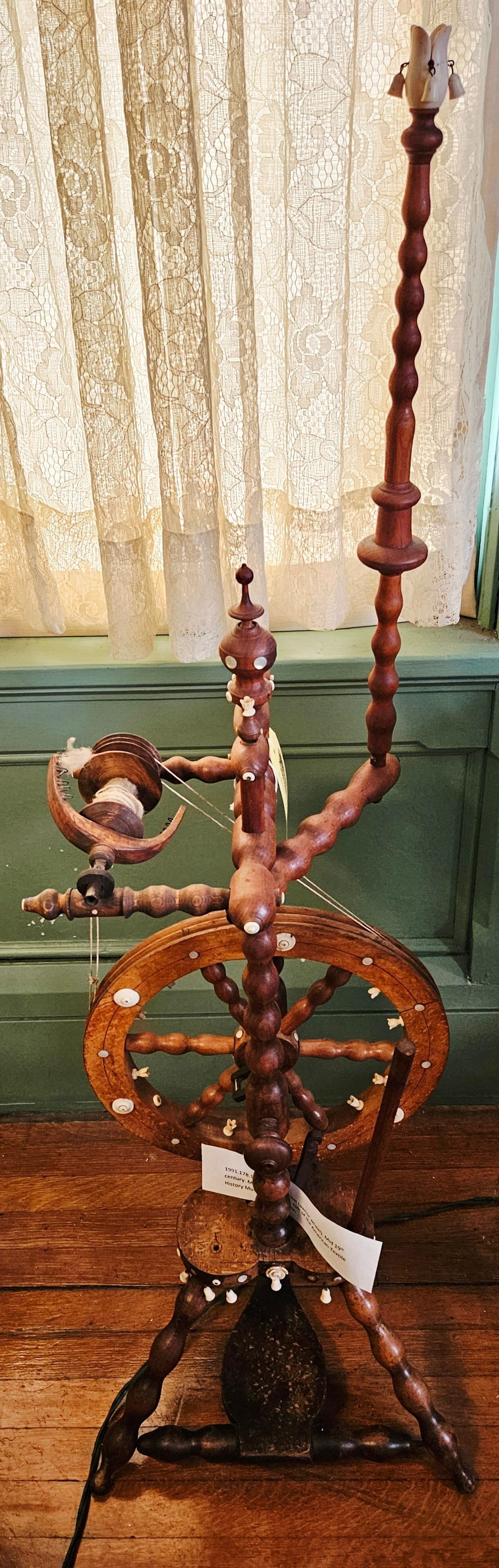
Parlor spinning wheel. Mid-19th-century. Vertical with bobbin/flyer above wheel, treadle. The heart-shaped table rests on three splayed legs. The treadle is set into a pivoting bar between two legs. A cut-out table accommodates the footman, which is attached to the treadle by by a metal hinge and connects the treadle to a U-shaped drive wheel axle extension. Two wheel posts set into the table hold the drive wheel, which is adjusted by a threaded screw on the front post. The drive wheel has six spokes; the rim, with two grooves, is constructed in four sections. The mother-of-all fits onto the tops of the wheel posts, with the maidens horizontal on the spinner's left. The bobbin/flyer is complete and connected to the drive wheel by a doubled drive-band. The tensioning screw passes through the rod connecting the tops of the wheel posts. A distaff arm fits on the front wheel post and holds a stick-style distaff. A rod that fits into the table to the right of wheel post probably held a water vessel. There are turnings on the legs, wheel posts, maidens, and distaff arm. The table edge is decorated by an ivory floret, plus ivory and mother-of-pearl buttons; 1f3 ivory bells hang from wires on underside. The drive wheel has five large ivory buttons, 7 mother-of-pearl buttons on each side of the rim surface. Twelve small ivory tulips (one broken) are attached between the spokes. Six mother-of-pearl buttons decorate the mother-of-all and tensioning screw knob. Small ivory tulip filials decorate the wheel posts. The top of distaff has a large ivory tulip with four small bells hanging from it. This wheel is spinning wheel #114 In Joan Whitaker Cummer, "A Book of Spinning Wheels" (Portsmouth, NH: Peter E. Randall. 1994), 248-249.Use
Spinning thread or yarn by hand.Context
As industrialization progressed in the 19th century, spinning and weaving declined slowly as cottage industries. But at the same time, spinning in particular became a popular craft among middle-class and upper-class women. Parlor wheels were used by such crafters and were often ornate or decorative -- hence our decision to display this wheel in the Mill Manager's Parlor Exhibit Room. Wheels like this were often given as wedding presents, according to Joan Cummer.Collection
American Textile History Museum CollectionMade/Created
Artist Information
Artist
UnknownRole
CarpenterDate made
circa 1850Time Period
19th CenturyPlace
* Untyped Place
Germany or EnglandLexicon
Nomenclature 4.0
Nomenclature Primary Object Term
Wheel, SpinningNomenclature Sub-Class
Textile Manufacturing EquipmentNomenclature Class
Textileworking T&ENomenclature Category
Category 04: Tools & Equipment for MaterialsOther Names and Numbers
Other Numbers
Number Type
ATHMOther Number
1991.178.114Dimensions
Height
42 inWidth
15-1/2 inDepth
15 inMaterial
Wood, Ferrous metal, Ivory, NacreLocation
Location
Exhibit Room
Mill Manager's Parlor Exhibit* Untyped Location
Main Museum BuildingCategory
ExhibitDate
April 18, 2026Condition
Overall Condition
GoodDate Examined
Apr 18, 2026Examined By
Eves, JamieProvenance
Provenance Detail
Donated by American Textile History Museum in 2017.Create Date
April 11, 2026Update Date
April 18, 2026