Name/Title
How to Play BackgammonDescription
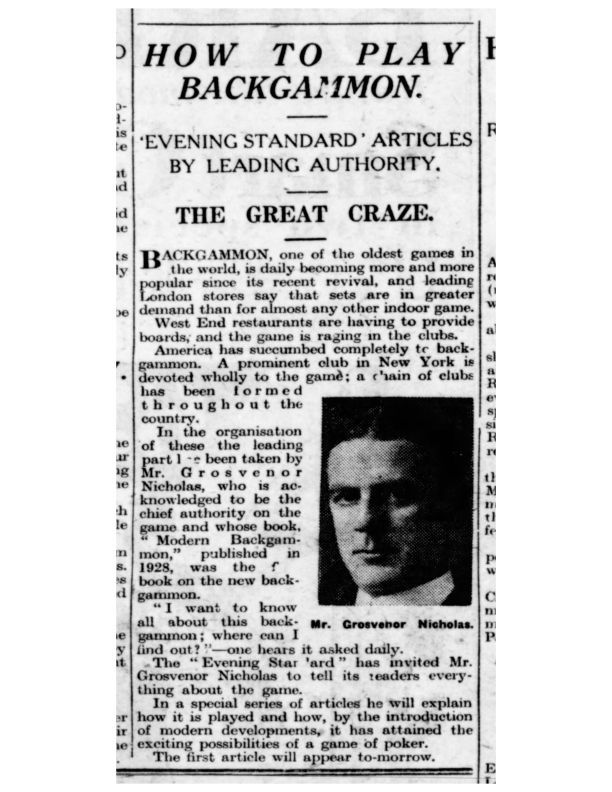
It is no great surprise that Grosvenor Nicholas would have published a series of backgammon articles in a major newspaper, as had Elizabeth Clark Boyden and J. Van Cleft Cooper the previous year. But Grosvenor Nicholas’ series for London’s 'Evening Standard' is full of fresh surprises. It had been three years since he wrote his introductory book, Modern Backgammon (1929), and as he revisits the topics of doubling and chouette play, he adds plenty of fresh color to our picture of how these innovations were originated and practiced.
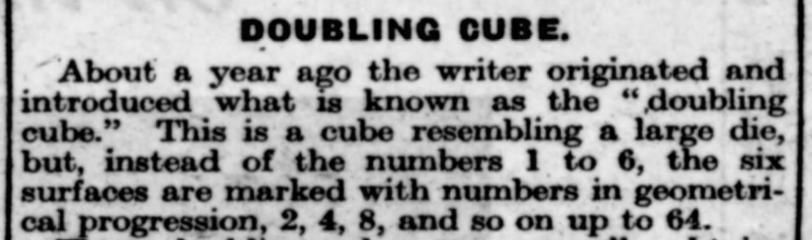
In the May 13th installment, Nicholas mentions that doubling “is said to be the invention of the Grand Duke Dmitri,” and identifies the Travellers’ Club of Paris as its birthplace — details that would be confirmed in greater detail in Walter Richards’ “Backgammon Boom” article a few months later in Vanity Fair. But as for the device we call the doubling cube — he claims that invention for his own.
After referring to the use of common matches to keep score, Nicholas goes on to note: “There are now available what are known as ‘backgammon matches.’ While these will not strike, they are in striking colors, denoting different values, after the manner of the chips used at poker or roulette and, of course, ordinary chips would serve the same purpose.” This is the only known reference to the little cylinders of Backgammon Matches prized by collectors, and suggests they became available, not as a precursor to the doubling cube, but as a newer, deluxe method of the tried and true “doubling by matches” that had been in practice for several years at this point.
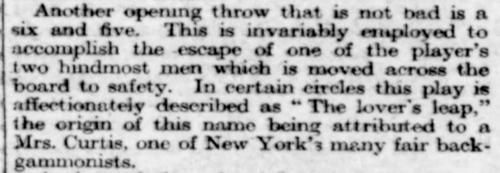
The series also includes a couple of nice points of terminology. The 5th part of the series is titled “Blocks and Blots“ — “a block is a point occupied by two or more men.” Although writers of the day routinely spoke of “making a point,” calling held points “blocks” makes for a nicely consonant companion term for “blots,” and it seems a shame it hasn’t survived. On the other hand, one expression that certainly has survived is the perfectly apt “the lovers leap” for the opening 65 running play — and Nicholas credits a New Yorker named “Mrs. Curtis” for its invention.Publication Details
Publication Type
ArticlePeriodical
Evening Standard, LondonPeriodical Type
NewspaperDate Published
circa 1931Time Period
Modern BackgammonOther Names and Numbers
Other Numbers
Number Type
SequenceOther Number
1931_05_05