Note
Per the Craven Museum's website (http://www.cravenmuseum.org/archaeology/fact-sheets/roman-pottery-lamps/), although there was no electricity or light bulbs, artificial light was common throughout the Roman empire. Pottery oil lamps were an alternative to candle light. Candles were cheaper to buy, but did not survive as well. Oil was poured through a central hole and wick was placed in nozzle area. Lamps could be handmade, wheel made, or by mold. Mold often created air bubbles. Glazes could be used to ensure the lamp was more watertight, not necessarily for decorative purposes.
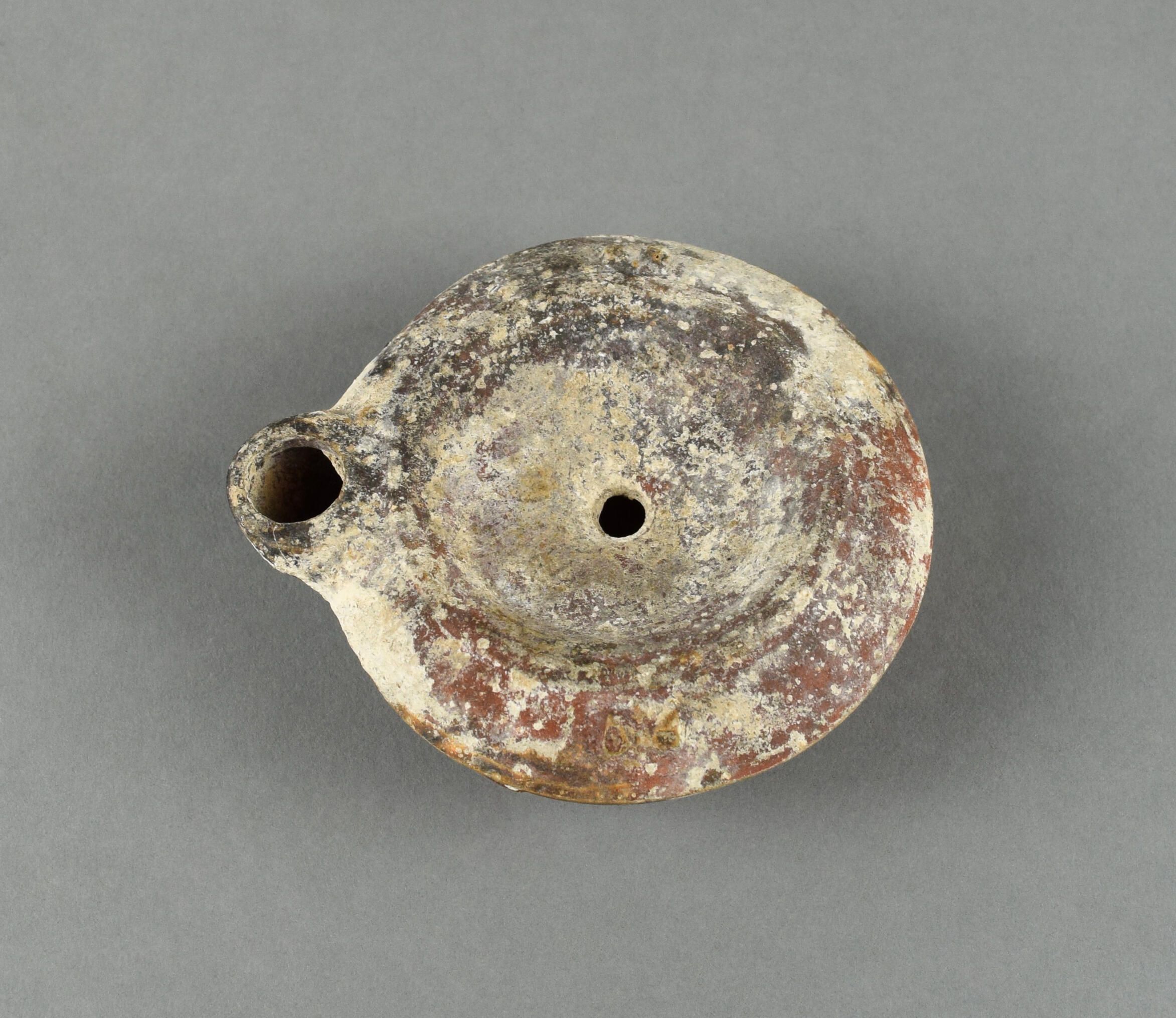
Per "History of Ancient Pottery" by H.B. Walters (1905), Roman lamps were often made of terracotta. The purposes included: for illuminating private houses, public buildings, or celebrations; for offerings in templs; for funerary furniture. In small houses, lamps were placed in niches in the walls or suspended by chains. There were three different prominant styles of lamps: ones with knowbs for hanging, ones with handles for carrying, one without either that would be placed on a table or bracket. When used in temples, lamps were subject of votive offerings to gods. When in tombs, lamps were intended to be used by the dead, with the idea that they would be burning perpetually. During the time period of this lamp (#538), most lamps were devoid of subkects. Most lamps at the time only had 1 wick, but more might be added if not bright enough. The average size was a 3 to 4 inch diameter, with a 1 inch height. Lamps were usually clay of a red color, revealing the presence of red ochre. From the 1st century BCE onward, lamps were almost always made by a mold. Lamps were often contrary to usual principles of ancient art to crowd pieces with details. People of intefor classes would purchase terracotta lamps; wealthier people could afford to buy bronze and metal lamps.
Per the Penn Museum's exhibit, oil burning lamps were the primary source of artifical light. Cheap lamps were made in terracotta. Lamps with standing positions or multiple hangings were essential for larger rooms. Olive oil was an expensive fuel, and families with tight budgets would have used sparingly and with judgement.
Label 12/2014
Oil burning lamps were the primary source of artificial light in the Roman Empire, making these lamps a necessity in everyday life. Lamps were used to illuminate private houses and public buildings, to make votive offerings in temples, and to furnish burial chambers. Terracotta lamps such as this one would have been used by people of the poorer classes because they would have been less expensive to purchase than their bronze counterparts.