J. W. VanDyke - Lincoln House 1898, Electric Light Station, Evaporator Plant
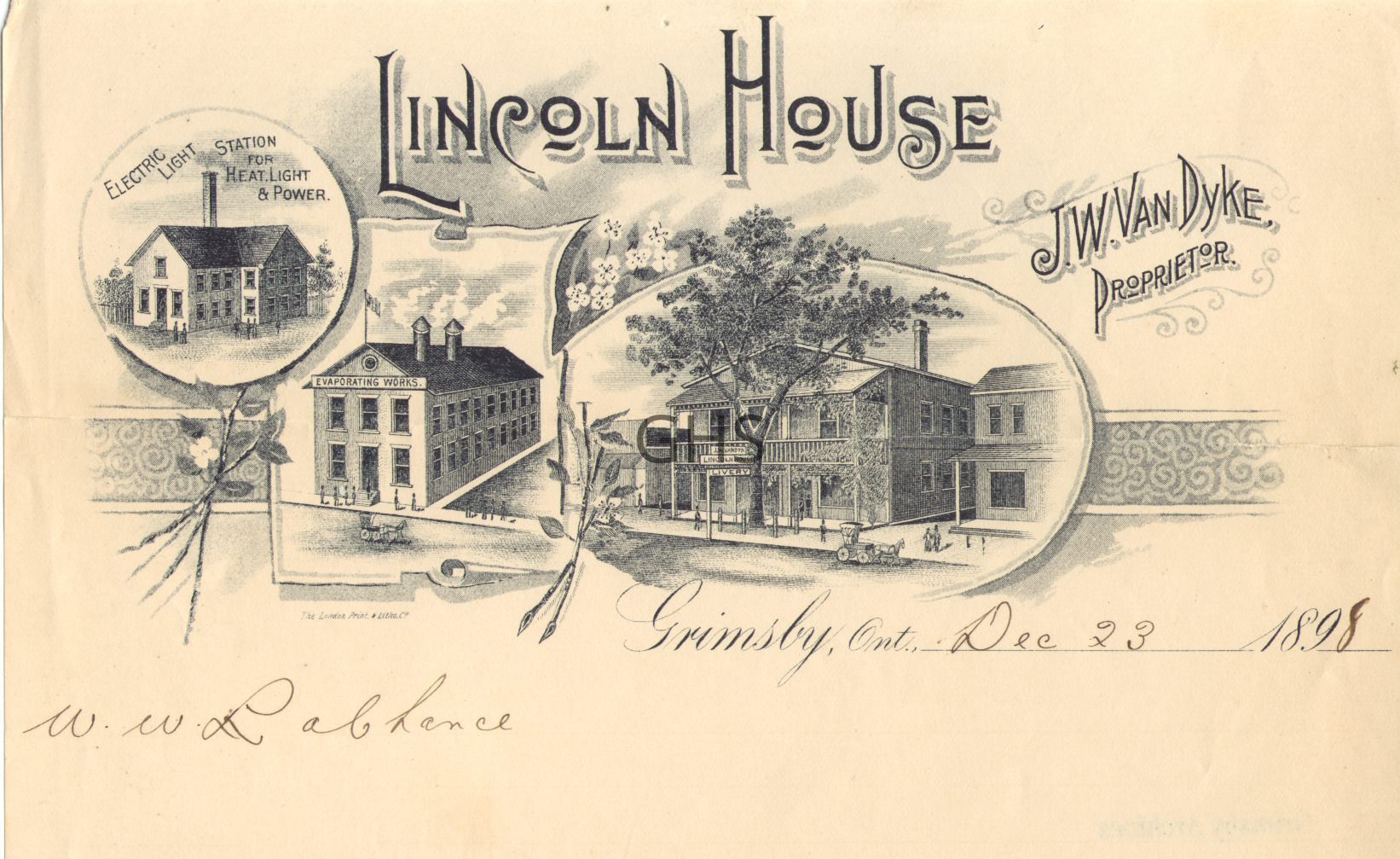
Letterhead of Lincoln House, VanDyke proprietor of hotel, electric light station and evaporator plant
Name/Title
J. W. VanDyke - Lincoln House 1898, Electric Light Station, Evaporator PlantEntry/Object ID
P2006-01-09-93Description
John Wesley (J. W., Jack) VanDyke, 1857-1913 J. W. VanDyke came from a family of prominent carriage makers and blacksmiths in Grimsby. He was an ambitious, inventive and genial businessman who played an active part in Grimsby life in the late 19th and early 20th centuries. His first wife, Mary Ann Mabey was the sister of S. E. and Charles F. Mabey. John and Mary Ann had two sons, Fred and Melville. After Mary Ann’s death in 1894, VanDyke married Mary A. Ness of Smithville. In the early 1890s, VanDyke moved an old military drill shed behind the old Town Hall on Adelaide Street to Victoria Avenue and established there a roller rink and then a fruit evaporator plant. When in 1897 a fire destroyed the building, he built a new cement block factory at 18 Victoria Avenue. It was fully operational by the fall of 1898. The fruit drying took place on the upper level of the building and the lower level was used in the winter as an ice skating rink. The dried apples, pears, and other fruits were shipped to various destinations in Canada and the United States. Gradually, however, the canneries took over and dried fruits weren’t as popular as they once were. And so, in 1907, the evaporator plant closed operations. While still operating the evaporator plant, VanDyke began providing street lighting to Grimsby. In 1895 he purchased from William F. Lewis, the owner of a flour and grist mill near the 40 Mile Creek east of Patton Street, a small town lighting system with power generated by a dynamo. A year later he concluded a ten-year agreement with the village agreeing to purchase and pay for all expenses connected to setting up of an expanded lighting and electric power station. The village had the option of purchasing the system from VanDyke at some future date provided it gave him one year’s notice. In 1901, a second 7 year contract was signed with the council in which VanDyke agreed to provide an additional 13 street lights to the village, bringing the total number of lights to 50. In 1902, VanDyke was operating his Grimsby Light Plant in the car barns of H.G.&B. Railway on the corner of Murray Street and Livingston Avenue. This building was a booster sub-station for the H.G.& B. The power was provided by the Cataract Power Company of Hamilton which also provided power to VanDyke’s Grimsby Light Plant at the same location. After VanDyke’s death in 1913, his son sold the electric plant to the Dominion Power and Transmission Company. Before Grimsby had a waterworks system, people relied on wells and water from the lake. Although a small number of influential people around town had their own wells, VanDyke built a more advanced private water system taking water from a deep well on the side of the hill around the present 28 Main Street East and pumping it into a reservoir tank that he constructed. VanDyke was paid by the village to water both Main Street and Depot (Ontario) Streets. Although limited, VanDyke’s reservoir was the first attempt at a “water system” in Grimsby. After a number of large fires, however, it became apparent that Grimsby needed its own waterworks plant and in 1905 Grimsby opened its first pumphouse on Elizabeth Street. Like many businessmen in Grimsby Village, VanDyke owned considerable land including two large farms: a 74 acre property on Main Street West just to the east of Ofield Road (now Casablanca Blvd.) that he purchased from Charles E. Woolverton; and a 76 acre farm on the east side of Kerman Avenue between the present QEW and the lake. Early on his farms were managed by William (Skip) Wilson, and later at least one of the farms was run by Jim Wentworth who later became a night constable in town. Reportedly during VanDyke’s time, popular cock fights were held in a big bank barn on one of his farms. VanDyke made a number leisure activities in Grimsby possible. He built a large bowling green off Elizabeth Street that ended somewhere behind his hotel. It was said to be the first of its kind in the peninsula. He also operated a pool hall on the upper floor of the building at 24 Main Street West just next to his hotel. When the floors of his evaporator plant were not in use, he opened them up as roller and skating rinks. Despite all he had done for his community, perhaps J. W. VanDyke was probably best remembered as the genial proprietor of Lincoln House (later called Hotel Grimsby) at 28 Main Street West. The hotel was said to have been originally built around 1885 by George Mabey. VanDyke and his brother-in-law, Charles Mabey jointly ran the hotel for almost a decade until 1896 when VanDyke became the sole proprietor. The Lincoln House was said to be clean, well-managed, and providing superior service. Guests in 1896 paid $1 to $1.50 per room. The dining area regularly hosted dinners and special events for local groups. The hotel bar was a popular “watering hole” providing men of the village and beyond, good beer, fine liquour and cigars. In poor health for some years, J. W. (Jack) VanDyke died at his hotel on December 10, 1913.Category
Photos - Commerce