Name/Title
Exerpts from "Ida Saxton McKinley."Entry/Object ID
2016.2.33aScope and Content
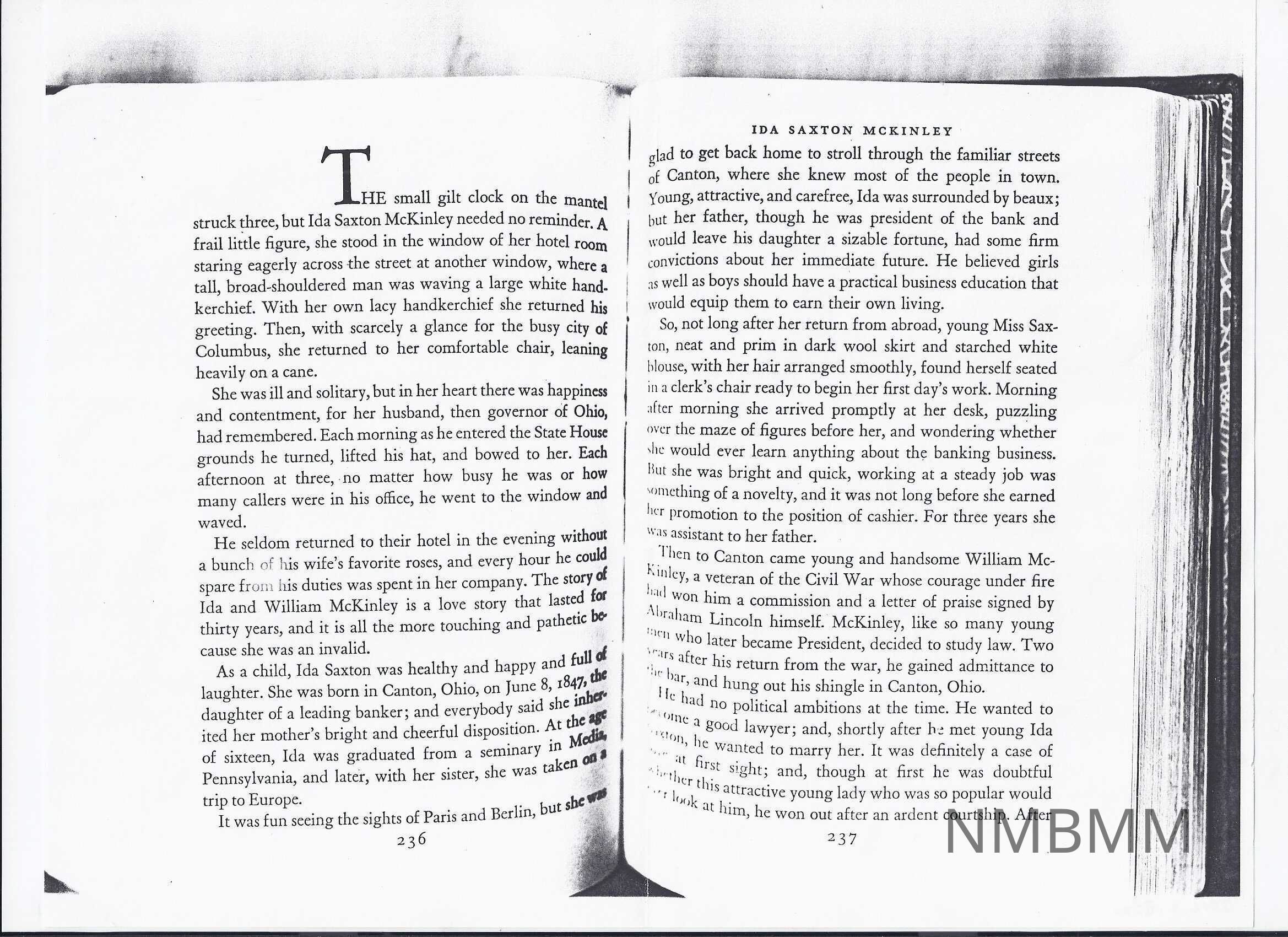
The is one of three pages extracted from 'Ida Saxton McKinley.'
The small gilt clock on the mantel struck three, but Ida Saxton McKinley needed no reminder. A frail little figure, she stood in the window of her hotel room staring eagerly across the street at another window, where a tall, broad-shouldered man was waving a large white handkerchief. With her own lacy handkerchief she returned his greeting. Then, with scarcely a glance for the busy city of Columbus, she returned to her comfortable chair, leaning heavily on a cane.
She was ill and solitary, but in her heart there was happiness and contentment, for her husband, the the governer of Ohio, had remembered. Each morning as he entered the State House grounds he turned, lifted his hat, and bowed at her. Each afternoon at three, no matter how busy he was or how many callers were at his office, he went to the window and waved.
He seldom returned to the hotel in the evening without a bunch of his wife's favorite roses, and for every hour he could spare from his duties was spent in her company. The story of Ida and William McKinley is a love story that lasted for thirty years, and it is all the more touching and pathetic because she was an invalid.
As a child, Ida Saxton was healthy and happy and full of laughter. She was born in Canton, Ohio, on June 8, 1847, the daughter of a leading banker; and everybody said she inherited her mother's bright and cheerful disposition. At the age of sixteen, Ida was graduated from seminary in Media, Pennsylvania, and later, with her sister, she was taken on a trip to Europe. It was fun seeing the sights of Paris and Berlin, but she was glad to get back to stroll through the familiar streets of Canton, where she knew most of the people in town. Young, attractive, and carefree, Ida was surrounded by beaux; but her father, though he was president of a bank and would leave his duaghters a sizable fortune, had some firm convictions about her immediate future. He believed girls as well as boys should have a practical business education that would equip them to earn their own living.
So, not long after her return form abroad, young Miss Saxton, neat and prim in dark wool skirt and starched white blouse, with her hair arranged smoothly, found herself seated in a clerk's chair ready to begin her first day's work. Morning after morning she arrived promptly at her desk, puzzling over the maze of figures before her, and wondering whether she would ever learn anything about the banking business. But she was bright and quick, working at a steady job was something of a novelty, and it was not long before she earned her promotion to the position of cashier. For three years she was assistant to her father.
Then to Canton came young and handsome William McKinley, a vetern of the Civil War whose courage under fire had won him a commission and a letter of praise signed by Abraham Lincoln himself. McKinley, like so many young men who later became President, decided to study law. Two years after his return from the war, he gained admittance to the bar, and hung out his shingle in Canton, Ohio.
He had no political ambitions at the time. He wanted to become a good lawyer; and, shortly after he met young Ida Saxton, he wanted to marry her. It was definitely a case of love at first sight; and, though at first he was doubtful whether this attractive young lady who was so popular would ever look at him, he won out after an ardent courtship. After...Collection
BlaneyAcquisition
Accession
2016.2.0Source or Donor
Eileen B. BlaneyAcquisition Method
Gift