Name/Title
Ida Saxton McKinley, page 2.Entry/Object ID
2016.2.33bScope and Content
This is page two of three pages from 'Ida Saxton McKinley.'
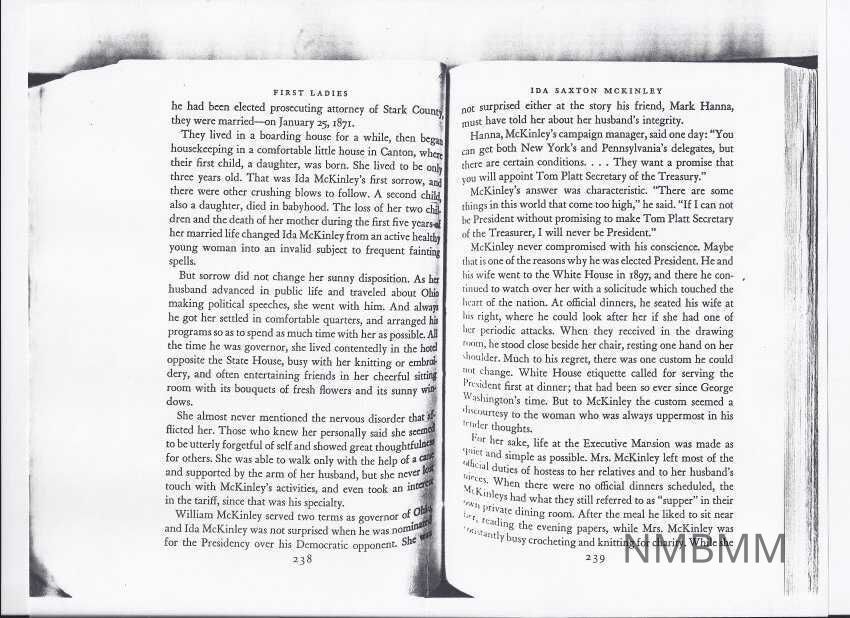
...he had been elected prosecuting attorney of Stark County, they were married -- on January 25, 1871.
They lived in a boarding house for a while, then began housekeeping in a comfortable little house in Canton, where their first child, a daughter, was born. She lived to be only three years old. That was Ida McKinley's first sorrow, and there were other crushing blows to follow. A second child, also a daughter, died in babyhood. The loss of her two children and the death of her mother during the first five years of her married life changed Ida McKinley from a active healthy young woman into an invalid subject to frequent spells.
But sorrow did not change her sunny disposition. As her husband advanced in public life and traveled about Ohio making political speeches, she went with him. And always he got her settled in comfortable quarters, and arranged his progarms so as to spend as much time with her as possible. All the time he was governor, she lived contentedly in the hotel opposite the State House, busy with her knitting or embroidery, and often entertaining friends in her cheerful sitting room with its bouquets of fresh flowers and its sunny windows.
She almost never mentioned the nervous disorder that afflicted her. Those who knew her personally said she seemed to be utterly forgetful of self and showed great thoughtfulness for others. She was able to to walk only with the help of a cane and supported by the arm of her husband, but she never lost touch with McKinley's activities, and even took an interest in the tariff, since that was his specialty.
William McKinley served two terms as governor of Ohio and Ida McKinley was not surprised when he was nominated for the Presidency over his Democratic opponent. She was not surprised either at the story hos friend, Mark Hanna, must have tols her about her husband's integrity.
Hanna, McKinley's campaign manager, said one day: "You can get both New York's and Pennsylvania's delegates, but there are certain conditions.... They want a promise that you will appoint Tom Platt Secretary of the Treasury."
McKinley never compromised with his conscience. Maybe that is one of the reasons why he was elected President. He and his wife went to the White House in 1897, and there he continued to watch over her with a solicitude which touched the heart of the nation. At official dinners, he seated his wife at his right, where he could look after her if she had one of her periodic attacks. When they received in the drawing room, he stood close beside her chair, resting one hand on her shoulder. Much to his regret, there was one custom he could not change. White House etiquette called for serving the President frist dinner; that had been so ever since George Washington's time. But to McKinley the custom seemed a discourtsey to the woman who was always uppermost in his tender thoughts.
For her sake, life at the Executive Mansion was made as quite and simple as possible. Mrs. McKinley left most of the official duties of hostess to her relatives and to her husband's mieces. When there were no official dinners scheduled, the McKinleys had what they still referred to as "supper" in thier own private dining room. After the meal he liked to sit near her, reading the evening papers, while Mrs. McKinley was constantly busy crocheting and knitting for charity. While she...Collection
BlaneyAcquisition
Accession
2016.2.0Source or Donor
Eileen B. BlaneyAcquisition Method
Gift