Name/Title
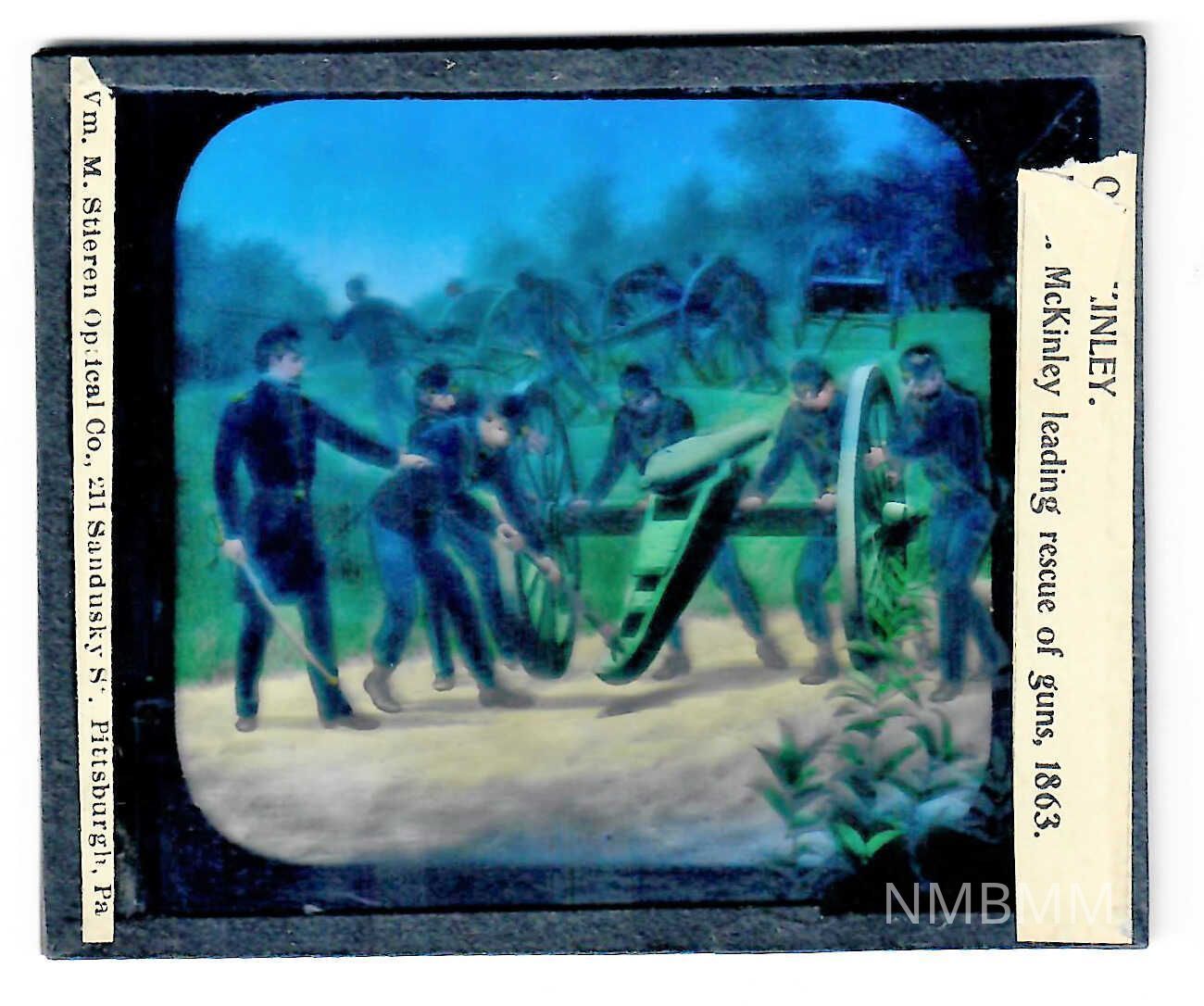
Life of McKinley 3. Lieut McKinley leading rescue of guns, 1863.Entry/Object ID
2015.4.187Description
Colored artist's rendering of McKinley and the 23rd Ohio Volunteer Infantry rescuing a large cannon, at Battle of Kernstown, July 1864 (note date on slide is incorrect). There is a sticker on the front right, showing the title of the slide. There is another sticker on the left side front of the slide showing the publisher's name and address.
The lantern slide has its origins in 17th century optical viewing devices which came to be known as “magic lanterns.” The earliest slides for magic lanterns consisted of hand-painted images on glass, projected by itinerant showmen telling stories about the images that were projected.
They can be recognized by the simple paint areas applied with a brush and the obvious brush strokes.
By the difficult term Decalcomania we describe the technique of transferring pictures from specially prepared paper to surfaces such as glass, china, pottery etc. In the world of magic lanterns we specifically mean the application of this process while making a lantern slide by transferring an image to a square or oblong piece of glass. The technique was used by professional slide makers, but enjoyed a vogue among amateurs too. Images were printed in colors by the chromo-litho principle, and then transfered to glass. Porous paper was coated with a solution of starch, albumen and glycerin. The colored pictures were printed, details first, background last, and then finished by a coat of glue.
http://www.magiclanternsociety.org/about-magic-lanterns/lantern-slides/Collection
ScarmuzziAcquisition
Accession
2015.4.0Source or Donor
Patricia A. ScarmuzziAcquisition Method
Gift