Name/Title
McKinley's words still work.Entry/Object ID
2016.2.91Description
McKinley's words still work, 100 years later, librarian says
McKinley vowed to raise foreign tariffs, balance the federal budget and make improvements to the nation's immigration and civil service laws.
by David Skolnick
Vindicator Trumbull Writer
Niles -- President William McKinley, Niles' most famous citizen, promised to bring the nation together during his inauguration speech 100 years ago Tuesday.
"It will be my constant aim to do nothing, and permit nothing to be done, that will arrest or disturb this growing sentiment of unity and cooperation... but I shall cheerfully do everything possible to promote and increase it," McKinley said March 4, 1897, from the east front of the Capitol.
His topics: McKinley vowed during the speech to get the country out of debt, raise foreign tariffs, reform immigration laws, improve civil service laws and expand the Navy, which he said was "once the pride of the seas."
"Parts of what he said are applicable today," said Ann Yancura, director of the McKinley Memorial Library.
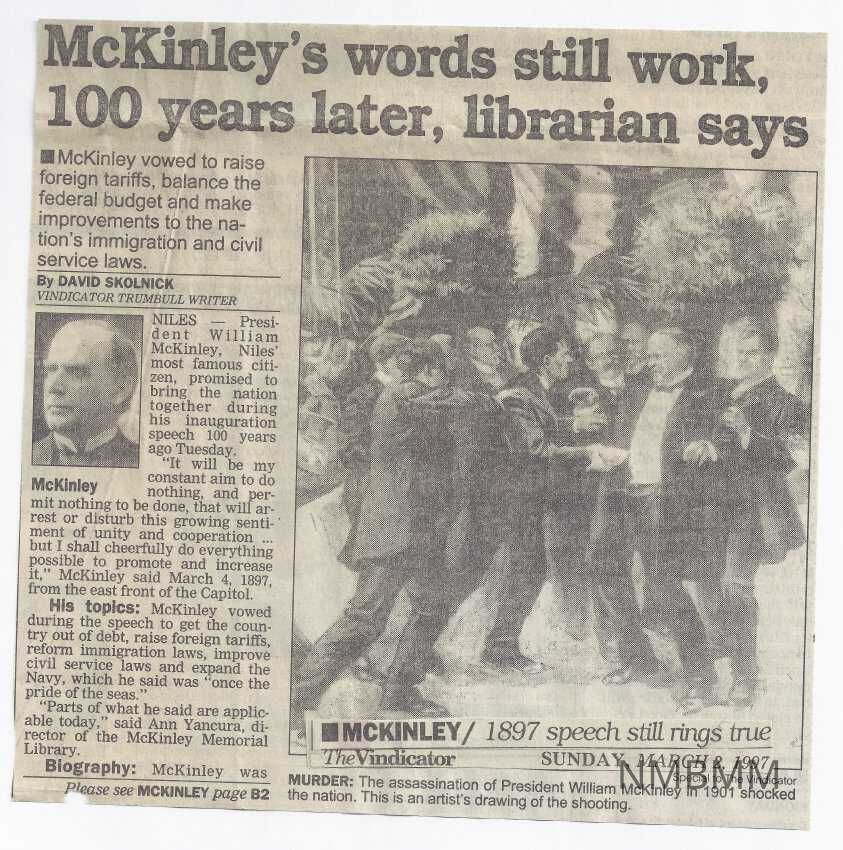
Picture: Murder: The assassination of President William McKinley in 1901 shocked the nation. This is an artist's drawing of the shooting.
Front II: B2
... born Jan. 29, 1843, in a home on South Main Street, where he lived until he was 8, when he moved to Poland.
McKinley attended Allegheny College in Meadville, studied law at Albany Law School in New York and was admitted to the bar in Warren in 1867.
A law practice in Canton led to his election as Stark County prosecuting attorney, a position he held from 1869 until 1871.
McKinley, a Republican, served in the U.S. House of Representatives from 1877 to 1883 and 1885 to 1891 and then as governor of Ohio from 1892 to 1896.
'96 campaign: As the Republicans convened in June 1896 in St. Louis for the nominating convention, McKinley was the front-runner for the position and was nominated the party's presidential candidate on the first ballot.
McKinley's Democratic opponent, William Jennings Bryan of Nebraska , went across the country, traveling 18,000 miles in three months and attempting to drum up support for his campaign.
In contrast, McKinley gave speeches from his front porch in Canton while 1,400 surrogate speakers stumped for him nationwide.
His platform: McKinley won the Nov. 5 1896, election, capturing 51 percent of the popular vote and beating Bryan 271-176 in electoral votes. McKinley, the nation's 25th president, was elected on a platform of a gold standard and protective tariffs.
McKinley's first term was noted for the country's annexation of Hawaii and involvement in the Spanish-American War, both in 1898.
McKinley was hesitant to interfere in Cuba's fight for independence from Spain. During his inaugural address, McKinley said, "War should never be entered upon until every agency of peace has failed; peace is preferable to war in almost every contingency."
What changed this: But when the U.S. battleship Maine exploded and sank Feb. 15, 1898, in Havana Harbor, killing most of the crewmen aboard, McKinley demanded Spain's withdrawal from Cuba.
The cause of the sinking was never determined, but two months later, Congress announced a state of war. The war was over Feb. 6, 1899, with Cuba under U.S. military occupation until a local government was established in 1902.
Final year: McKinley was easily re-elected over Bryan again in 1900. But McKinley's second term was cut short when he was shot Sept. 6, 1901. in Buffalo, N.Y., by anarchist Leon Czolgosz. McKinley died eight days later.
The McKinley National Memorial to honor the slain president was dedicated Oct. 5, 1917, with President Howard Taft leading the ceremony.Collection
BlaneyAcquisition
Accession
2016.2.0Source or Donor
Eileen B. BlaneyAcquisition Method
Gift