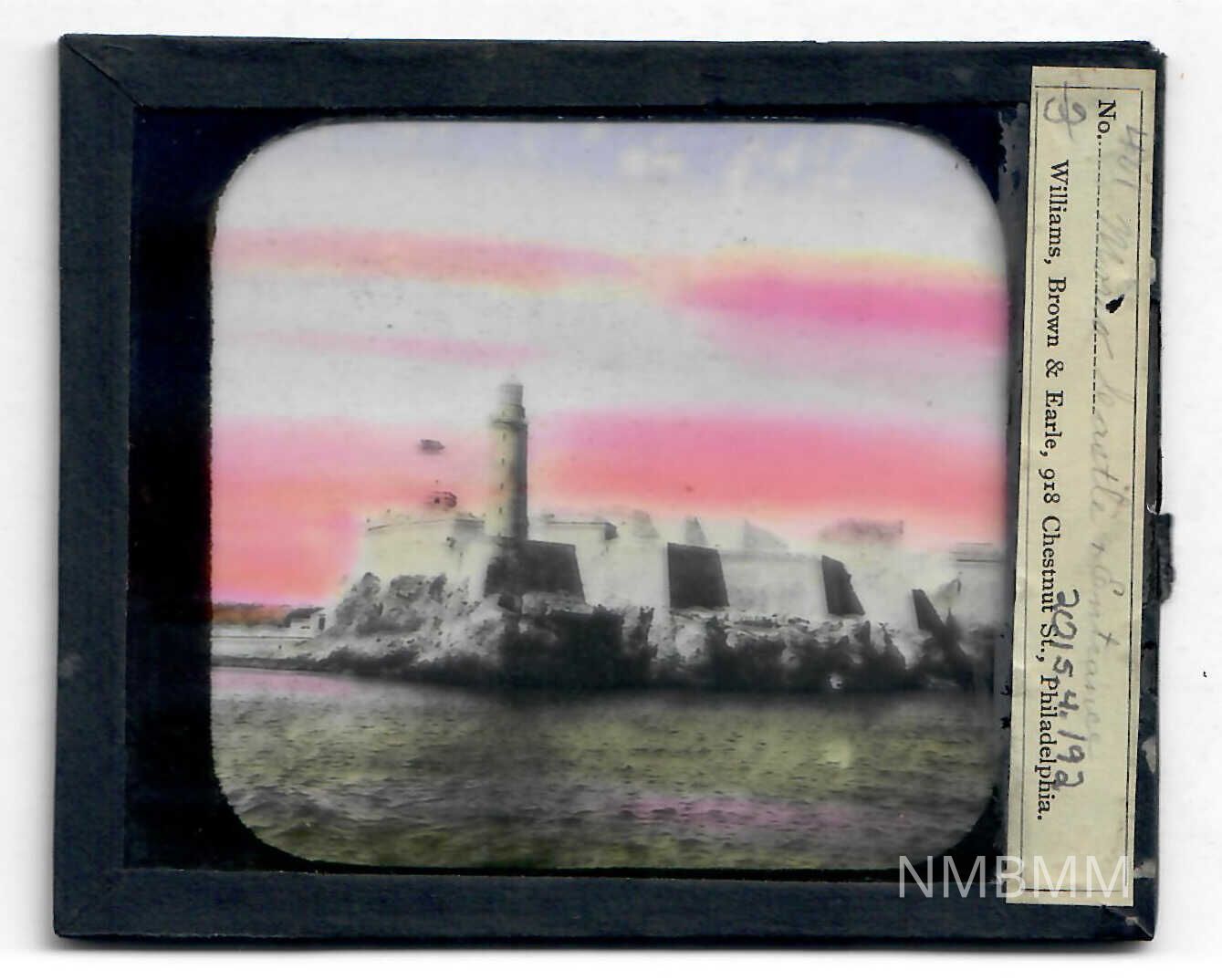
Name/Title
Morro Castle EntranceEntry/Object ID
2015.4.192Description
Sepia with red tint photographic glass slide of Morro Castle. According to the Havana Tour Company (havannatourcompany.com/morro-castle-cuba):
"It’s much easier to simply refer to this magnificent, sprawling building as the Morro Castle Cuba. If you’re feeling brave, you might want to attempt to call it by its proper Spanish name: Castillo de los Tres Reyes Magos del Morro. The city of Havana (which was a Spanish territory at the time) needed protection from the regular unfriendly forces who sailed into the harbor, and so 1589 saw the construction of the Morro Castle Cuba. While the castle was usable shortly thereafter, it wasn’t deemed to be finished until 1630, and numerous additions have been constructed over the centuries.
Perhaps one of the most remarkable features of the castle in its role of defending the city was a massive chain. This chain stretched across the mouth of the harbor and could be pulled up once unwelcome ships were spotted. This chain essentially closed the harbor, and if they were lucky, it could also cause a fair amount of damage to those invading boats. The chain extended across the mouth of the harbor and was connected to the equally lovely La Punta Castle. The chain was put into place in 1630, once the Morro Castle was finished.
Pirates and other hostile foreign forces were less of a problem in recent times. Certainly, Cuba wasn’t on the best of terms with the US, and there were times when it seemed like the island nation would be engulfed in yet another conflict.
But the Cuban Missile Crisis didn’t involve foreign forces sailing into Havana’s harbor, so the castle was no longer used for its intended purpose. The solid nature of the building and its strategic location made it extremely useful as a prison. A number of opponents to the government were imprisoned here, and escape was practically impossible.
Nowadays, it’s mostly cargo ships and cruise ships that make their way into Havana’s harbor. These boats are more than welcome, and they deposit eager visitors in the city, ready to experience the delights of the city. A watchtower is no longer needed (and the original one was destroyed when the British captured the castle), but the castle’s elevated position is still helpful for keeping an eye on the harbor.
The city port authorities have an office here, and you couldn’t think of a nicer place to go to work each day. There is also a lighthouse, and it’s funny to think that something that was added in the 1800s is considered to be a modern development. When you think of how old the castle is, this certainly makes sense.
Don’t be frightened if you happen to be visiting the castle in the evening. Cannons are fired each night at 9pm. This was the signal that the city walls of Havana needed to be closed for the night.
Havana has of course extended far beyond these original city walls, and it definitely doesn’t close up for the night at 9pm. Sometimes it feels like it doesn’t close at all! The castle operates as a museum and you can explore its depths for a small fee. This is definitely interesting, but the real appeal of the Morro Castle Cuba is to walk around its upper battlements.
You can stroll around the top of the castle, enjoy a sensational view and wonder what it must have been like to look out over the ocean and see a fleet of foreign war boats making their way towards you. “Quick! The pirates are coming! Time to raise the chain…” "
The lantern slide has its origins in 17th century optical viewing devices which came to be known as “magic lanterns.” The earliest slides for magic lanterns consisted of hand-painted images on glass, projected by itinerant showmen telling stories about the images that were projected.
They can be recognized by the simple paint areas applied with a brush and the obvious brush strokes.
By the difficult term Decalcomania we describe the technique of transferring pictures from specially prepared paper to surfaces such as glass, china, pottery etc. In the world of magic lanterns we specifically mean the application of this process while making a lantern slide by transferring an image to a square or oblong piece of glass. The technique was used by professional slide makers, but enjoyed a vogue among amateurs too. Images were printed in colors by the chromo-litho principle, and then transfered to glass. Porous paper was coated with a solution of starch, albumen and glycerin. The colored pictures were printed, details first, background last, and then finished by a coat of glue.
http://www.magiclanternsociety.org/about-magic-lanterns/lantern-slides/Collection
ScarmuzziAcquisition
Accession
2015.4.0Source or Donor
Patricia A. ScarmuzziAcquisition Method
Gift