Name/Title
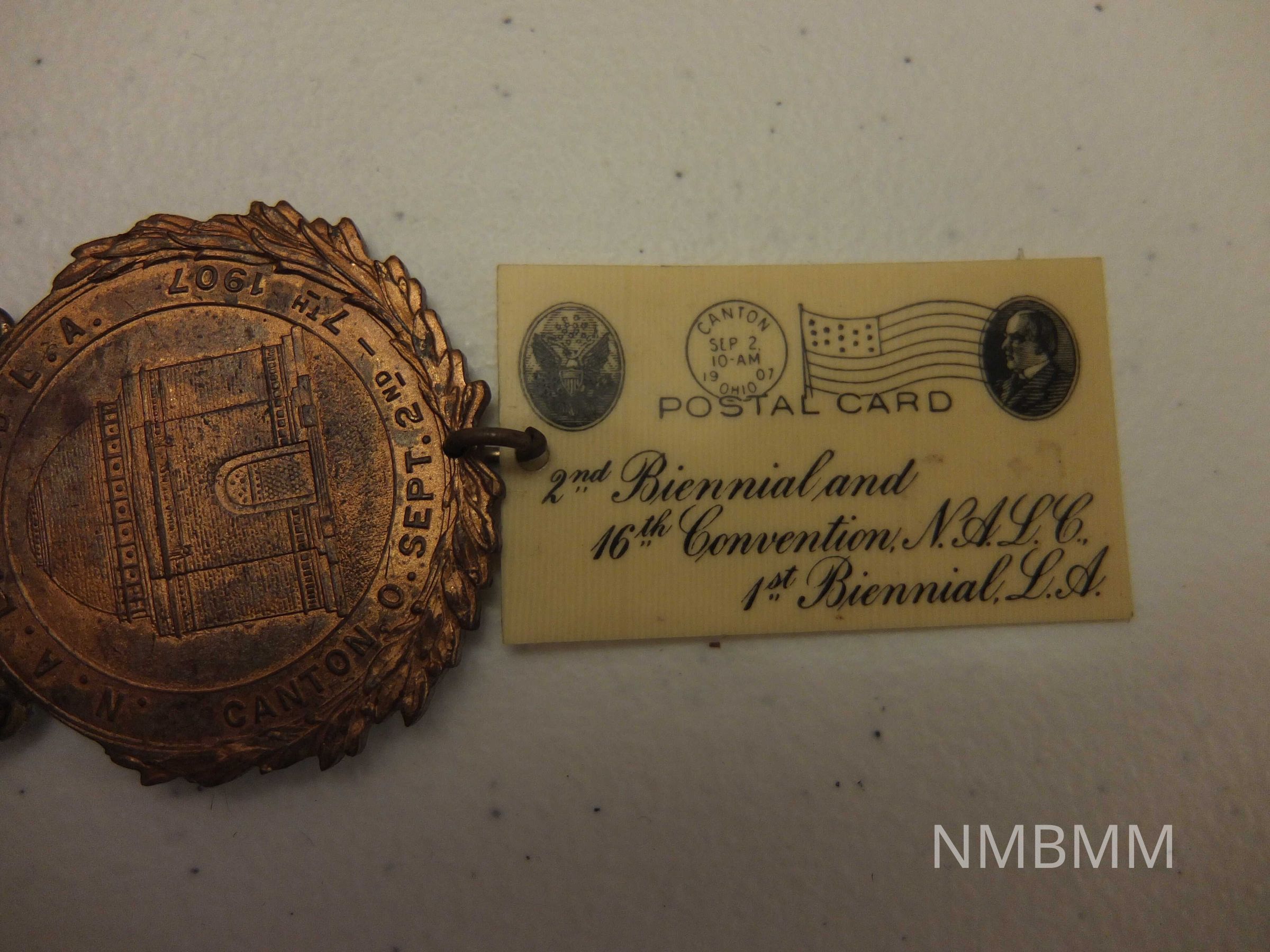
Ohio N.A.L.C. and L.A. 1907 convention medal.Entry/Object ID
2010.1.2218bDescription
This is a 3 part brass and celluloid medal from the 2nd Biennial and 16th Convention of the National Association of Letter Carriers (N.A.L.C.), and the 1st Biennial of the Ladies Auxiliary (L.A.) held in Canton, Ohio, from Sept. 2nd-7th, 1907. The President of the N.A.L.C. at the time was William E. Kelly. Nellie Heffelfinger was the first Auxiliary president whose organization was founded in 1905.
The medal consists of a decorative banner measuring 7/8 in. x 1 3/4 in. with the word "OHIO" inscribed on it. The leaves from a Buckeye tree and pods are etched into the metal and each letter in inside a pod. Suspended from the banner by 4 links of chain on either side is a round brass medal measuring 1 3/ in. in diameter. The McKinley Monument is etched into the disc surrounded by a border with words reading "N. A. L. C. And L.A. Canton, O. Sept. 2nd-7th 1907." At the bottom of the disc are leaves extending up and around the sides. Suspended from the disc by a chain link is a celluloid facsimile of a postcard. 1 1/8 in. x 1 7/8 in. A portrait of McKinley is in the upper right hand corner. The presidential seal is located in the upper left hand corner. Between the 2 are a postmark reading "Canton Sept. 2 10-AM 19 -Ohio-07," a sketch of a flag, and the words "Postal Card." Below are three lines of text in script reading, "2nd Biennial and 16th Convention, N.A.L.C., 1st Biennial, L.A."
On the reverse side of the banner is a metal pin for attachment. On the disc part of the medal
in a circular pattern is the manufacturer's marking "The Whitehead & Hoag Co. Newark, N.J." The reverse side of the celluloid facsimile post card is plain with no markings.
The following is information obtained from 2 different websites pertaining to the N.A.L.C. and the L.A. and their conventions.
"Union Administration
Convention history
National biennial conventions
NALC’s national convention is the union’s supreme governing body. The convention meets every two years and elected delegates from every branch across the country are eligible to attend.
At the convention, delegates elected by their local branch consider constitutional amendments, discuss key issues in standing committees, and set national policy for NALC. Delegates also have the opportunity to attend many educational breakfast meetings, workshops, and seminars that are run every day before and after the daily general business sessions. In addition, delegates to every other convention nominate national officers for election.
History
Ever since its founding meeting held in Milwaukee during late August of 1889, NALC members have met in national convention to set the policy and direction of the national union, to discuss political measures that affect letter carriers and their families and to find solutions for problems they face during the course of their working day.
Annual conventions were held every year from 1889 until 1903. Then the union started holding biennial conventions which have continued to the present day, with the exception of skipping one year during World War II."
https://www.nalc.org/union-administration/nalc-convention/conventions-history
The L. A.
"The NALC Auxiliary Collection
1905-1994
Accession No. 1922
The records of the National Ladies’ Auxiliary, known today as the NALC Auxiliary,
were placed in the Archives of Labor and Urban Affairs in 2001 and opened for
research in December of 2006.
In 1905, as delegates to the Fifth National Convention of the National Association of
Letter Carriers met in Portland, OR, a group of women—wives, daughters, mothers
and sisters of letter carriers-also met in Portland with the intention of forming a
national women’s auxiliary. Seventy-two women from twenty-six states attended
this founding meeting and, on September 5, 1905, the National Ladies’ Auxiliary
was established. Nellie Heffelfinger, of Los Angeles, was unanimously elected the
first president. The objectives of the organization were to provide a social network
for Auxiliary members and their families, collectively pursue charitable works and,
with the strength of their numbers—despite the fact that they, as women, could not
vote—assist in gaining favorable legislation to improve working conditions for letter
carriers and improve the lives of both active and retired letter carriers and their
families."
http://reuther.wayne.edu/files/LR001922_0.pdf
More information may be found at the websites listed.Collection
BechtelAcquisition
Accession
2010.1Source or Donor
Mr. BechtelAcquisition Method
Gift/PurchaseCredit Line
BECHTEL