Name/Title
William McKinley: man of the people.Entry/Object ID
2016.2.97Description
Front:
McKinley news
Vol. X No. 1
McKinley Day
January 29, 1994
McKinley Day celebrations at the muesum this year will be held on Saturday, January 29, the date of McKinley's 151st birthday. Many special activities are planned for the day including pioneer crafts and cooking demonstrations, Civil War reenactment exercises and the Presidential Wreath Laying Ceremony. Many muesum docents will wear their period costumes making history come alive.
Members of the Canton Exchange Club will join us in celebrating McKinley Day. Flags will be passed out to children for the Wreath Laying Ceremony compliments of the Exchange Club's Giveakidaflagtowave Program. The flags are a welcome addition to ceremonies honoring the memory of our nation's twenty-fifth president.
William McKinley's experience as a Civil War soldier (he served with the 23rd O.V.I.) can be better understood through visits with the 8th Ohio Volunteer Infantry, a local Civil War reenactment group. The group will march to the memorial to participate in the Wreath Laying Ceremony. Throughout the afternoon they will also interact with visitors, give demonstrations, deliver a recruitment speech and set uo their encampment. The Street of Shops really comes to life with so many soldiers in uniform.
McKinley Day has evolved into a very special annual occasion at the McKinley Muesum both to honor President McKinley on his birthday and to promote our rich historical heritage. Please join us for the celebration.
Inside:
William McKinley: Man of the People
by Bill Wyss, Curator/Historian
Since one of the major components of the museum's mission is to honor the memory of President William McKinley, it is very appropiate that the anniversary of his birthday (January 29, 1843) be properly observed. The current exhibition concentrates on McKinley's relationships with people from variety of backgrounds. In a time of significant class conflict, he moved easily among citizens of all walks of life. McKinley's interactions with the public is examined through artifacts and photographs.
Mark Twain referred to the post Civil War period as the "Gilded Age." It was a time of rapid industrial expansion when great wealth was generated in America. Families such as the Rockefellers, Carnegies and Vanderbilts amassed huge fortunes and constructed lavish homes to demostrate their position in society. At the same time, industrial workers often lived in very modest conditions and immigrants who flocked to the New World with hopes of prosperity frequently resided in urban slums or poorly constructed company housing. The disparity of wealth between the successful industrialists and the common laborers bred a social tension that frequently erupted into violent strikes, often put down bloodily by state militias. After the Panic of 1893 resulted in dramatic pay cuts for those lucky enough to hold onto their jobs, political leaders like Governor McKinley were placed in very difficult circumstances, They were charged with maintaining order, while attempting to treat both sides fairly. McKinley biographer Margaret Leech observed that, "the industrial warfare that followed the Panic of 1893 earned most men in public life the hatred of either conservative citizens or labor groups. McKinley, to a remarkable degree, succeeded in retaining the respect of both sides."
From the time of the Canton legal practice, William McKinley had demonstrated a willingness to stand by unpopular causes, if he judged them to be proper. In 1876 he defended a group of coal miners from Massillon who had been jailed for participating in a roit during a strike. His unwavering support for high import tariffs during his Congressional years could be explained by his adherence to principles. In the long-run, he believed that protectionism favored both industrialists and workers. Even when the McKinley Tariff Act of 1890 contributed to his election defeat, he remained convinced that his policy was correct. McKinley's election as governor the next year vindicated that position.
Other examples of McKinley's ability to interact with diverse elements of the community included his attitudes on race, region and sex. As a soldier in the Civil War, William McKinley became an abolitionists and ardent supporter of President Lincoln. In addition, he shared Lincoln's belief in a moderate reconstruction of the South that would emphasize justice rather than punishment. McKinley's progressive opinion of women's rights was demonstrated by his support of the Women's Christian Temperance Union (WCTU). As prosecuting attorney for Stark County, he attempted to eradicate illegal alcohol sales. For a number of years, he was a leading speaker on behalf of the local temperance movement.
Even though McKinley's sense of justice had caused him to side with many unpopular groups throughout his career some historians have described him as a "tool of the rich." They viewed his relationship with industrialist Mark Hanna as one of a political boss and his puppet. It is true Hanna was able to solicit the campaign contributions of many wealthy supporters in 1896. However, recent scholarship has revealed that the condidate was clearly in command and that the McKinley-Hanna partnership was based upon mutual respect. Hanna offered campaign strategy assistance, but policy decisions rested with McKinley.
After four years of depression resulting from the Panic of 1893, the policies of the McKinley Administration restored prosperity to the nation. Obviously this benefited the wealthy, but also dramatically improved the lives of industrial laborers. The President favored cooperation with organized labor and appointed two union leaders to his administration. In addition, Samuel Gompers, who served as President of the American Federation of Labor, was invited to the White House in 1898 where he was asked to submit suggestions for McKinley's annual message to Congress.
Although critics such as William Randolph Hearst attempted to create an image of President McKinley as a politician controlled by the powerful business trusts, his actions contradicted that view. He did not attempt to retreat within the White House, but rather he traveled frequently and sought out the opinions of a wide variety of citizens. Unfortunately, it was McKinley's genuine fondness for the public that ended his life. While attending the Pan-American Exposition in Buffalo, New York, the President was assassinated at a public reception. He died as he had lived, as a man of the people.
Back:
Education Program Gets New Look!
Look for the new education brochure in early January. It is smaller in size, but contains more workshops and programs than ever before. A new title, Discovery 2000, and a new logo have been adopted. Classes are now offered to four age groups of children instead of three and, of course, there are classes and programs for adults. The new brochure will ne mailed in early January to those who are active in our education program and to members who have recently joined the Society. If you would like to receive a copy, please call the museum at 455-7043.
Old-ffashioned Sentiments of Love
The museum's beautiful collection of antique valentines will be exhibited January 10 through February 25. Valentine sentiments range from sweet or very serious to whimsical and delightfully humorous. The collection contians a variety of intricate cutouts, mechanical, pullouts, and three dimensional cards. It represents a different view of history, a closer look into the lives and feelings of individuals from an earlier era. The world has changed a great deal since the time of McKinley. These antique cards show that messages to those we love, of Valentines Sentiments, the same.
Wedding Dresses Needed
A very special fund raiser is being planned for April using wedding dresses from the turn-of-the-century to the present. If you have a wedding dress you could model or would permit someone else to model, please call Rosemary Anderson at 455-7043.
There is also a "McKinley's Titles Puzzle"
Fresh Look
Over the last several months much has been done to give the museum a fresh look. Volunteers and staff members have donated their time and many supplies were purchased by "angels."
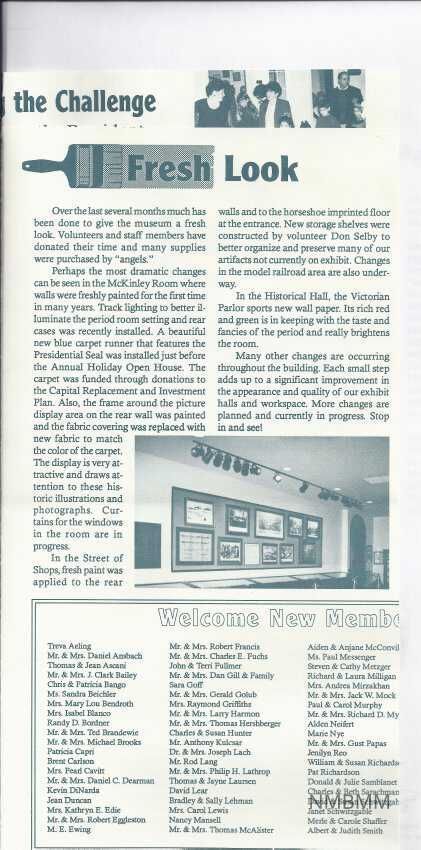
Perhaps the most dramatic changes can be seen in the McKinley Room where walls were freshly painted for the first time in many years. Track lighting to better illuminate the period room setting and rear cases was recently installed. A beautiful new blue carpet runner that features the Presidential Seal was installed just before the Annual Holiday Open House. The carpet was funded through donations to the Capital Replacement and Investment Plan. Also, the frame around the picture display area on the rear wall was painted and the fabric covering was replaced with new fabric to match the color of the carpet. The display is very attractive and draws attention to these historic illustrations and photographs. Curtains for the windows in the room are in progress.
In the Street of Shops, fresh paint was applied to the rear walls and to the horseshoe imprinted floor at the entrance. New storage shelves were constructed by volunteer Don Selby to better organize and preserve many of our artifacts not currently on exhibit. Changes in the model railroad area are aslo underway.
In the Historical Hall, the Victorian Parlor sports new wall paper. Its rich red and green is in keeping with the taste and fancies of the period and really brightens the room.
Many other changes are occurring throughout the building. Each small step adds up to a significant improvement in the appearance and quality of our exhibit halls and workspace. More changes are planned and currently in progress. Stop in and see!Collection
BlaneyAcquisition
Accession
2016.2.0Source or Donor
Eileen B. BlaneyAcquisition Method
Gift