Name/Title
Benicia's Water SupplyEntry/Object ID
2008.011.0006Scope and Content
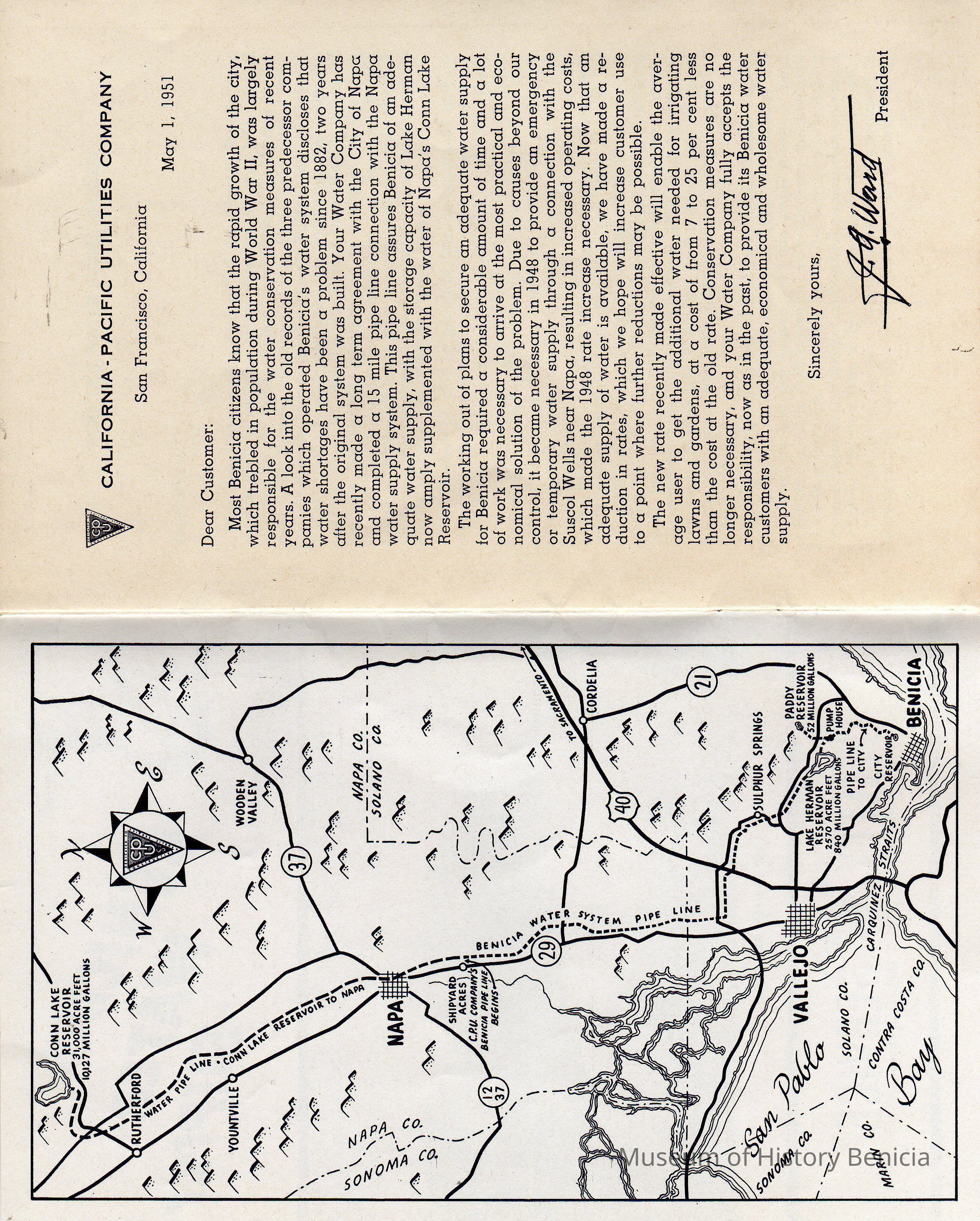
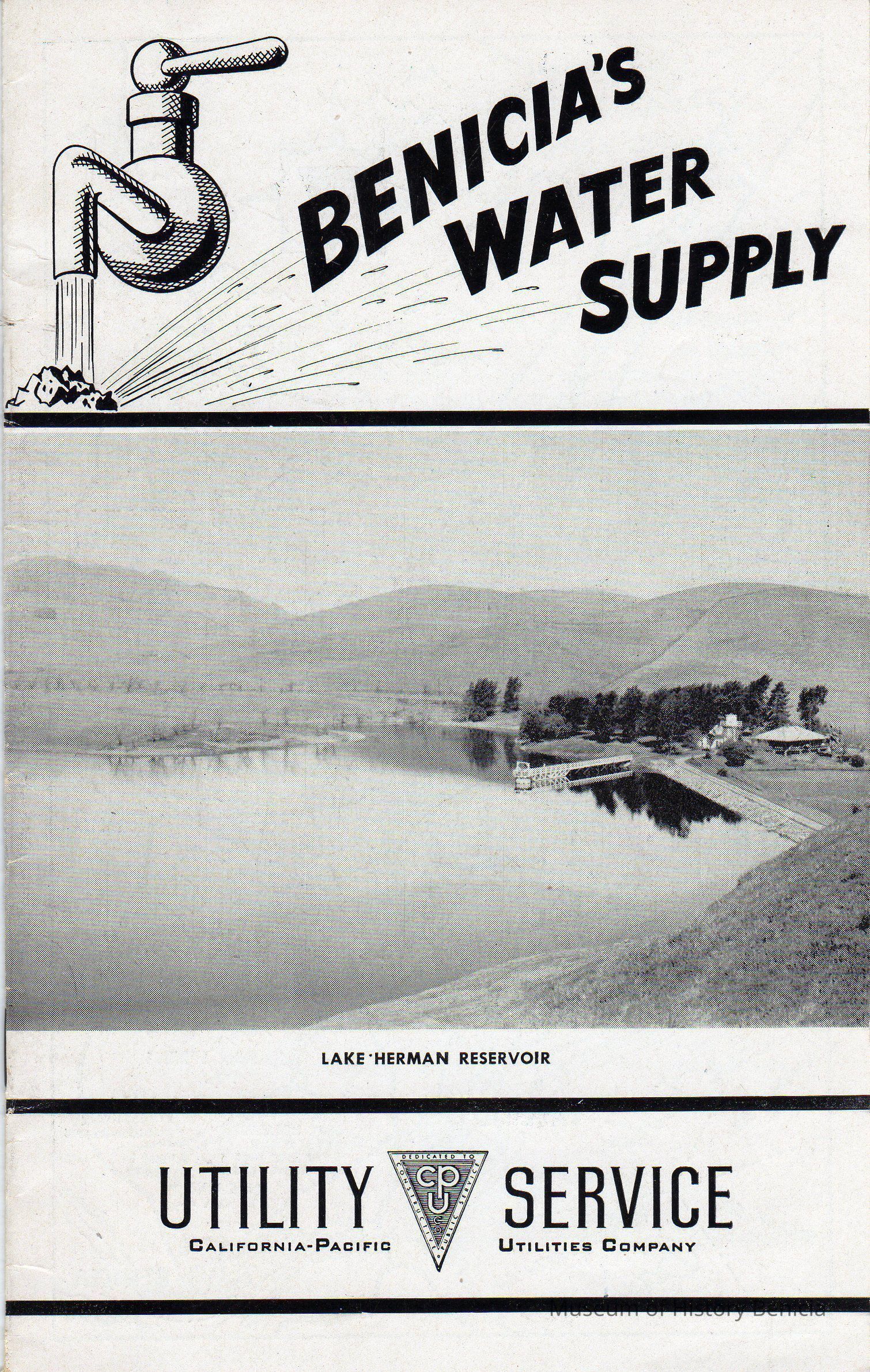
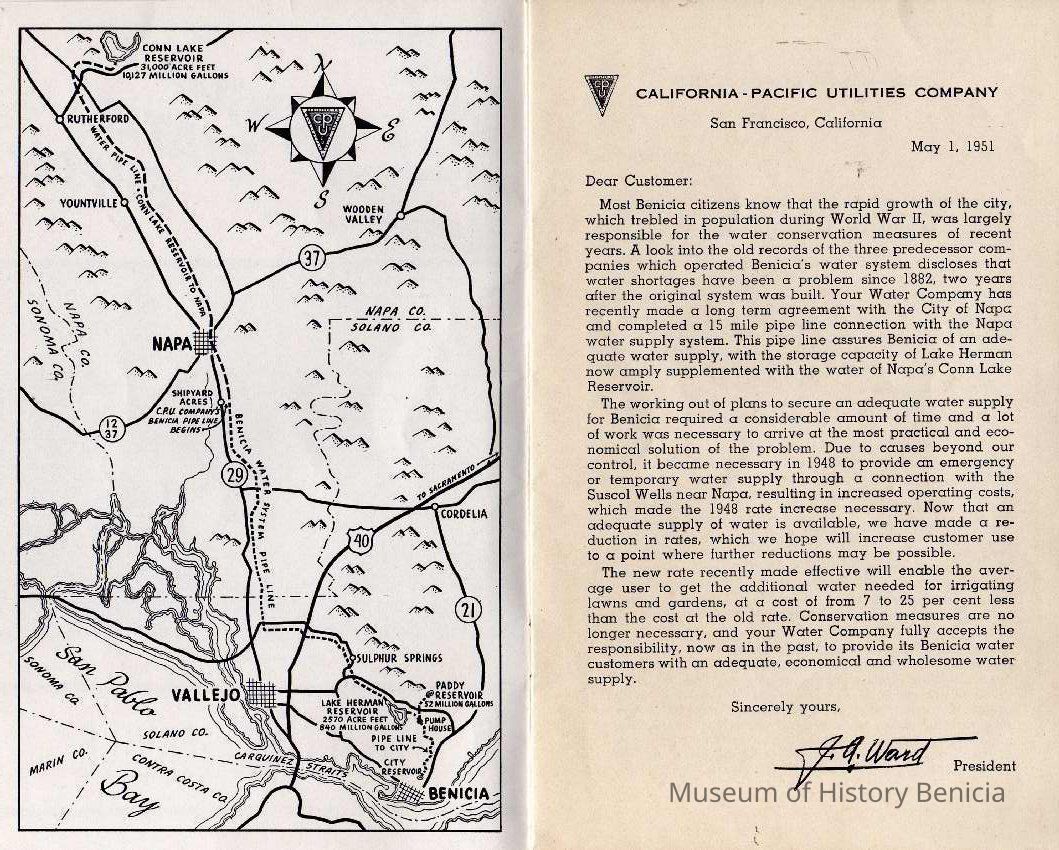
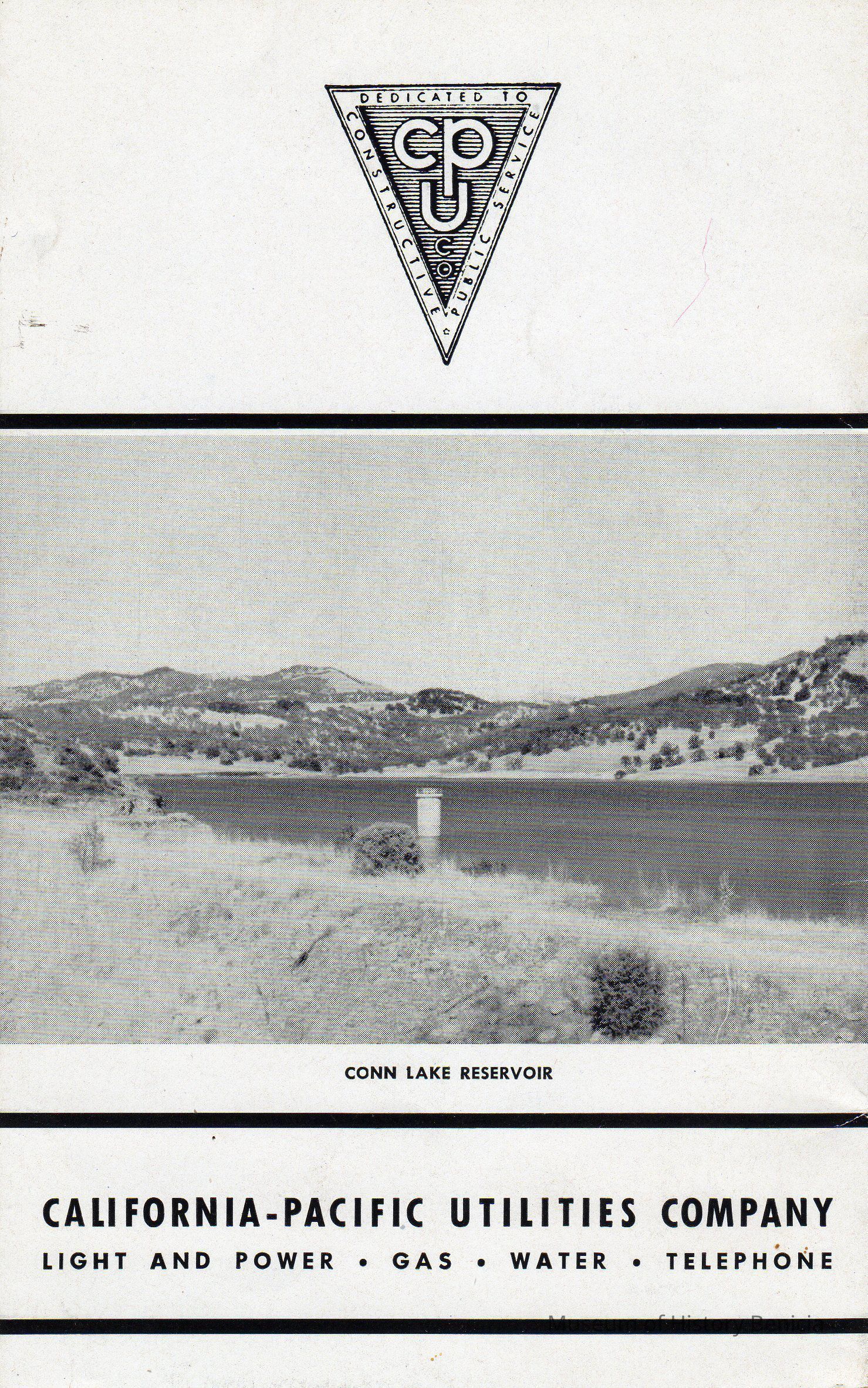
Published by the Utility Service of California-Pacific Utilities Company. Benicia's Water Supply with a b/w photograph of Lake Herman Reservoir. Inside is a letter from the President of the company dated May 1, 1951. A brief history of Benicia's water supply system, its source, and everyday questions and answers about the water business.
From the booklet:
Benicia's Water Supply System Historical:
The first water works system for the City of Benicia was built in 1880, thirty-three years after the city was laid out and founded by Dr. Robert Semple and Thomas O. Larkin in the year 1847. Benicia, as many of you know, was named after Senora Benicia Francesca Carrillo de Vallejo, wife of General Vallejo, who deeded the town site to these men, with the express provision that the city should be named in honor of his wife. Benicia was incorporated as a city of the 6th class in 1850. As the main terminus of the Southern Pacific Railroad, where all trains from the east and the north stopped for transportation across the Sacramento River at Carquinez Straits by train ferry, the city grew rapidly.
On October 10, 1879, a group of citizens organized and incorporated the first water company. It was known as the Benicia Water Company, and was capitalized at $30,000. These men acquired water rights on Paddy Ranch Creek and Sulphur Springs Creek, north of the city in October of 1879. They also secured right of way for a pipe line to the site of the first city reservoir atop what was then known as Kaiser Hill. This reservoir site was purchased from Mr. Kaiser for the sum of $50. The next location of a city resevoir, at East Third and W Streets, is still the site of the present city resevoir of 1,555,000 gallon capacity. In December 1879 the Company hired a Mr. Delaney to build Sulphur Springs Dam, a pumping plant, the pipe lines and the first reservoir mentioned above. Construction work began in January 1880 and by summer that year all pipe had been laid in the streets and alleys of the city, and water was first pumped into the distribution mains June 25, 1880.
The new water company almost immediately began experiencing a shortage of water supply. In 1882 the Company experienced its first dry season, and the small reservoir back of Sulphur Springs Dam ran dry. Two wells were quickly sunk just below the Dam, to supply the water requirements during the remainder of that season and until the small reservoir back of Sulphur Springs Dam again became filled with water during the fall and winter months. Additional land was purchased in November 1883 from the D. N. Hastings ranch along Paddy Ranch Creek, and construction started on Paddy Dam in 1884 was completed in 1885. Paddy Reservoir is still in use and each year contributes its storage capacity of 52 million gallons to Benicia's water supply.
As the city grew, and more water was used by the increasing population, the two reservoirs of Sulphur Springs Dam and Paddy Dam also failed to supply the water needed. The dry seasons of 1882-3 and 1887-88 again found Benicia short of water. The dry season continued through the next winter season of 1888-89 and, according to old Company ledger records, became so acute as to make it necessary to barge water from the San Joaquin River. During this period, a new pumping station was built and new cast iron mains were laid from Paddy Reservoir to the pumping plant and to the city reservoir on Kaiser Hill.
The rapid growth of the city during the five years prior to the turn of the century required the laying of numerous distribution mains and the addition of various other improvements, including the construction of a water intake tower in Paddy Reservoir. These improvements and additions to the water works system, of course, cost the owners and shareholders considerable money. The Company had no net income available for dividends, and all available funds were needed to pay the cost of the extensive additions to the system. The shareholder, consequently, soon decided it would be necessary to organize a new company, as they realized the thirty thousand dollar capitalization of the original company was literally but a drop in the bucket. A new company, which purchased the assets of the water company for $200,000, was therefore organized and incorporated April 27, 1901, under the name of Benicia Water Works, Inc.
As the city continued to grow, it became evident that Paddy Reservoir and the small reservoir back of the dame on Sulphur Springs Creek would be inadequate to furnish the requirements of a growing population. Plans were made for the construction of a large dam and the creation of a new reservoir. Surveys were made, water rights acquired and additional land was purchased. it soon became evident to the new company that it would be impossible to finance all the improvements needed out of revenues, and that a considerable sum of new money would be required. Accordingly, a third company was organized and incorporated January 24, 1905. The new company, capitalized at $500,000, took the name of the original company, the Benicia Water Company, and absorbed the Benicia Water Works, Inc. on May 1, 1905. In addition to the new financing arragned for by the sale of shares, a part of the new money needed for the necessary extensive additions was raised by issuing $160,000 of 5% bonds.
The first President of the Company was Mr. Herbert Kullman, an official of Benicia's largest industry, the Kullman-Salz and Company Tannery. Other officials of the tannery, who were also officials of the Benicia Water Company, included Mr. Ansley K. Salz, who was President of the Company for many years, beginning in 1910. He will be remembered by many of Benicia's older citizens. In addition to the ownership of shares in the water company by various tannery employees and officials, Kullman Salz & Company also bought a large number of shares to provide the capital needed to finance the extensive improvement to Benicia's water supply system. This is indicative of the importance of an adequate water supply system to any city whose progress depends upon the growth of its industrial plants. Here we have an example of industry helping finance a water system so it can grow and help build the community where its employees live. Benicia citizens have long been fortunate to have an investor-owned, taxpaying company in control of their water supply system.
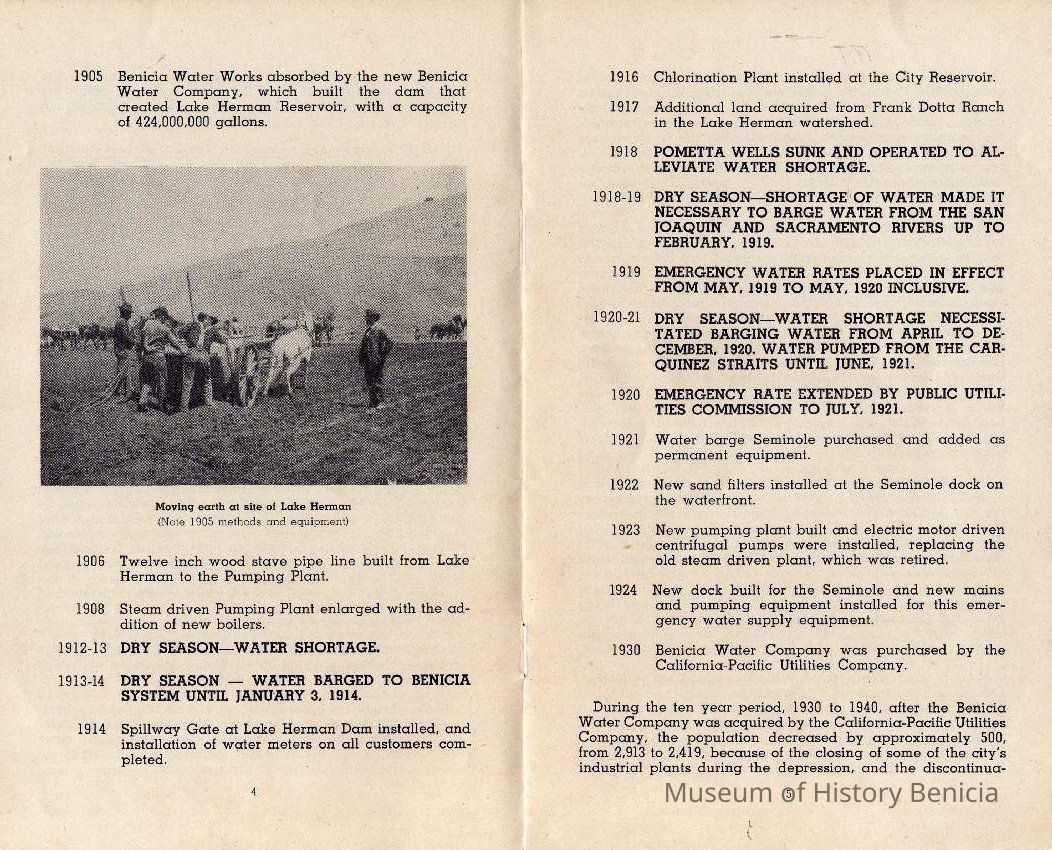
The continued growth of the City of Benicia, and the addition of most distribution mains and scores of new customers made it evident that greater water storage capacity was urgently needed. Additional land and water rights were acquired along Sulphur Springs Creek and Mr. Herman Schussler, a prominet San Francisco civil and hydraulic engineer, was engaged to design the dam which created the lake which was named after him. Lake Herman Dam and Reservoir were built under Mr. Schussler's supervision in 1905, and the Benicia Water Company, in the opinion of most citizens of Benicia, was now a going concern that would care for the growing needs of the city without the repetition of the water shortages experienced by the two former companies.
Yet this new company found it necessary to add new facilities continually, and even with its added financial capacity and business management ability, it also began to encounter the difficulties of the previous companies. Company No. 3 soon found that operating a water supply system in a growing community was no bed of roses, and the addition of new facilities, with the spending of thousands of dollars, did not eliminate the water shortages of the early years of Benicia's water supply system, as the following chronology outline will show:
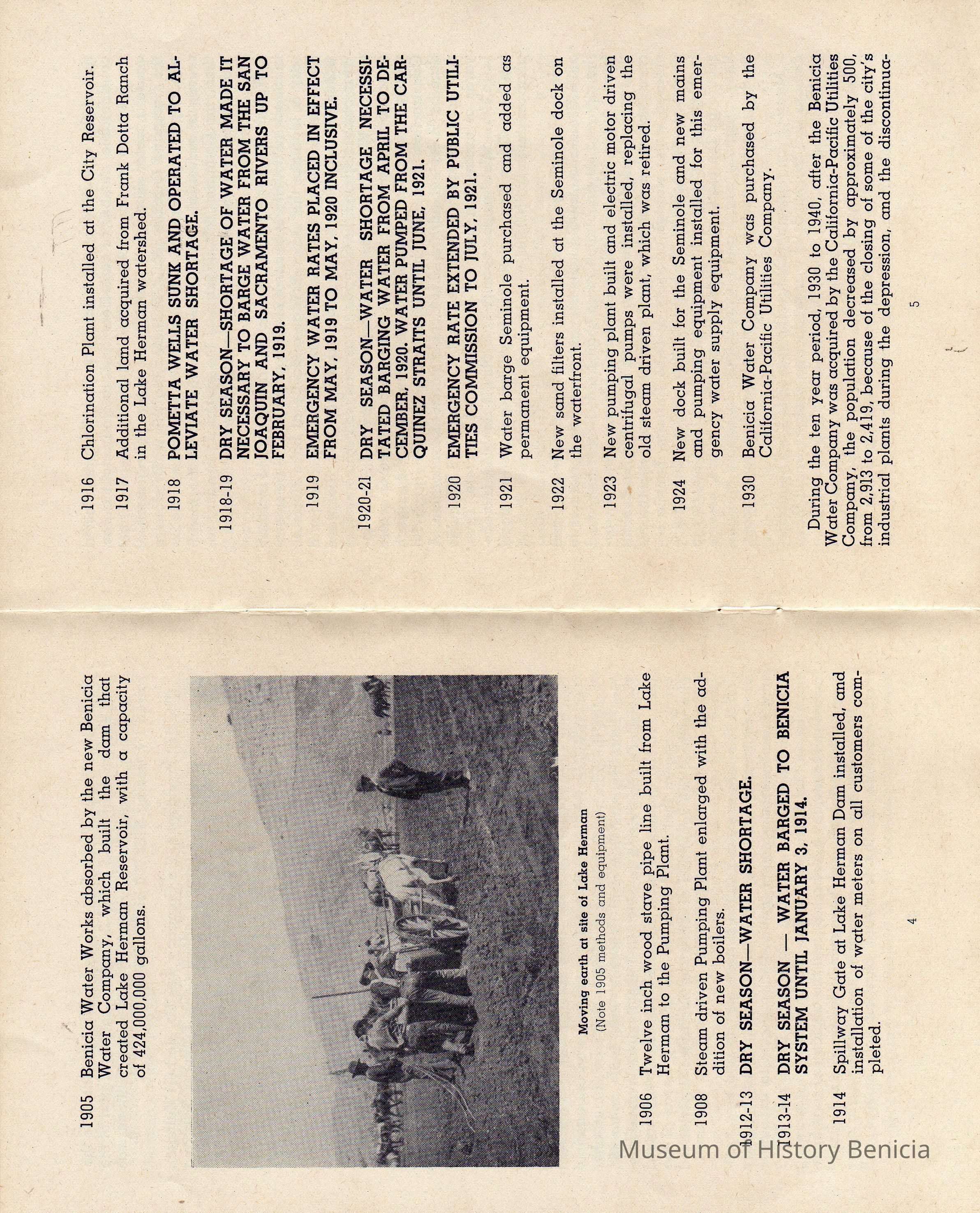
1905: Benicia Water Works absorbed by the new Benicia Water Company, which built the dam that created Lake Herman Reservoir, with a capacity of 424,000,000 gallons.
1906: Twelve inch wood stave pipe line built from Lake Herman to the Pumping Plant.
1908: Steam drivien Pumping Plant enlarged with the addition of new boilers.
1912-13: DRY SEASON -- WATER SHORTAGE
1913-14: DRY SEASON -- WATER BARGED TO BENICIA SYSTEM UNTIL JANUARY 3, 1914.
1914: Spillway Gate at Lake Herman Dam installed, and installation of water meters on all customers completed.
1916: Chlorination Plant installed at the City Reservoir.
1917: Additional land acquired from Frank Dotta Ranch in the Lake Herman watershed.
1918: POMETTA WELLS SUNK AND OPERATED TO ALLEVIATE WATER SHORTAGE.
1918-19: DRY SEASON -- SHORTAGE OF WATER MADE IT NECESSARY TO BARGE WATER FROM THE SAN JOAQUIN AND SACRAMENTO RIVERS UP TO FEBRUARY 1919.
1919: EMERGENCY WATER RATES PLACED IN EFFECT FROM MAY 1919 TO MAY 1920 INCLUSIVE.
1920-21: DRY SEASON -- WATER SHORTAGE NECESSITATED BARGING WATER FROM APRIL TO DECEMBER 1920. WATER PUMPED FROM THE CARQUINEZSTRATES UNTIL JUNE 1921.
1920: EMERGENCY RATE EXTENDED BY PUBLIC UTILITIES COMMISSION TO JULY 1921.
1921: Water barge Seminole purchased and added as permanent equipment.
1922: New sand filters installed at the Seminole dock on the waterfront.
1923: New pumping plant built and electric motor driven centrifugal pumps were installed, replacing the old steam driven plant, which was retired.
1924: New dock built for the Seminole and new mains and pumping equipment installed for this emergency water supply equipment.
1930: Benicia Water Company was purchased by the California-Pacific Utilities Company.
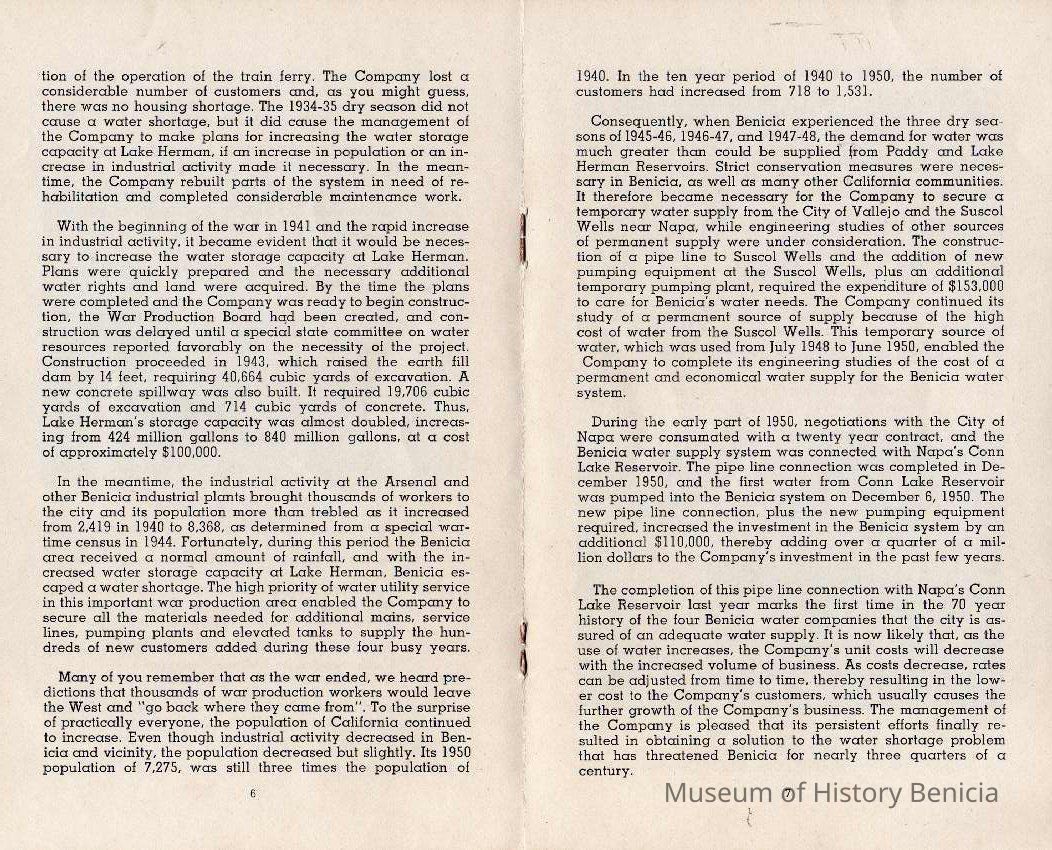
During the ten year period, 1930-1940, after the Benicia Water Company was acquired by the California-Pacific Utilities Company, the population decreased by approximately 500, from 2,913 to 2,419, because of the closing of some of the city's industrial plants during the depression, and the discontinuation of the operation of the train ferry. The Company lost a considerable number of customers and, as you might guess, there was a housing shortage. The 1934-35 dry season did not cause a water shortage, but it did cause the management of the Company to make plans for increasing the water storage capacity at Lake Herman, if an increase in population or an increase in industrial activity made it necessary. In the meantime, the Company rebuilt parts of the system in need of rehabilitation and completed considerable maintenance work.
With the beginning of the war in 1941 and the rapid increase in industrial activity, it became evident that it would be necessary to increase the water storage capacity at Lake Herman. Plans were quickly prepared and the necessary additional water rights and land were acquired. By the time the plans were completed and the Company was ready to begin construction, the War Production Board had been created, and construction was delayed until a special state committee on water resources reported favorably on the necessity of the project. Construction proceeded in 1943, which raised the earth fill dam by 14 feet, requiring 40,664 cubic yards of excavation. A new concrete spillway was also built. It required 19,706 cubic yards of excavation and 714 cubic yards of concrete. Thus, Lake Herman's storage capacity was almost doubled, increasing from 424 million gallons to 840 million gallons, at a cost of approximately $100,000.
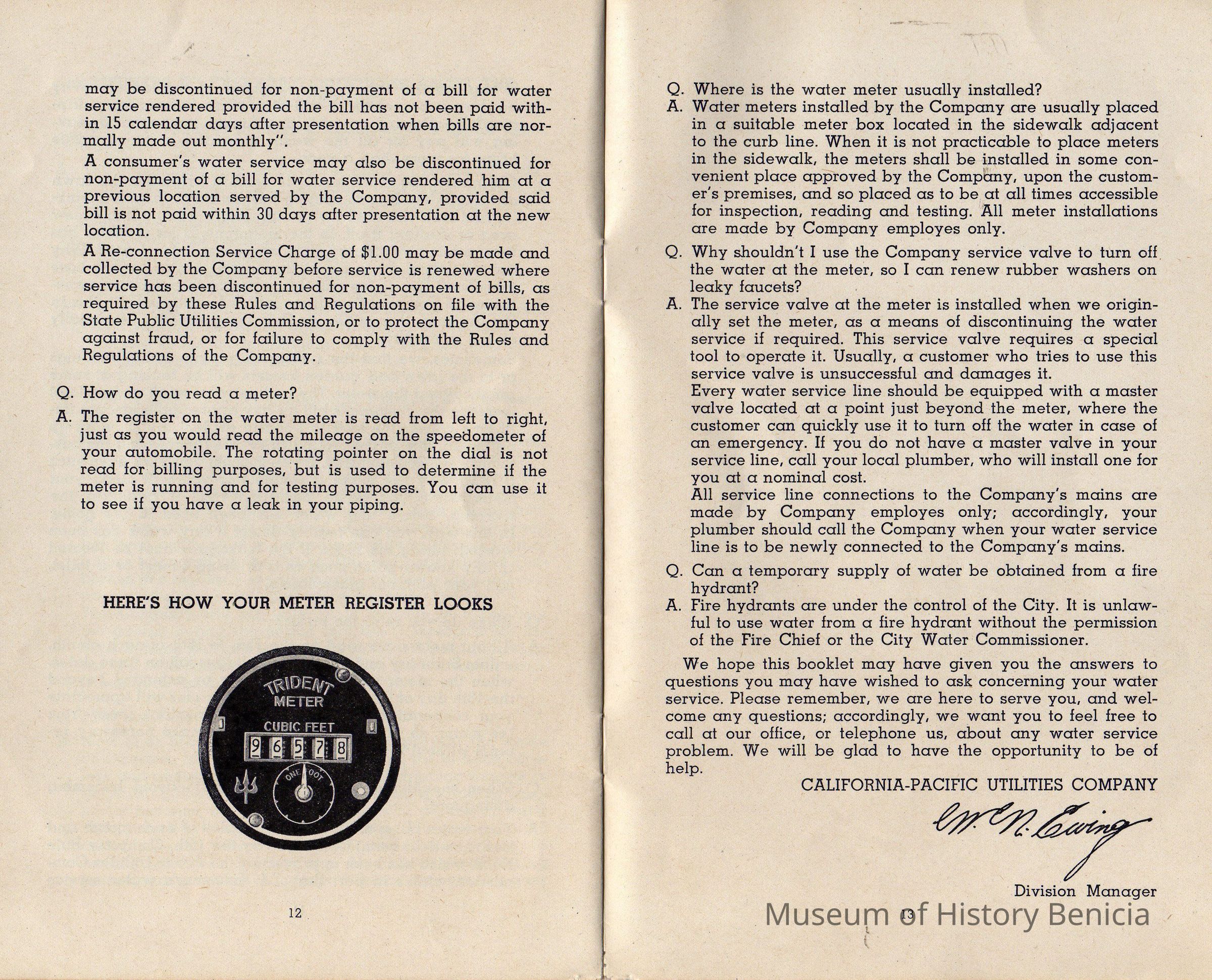
In the meantime, the industrial activity of the Arsenal and other Benicia industrial plants brought thousands of workers to the city and its population more than tripled as it increased from 2,419 to 8,368, as determined from a special wartime census in 1944. Fortunately, during this period the Benicia area received a normal amount of rainfall, and with the increased water storage capacity at Lake Herman, Benicia escaped a water shortage. The high priority of water utility service in this important war production area enabled the Company to secure all the materials needed for additional mains, service lines, pumping plants and elevated tanks to supply the hundreds of new customers added during these four busy years....Collection
Benicia Industrial Collection