Name/Title
Narrow Leaf Willow (Salix longifolia)Entry/Object ID
2021.1.22 BScope and Content
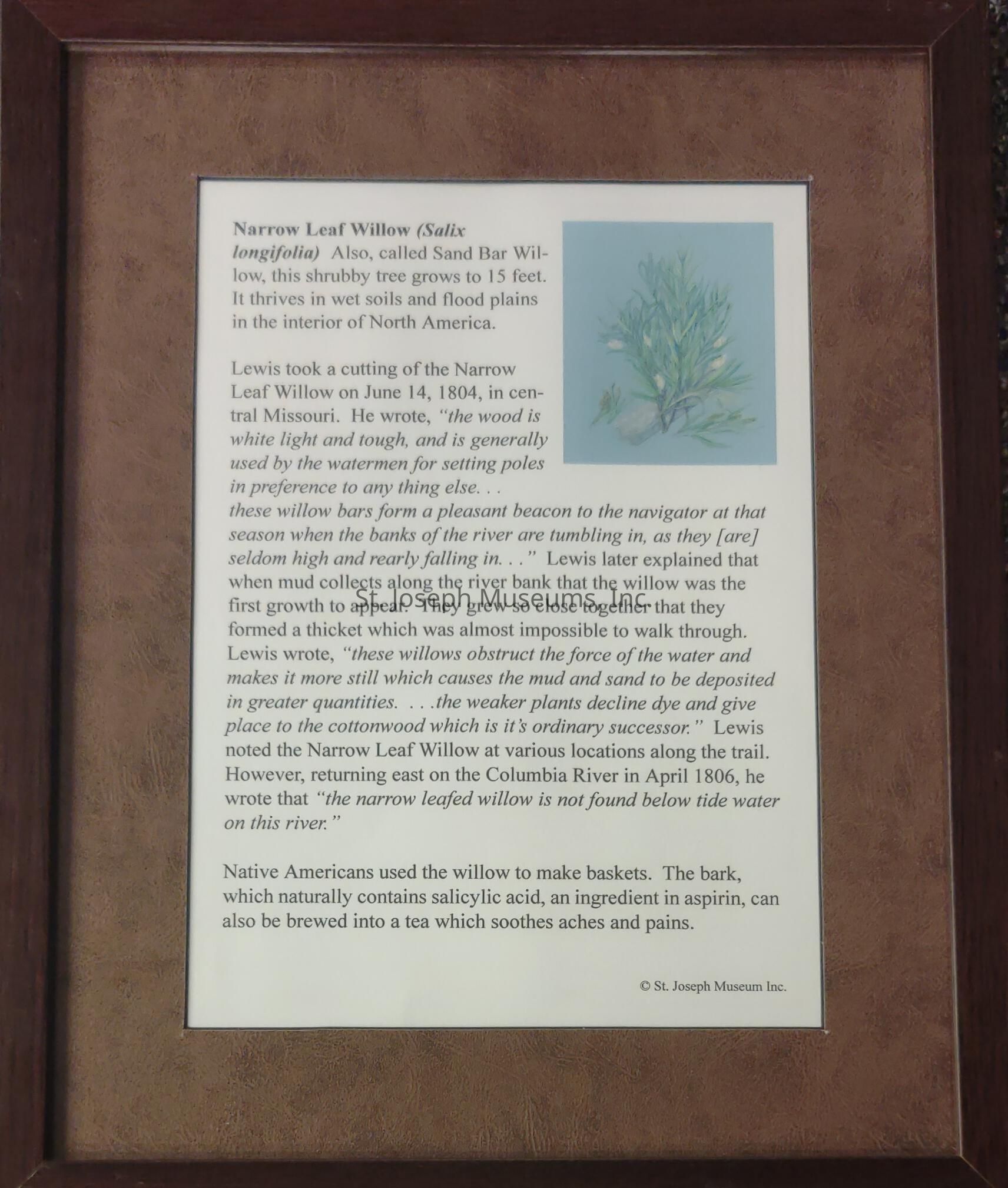
Narrow Leaf Willow (Salix longifolia) plant description, framed.
Also called Sand Bar Willow, this shrubby tree grows to 15 feet. It thrives in wet soils and flood plains in the interior of North America.Context
Originally designed by the St. Joseph Museum in the fall of 2004. Titled "Botanical Wonders of the Uncharted West. The Recorded Flora of the Lewis & Clark Expedition."
Lewis took a cutting of the Narrow Leaf Willow on June 14, 1804, in central Missouri. He wrote, "the wood is white light and tough, and is generally used by the watermen for setting poles in preference to any thing else... these willow bars form a pleasant beacon to the navigator at that season when the banks of the river are tumbling in, as they [are] seldom igh and rearly falling in..." Lewis later explained that when mud collects along the river bank that the willow was the first growth to appear. They grew so close together that they formed a thicket which was almost impossible to walk through. Lewis wrote, "these willows obstruct the force of the water and makes it more still which causes the mud and sand to be deposited in greater quantities... the weaker plants decline dye and give place to the cottonwood which is it's ordinary successor." Lewis noted the Narrow Leaf Willow at various locations along the trail. However, returning east on the Columbia River in April 1806, he wrote that "the narrow leafed willow is not found below tide water on this river."
Native Americans use the willow to make baskets. The bark, which naturally contains salicylic acid, an ingredient in aspirin, can also be brewed into a tea which soothes aches and pains.Collection
Lewis and ClarkLexicon
LOC Thesaurus for Graphic Materials
Botanical drawings, Expeditions & surveysArchive Items Details
Title
Narrow Leaf Willow (Salix longifolia)Creator
Mary L. FletcherDate(s) of Creation
2004Subjects
Plants, Watercolor paintingsParts
Count
2Parts
Watercolor of plant and descriptive label, both framed.Condition
Overall Condition
Very GoodProvenance
Notes
"Botanical Wonders of the Uncharted West" visually depicts how well Lewis followed Jefferson's instructions. In recognition of this achievement, The S. Joseph Museums, Inc. commissioned accomplished artist Mary Fletcher to create fifty (50) selected paintings of flora documented by the Corps during their Journey. These framed watercolor originals are accompanied by similarly framed labels, generated by former Head of Research Jackie Lewin, which describe the corresponding plants with appropriate quotations from the Journals. This collection makes available for study and appreciation plants that were new to Lewis and Clark, but which Native Peoples already recognized as valuable sources of food, medicine, and tools. Some of these still remain a mystery to many, but all will enjoy their beauty, their diverse uses, and their accomplished renderings.