Shoe

Object/Artifact

-

St. Joseph Museums

Name/Title

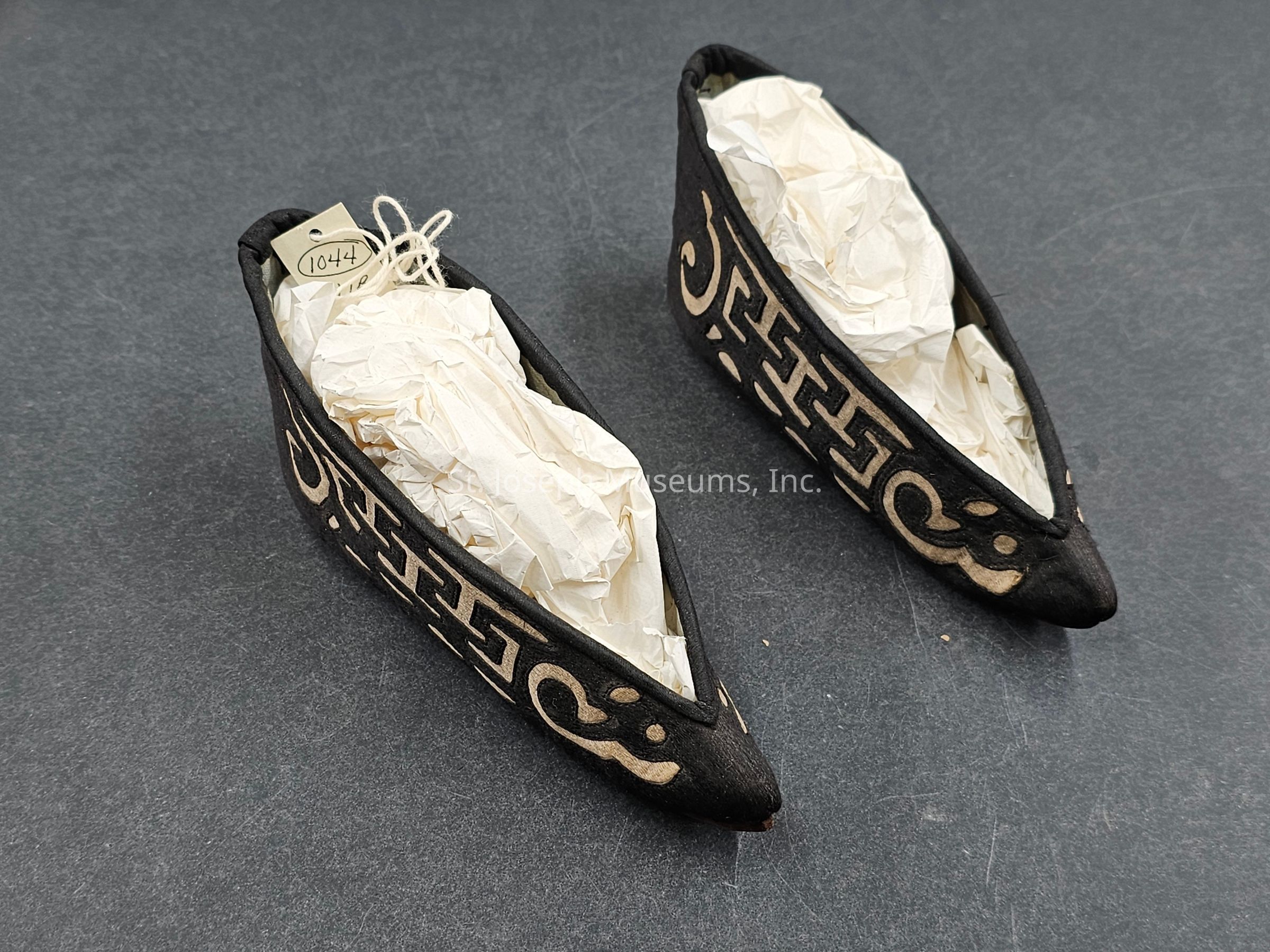
Shoe

Entry/Object ID

420/5545 B

Description

OF NORTHERN CHINESE LADY/PEKING CHINA/DES CUT IN OVERLAY

Collection

ETHNOGRAPHIC/CHINA

Made/Created

Place

Continent

Asia

Ethnography

Culture/Tribe

Chinese
Asian

Lexicon

Nomenclature 4.0

Nomenclature Primary Object Term

Shoe

Nomenclature Sub-Class

Footwear

Nomenclature Class

Clothing

Nomenclature Category

Category 03: Personal Objects

Dimensions

Length

6 in

Parts

Count

1

Condition

Overall Condition

Good

Interpretative Labels

Label Type

Cultural/Historical Context

Label

Ancient China is divided into distinct dynasties, each ruled over by a specific family. The guiding principle for the government of ancient China was called the Mandate of Heaven. The Mandate of Heaven was a philosophy that established whether rulers had the right to rule China. The rulers of ancient China were given vast amounts of power, but they had a moral obligation to use it for the good of their people. If a ruler did not do this, then the country would experience natural disasters. These natural disasters would be a sign to the peasants that the ruler lost the blessing of the gods to rule, and thus it was allowed to overthrow the existing government and install a new dynasty. Each dynasty saw specific achievements and major events. The Zhou dynasty (1046 BCE-256 BCE), for example, saw the formalization of their writing system and the rise of such important philosophers like Confucious, Lao-Tzu, and Sun-Tzu. The Qin Dynasty (221 BCE-206 BCE) began construction on the Great Wall of China. Shi Huangdi, the first emperor of the Qin dynasty, built for himself an enormous tomb which he filled with over 8,000 terracotta warriors to serve him in the afterlife. The Han Dynasty (206 BCE-220 CE) saw the invention of paper, established Confucianism as the exclusive philosophy of the government (a practice that has continued through to modern times), opened the Silk Road which opened trade routes to the rest of Asia and into Europe. The Sui Dynasty (589-618 CE) built the Grand Canal, enlarged the Great Wall, standardized coins across the country, built the army to its largest size, and encouraged the development of literature. The famous story Legend of Hua Mulan is thought to have been written during this time. The Tang Dynasty (618-907 CE) is considered the Golden Age of China, where the country saw an elongated period of peace, during which art, culture, and innovation could flourish. During this time, China also saw its first and only female monarch - Wu Zetian. The Song Dynasty (960 - 1279 CE) saw massive strides in artistic forms, characterized by large landscape paintings. Paper money was used for the first time, movable type was invented to make books and literature widely available and easier to print, traditional Chinese pottery was refined and the quintessential blue and white “China” was made popular, and public schooling was made available to all during this time. The Song Dynasty ended when the Mongols, led by Kublai Khan conquered the area, who established the Yuan Dynasty. There were only two more imperial dynasties that followed, and in 1911 the Republic of China was established.
Research Notes

Person

Tori Zieger

Notes

The practice of foot binding existed in China for thousands of years, beginning in the early 900s CE. The exact origin of the practice is not certain, though there are several legends that discuss how the practice started. While it began as a practice that only upper class women participated in, it soon spread to encompass women of all social classes and in all areas of China. In Chinese culture, the possession of small, bound feet was a very evident physical indicator of desirability, social standing, and whether a woman would make a good wife. It was not just the small feet that created visible indicators that a woman met the societal requirements of the time; the shoes themselves varied greatly. These shoes were hand-made, usually from silk, and highly decorated. The shape of the shoe would vary as well. Some shoes, such as these, had a flat base. Others, like some of the other shoes on display here, would have a slight heel and arch in them. In 1662, the Qing emperor attempted to ban the practice. As a Manchu, the emperor did not grow up as an indigenous Chinese. As such, his attitudes (and those of his court) were very different from the Han Chinese attitudes. The ban did not work. The disparate cultures of the Han and the Manchu people under Qing dynasty rule did not create ideal conditions for such a drastic cultural change that had existed for over 500 years by that point; the Han Chinese saw their culture as vastly superior to the Manchurian invaders and they held footbinding as the epitome example of their cultural superiority. The fact that Han women practiced it and Manchu women were forbidden by law provided a solid difference, a firm line between “us” and “them”, for both sides of the cultural line. In the latter half of the 19th century, the Chinese government again attempted to ban the practice of footbinding. However, this ban was also unsuccessful and the legislation that banned the practice was soon repealed completely in 1902. When the Qing dynasty fell in 1912, the Nationalist government which took power again attempted to ban foot-binding. This time, the ban was relatively successful in major cities that had a large government presence. In the countryside where there was less of a direct political presence saw little change in foot binding practices however. In 1949, when the Communist party came to power, was the first time a ban was successful in almost completely stopping the practice. The Communist leader Mao Zedong and his government treated women much more equally than in the past, plus foot binding made it near impossible for women to contribute to the workforce, a key tenet of Communism. When the practice was officially banned, thousands of women already had bound feet. Despite almost 50 years having passed since the government ban, the last factory that produced lotus shoes (the shoes for women with bound feet) did not close and stop production until 1999.