Transcription
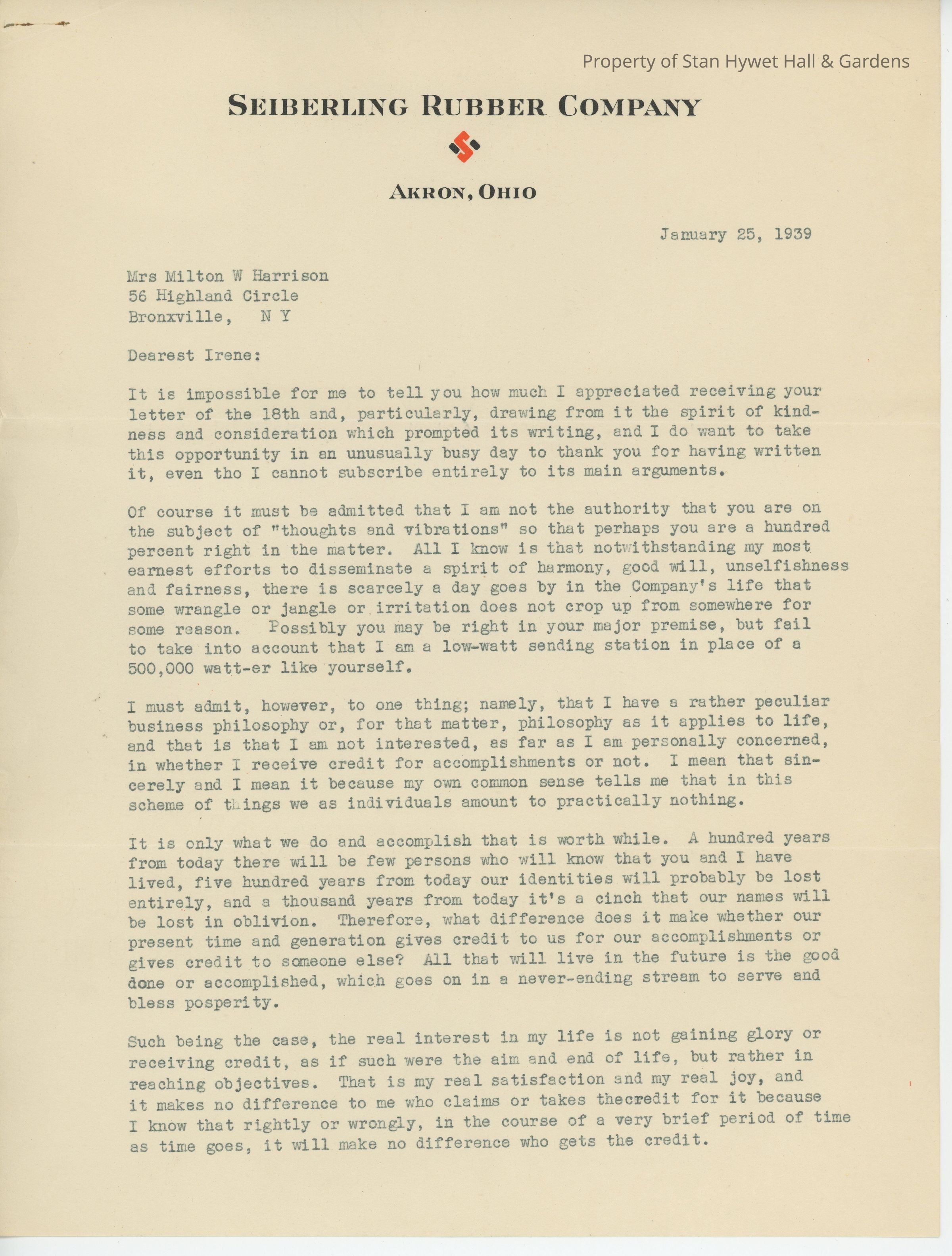
January 25, 1939
Mrs Milton W Harrison
56 Highland Circle
Bronxville, N Y
Dearest Irene:
It is impossible for me to tell you how much I appreciated receiving your letter of the 18th and, particularly, drawing from it the spirit of kindness and consideration which prompted its writing, and I do want to take this opportunity in an unusually busy day to thank you for having written it, even tho I cannot subscribe entirely to its main arguments.
Of course it must be admitted that I am not the authority that you are on the subject of “thoughts and vibrations” so that perhaps you are a hundred percent right in the matter. All I know is that notwithstanding my most earnest efforts to disseminate a spirit of harmony, good will, unselfishness and fairness, there is scarcely a day goes by in the Company’s life that some wrangle or jangle or irritation does not crop up from somewhere for some reason. Possibly you may be right in your major premise, but fail to take into account that I am a low-watt sending station in place of a 500,000 watt-er like yourself.
I must admit, however, to one thing; namely, that I have a rather peculiar business philosophy or, for that matter, philosophy as it applies to life, and that is that I am not interested, as far as I am personally concerned, in whether I receive credit for accomplishments or not. I mean that sincerely and I mean it because my own common sense tells me that in this scheme of things we as individuals amount to practically nothing.
It is only what we do and accomplish that is worth while. A hundred years from today there will be few persons who will know that you and I have lived, five hundred years from today our identities will probably be lost entirely, and a thousand years from today it’s a cinch that our names will be lost in oblivion. Therefore, what difference does it make whether our present time and generation gives credit to us for our accomplishments or gives credit to someone else? All that will live in the future is the good done or accomplished, which goes on in a never-ending stream to serve and bless posperity [sic].
Such being the case, the real interest in my life is not gaining glory or receiving credit, as if such were the aim and end of life, but rather in reaching objectives. That is my real satisfaction and my real joy, and it makes no difference to me who claims or takes thecredit [sic] for it because I know that rightly or wrongly, in the course of a very brief period of time as time goes, it will make no difference who gets the credit.
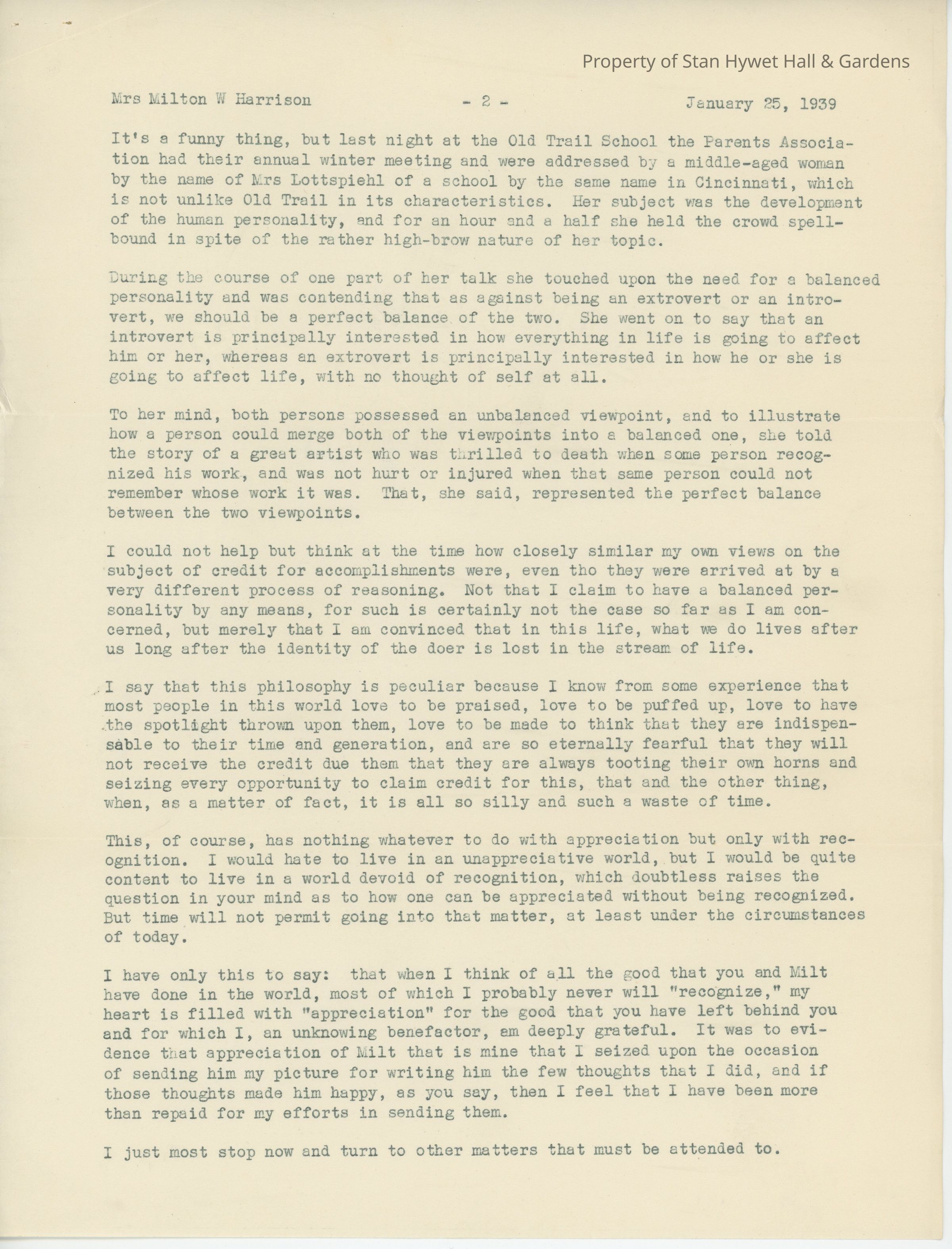
Mrs Milton W Harrison -2- January 25, 1939
It’s a funny thing, but last night at the Old Trail School the Parents Association had their annual winter meeting and were addressed by a middle-aged woman by the name of Mrs Lottspiehl of a school by the same name in Cincinnati, which is not unlike Old Trail in its characteristics. Her subject was the development of the human personality, and for an hour and a half she held the crowd spell-bound in spite of the rather high-brow nature of her topic.
During the course of one part of her talk she touched upon the need for a balanced personality and was contending that as against being an extrovert or an introvert, we should be a perfect balance of the two. She went on to say that an introvert is principally interested in how everything in life is going to affect him or her, whereas an extrovert is principally interested in how he or she is going to affect life, with no thought of self at all.
To her mind, both persons possessed an unbalanced viewpoint, and to illustrate how a person could merge both of the viewpoints into a balanced one, she told the story of a great artist who was thrilled to death when some person recognized his work, and was not hurt or injured when that same person could not remember whose work it was. That, she said, represented the perfect balance between the two viewpoints.
I could not help but think at the time how closely similar my own views on this subject of credit for accomplishments were, even tho [sic] they were arrived at by a very different process of reasoning. Not that I claim to have a balanced personality by any means, for such is certainly not the case so far as I am concerned, but merely that I am convinced that in this life, what we do lives after us long after the identity of the doer is lost in the stream of life.
I say that this philosophy is peculiar because I know from some experience that most people in this world love to be praised, love to be puffed up, love to have the spotlight thrown upon them, love to be made to think that they are indispensable to their time and generation, and are so eternally fearful that they will not receive the credit due them that they are always tooting their own horns and seizing every opportunity to claim credit for this, that and the other thing, when as a matter of fact, it is all so silly and such a waste of time.
This, of course, has nothing whatever to do with appreciation but only with recognition. I would hate to live in an unappreciative world, but I would be quite content to live in a world devoid of recognition, which doubtless raises the question in your mind as to how one can be appreciated without being recognized. But time will not permit going into that matter, at least under the circumstances of today.
I have only this to say: that when I think of all the good that you and Milt have done in the world, most of which I probably will never “recognize,” my heart is filled with “appreciation” for the good that you have left behind you and for which I, an unknowing benefactor, am deeply grateful. It was to evidence that appreciation of Milt that is mine that I seized upon the occasion of sending him my picture for writing him the few thoughts that I did, and if those thoughts made him happy, as you say, then I feel that I have been more than repaid for my efforts in sending them.
I just most [sic] stop now and turn to other matters that must be attended to.
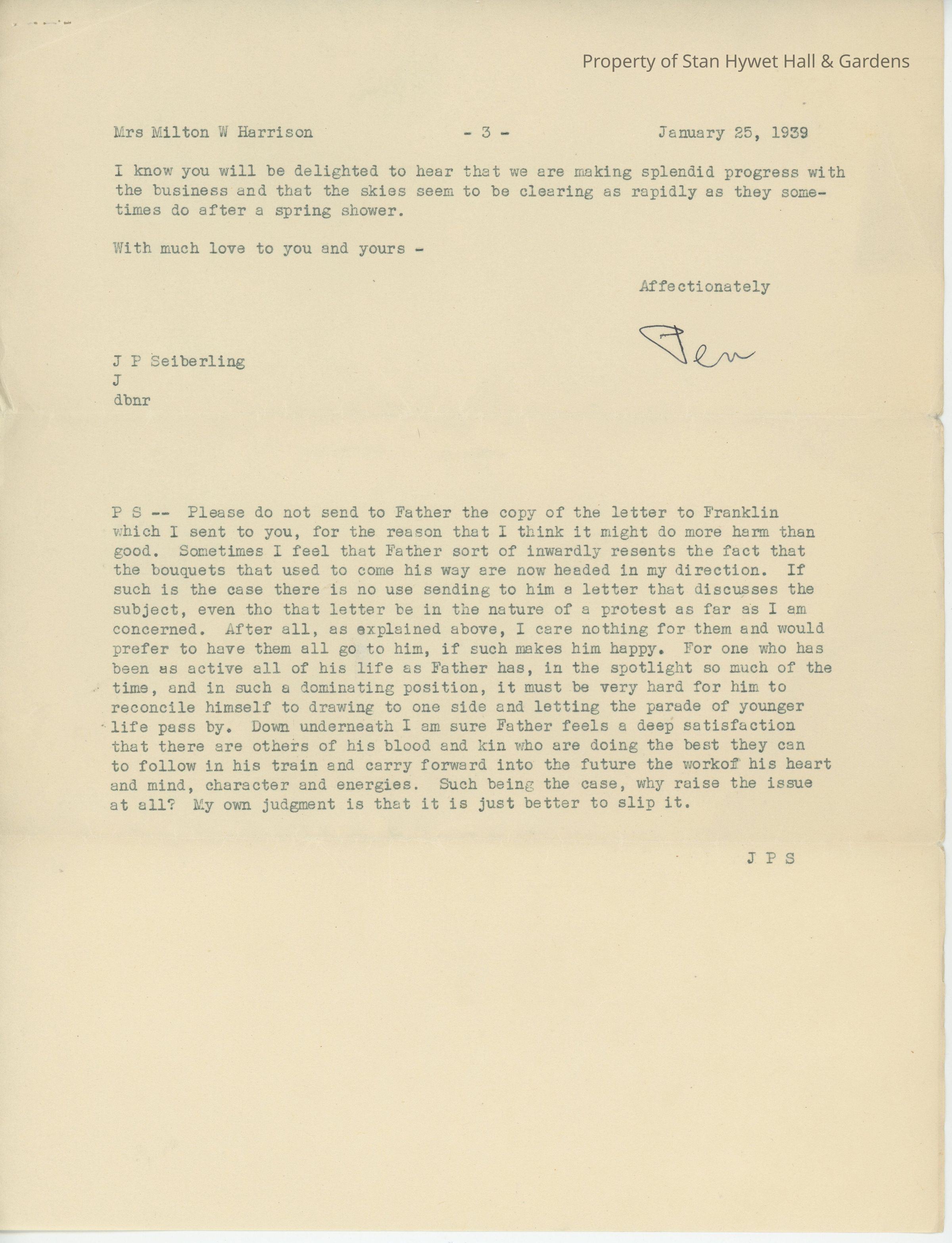
Mrs Milton W Harrison -3- January 25, 1939
I know you will be delighted to hear that we are making splendid progress with the business and that the skies seem to be clearing as rapidly as they sometimes do after a spring shower.
With much love to you and yours –
Affectionately
Pen
J P Seiberling
J
dbnr
P S – Please do not send to Father the copy of the letter to Franklin which I sent to you, for the reason that I think it might do more harm than good. Sometimes I feel that Father sort of inwardly resents the fact that the bouquets that used to come his way are now headed in my direction. If such is the case there is no use sending to him a letter that discusses the subject, even tho [sic] that letter be in the nature of a protest as far as I am concerned. After all, as explained above, I care nothing for them and would prefer to have them all go to him, if such makes him happy. For one who has been as active all of his life as Father has, in the spotlight so much of the time, and in such a dominating position, it must be very hard for him to reconcile himself to drawing to one side and letting the parade of younger life pass by. Down underneath I am sure Father feels a deep satisfaction that there are others of his blood and kin who are doing the best they can to follow in his train and carry forward into the future the workof [sic] his heart and mind, character and energies. Such being the case, why raise the issue at all? My own judgement is that it is just better to slip it.
J P STranscriber
Cindi RokeLanguage
English