Transcription
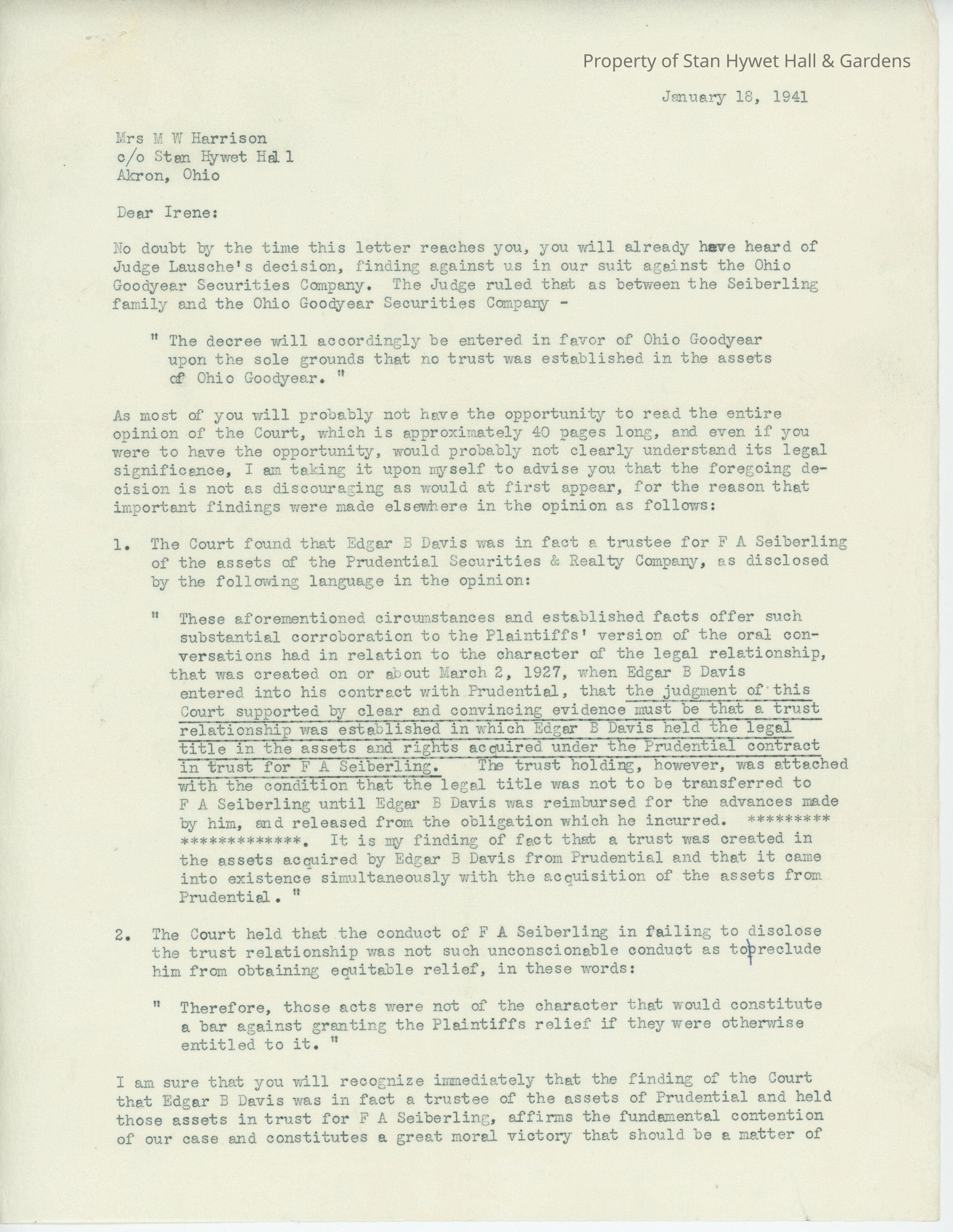
January 18, 1941
Mrs M W Harrison
c/o Stan Hywet Hall
Akron, Ohio
Dear Irene:
No doubt by the time this letter reaches you, you will already have heard of Judge Lausche’s decision, finding against us in our suit against the Ohio Goodyear Securities Company. The Judge ruled that as between the Seiberling family and the Ohio Goodyear Securities Company -
“The decree will accordingly be entered in favor of Ohio Goodyear upon the sole grounds that no trust was established in the assets of Ohio Goodyear.”
As most of you will probably not have the opportunity to read the entire opinion of the Court, which is approximately 40 pages long, and even if you were to have the opportunity, would probably not clearly understand its legal significance, I am taking it upon myself to advise you that the foregoing decision is not as discouraging as would at first appear, for the reason that important findings were made elsewhere in the opinion as follows:
1. The Court found that Edgar B. Davis was in fact a trustee for F A Seiberling of the assets of the Prudential Securities & Realty Company, as disclosed by the following language in the opinion:
“These aforementioned circumstances and established facts offer such substantial corroboration to the Plantiffs’ version of the oral conversations had in relation to the character of the legal relationship, that was created on or about March 2, 1927, when Edgar B Davis entered into his contract with Prudential, that the judgement of this Court supported by clear and convincing evidence must be that a trust relationship was established in which Edgar B Davis held the legal title in the assets and rights acquired under the Prudential contract in trust for F A Seiberling. The trust holding, however, was attached with the condition that the legal title was not to be transferred to F A Seiberling until Edgar B Davis was reimbursed for the advances made by him, and released from the obligation which he incurred. *************************. It is my finding of fact that a trust was created in the assets acquired by Edgar B Davis from Prudential and that it came into existence simultaneously with the acquisition of the assets from Prudential.”
2. The Court held that the conduct of F A Seiberling in failing to disclose the trust relationship was not such unconscionable conduct as to/preclude him from obtaining equitable relief, in these words:
“Therefore, those acts were not of the character that would constitute a bar against granting the Plaintiffs relief if they were otherwise entitled to it.”
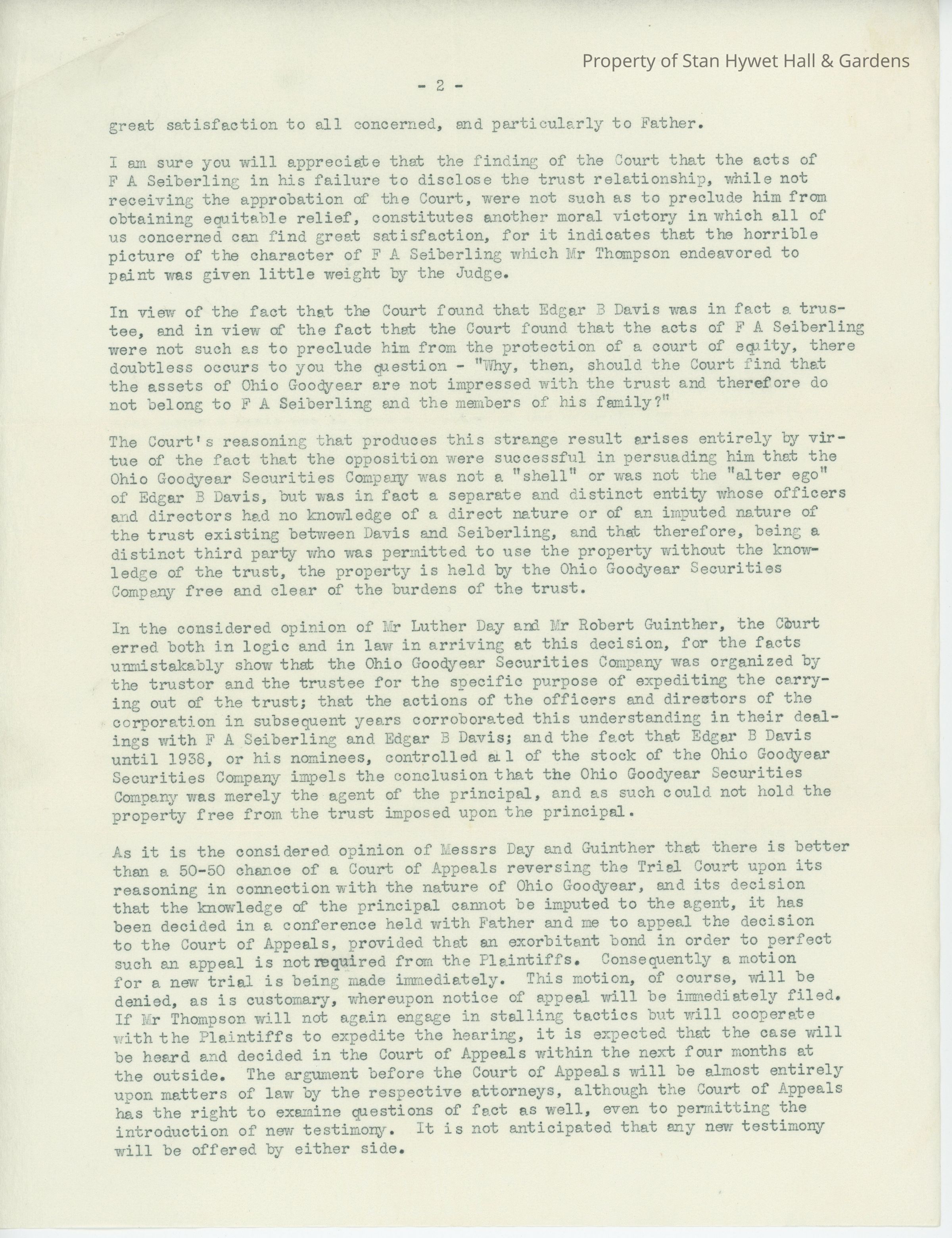
I am sure you will recognize immediately that the finding of the Court that Edgar B Davis was in fact a trustee of the assets of Prudential and held those assets in trust for F A Seiberling, affirms the fundamental contention of our case and constitutes a great moral victory that should be a matter of great satisfaction to all concerned, and particularly to Father.
I am sure you will appreciate that the finding of the Court that the acts of F A Seiberling in his failure to disclose the trust relationship, while not receiving the approbation of the Court, were not such as to preclude him from obtaining equitable relief, constitutes another moral victory in which all of us concerned can find great satisfaction, for it indicates that the horrible picture of the character of F A Seiberling which Mr Thompson endeavored to paint was given little weight by the Judge.
In view of the fact that the Court found that Edgar B Davis was in fact a trustee, and in view of the fact that the Court found that the acts of F A Seiberling were not such as to preclude him from the protection of a court of equity, there doubtless occurs to you the question – “Why, then, should the Court find that the assets of Ohio Goodyear are not impressed with the trust and therefore do not belong to F A Seiberling and the members of his family?”
The Court’s reasoning that produces this strange result arises entirely by virtue of the fact that the opposition were successful in persuading him that the Ohio Goodyear Securities Company was not a “shell” or was not the “alter ego” of Edgar B Davis, but was in fact a separate and distinct entity whose officers and directors had no knowledge of a direct nature or of an imputed nature of the trust existing between Davis and Seiberling, and that therefore, being a distinct third party who was permitted to use the property without the knowledge of the trust, the property is held by the Ohio Goodyear Securities Company free and clear of the burdens of the trust.
In the considered opinion of Mr Luther Day and Mr Robert Guinther, the Court erred both in logic and in law in arriving at this decision, for the facts unmistakably show that the Ohio Goodyear Securities Company was organized by the trustor and the trustee for the specific purpose of expediting the carrying out of the trust; that the actions of the officers and directors of the corporation in subsequent years corroborated this understanding in their dealings with F A Seiberling and Edgar B Davis; and the fact that Edgar B Davis until 1938, or his nominees, controlled all of the stock of the Ohio Goodyear Securities Company impels the conclusion that the Ohio Goodyear Securities Company was merely the agent of the principal, and as such could not hold the property free from the trust imposed upon the principal.
As it is the considered opinion of Messrs Day and Guinther that there is better than a 50-50 chance of a Court of Appeals reversing the Trial Court upon its reasoning in connection with the nature of Ohio Goodyear, and its decision that the knowledge of the principal cannot be imputed to the agent, it has been decided in a conference held with Father and me to appeal the decision to the Court of Appeals, provided that an exorbitant bond in order to perfect such an appeal is not required from the Plaintiffs. Consequently a motion for a new trial is being made immediately. This motion, of course, will be denied, as is customary, whereupon notice of appeal will be immediately filed. If Mr Thompson will not again engage in stalling tactics but will cooperate with the Plaintiffs to expedite the hearing, it is expected that the case will be heard and decided in the Court of Appeals within the next four months at the outside. The argument before the Court of Appeals will be almost entirely upon matters of law by the respective attorneys, although the Court of Appeals has the right to examine questions of fact as well, even to permitting the introduction of new testimony. It is not anticipated that any new testimony will be offered by either side.
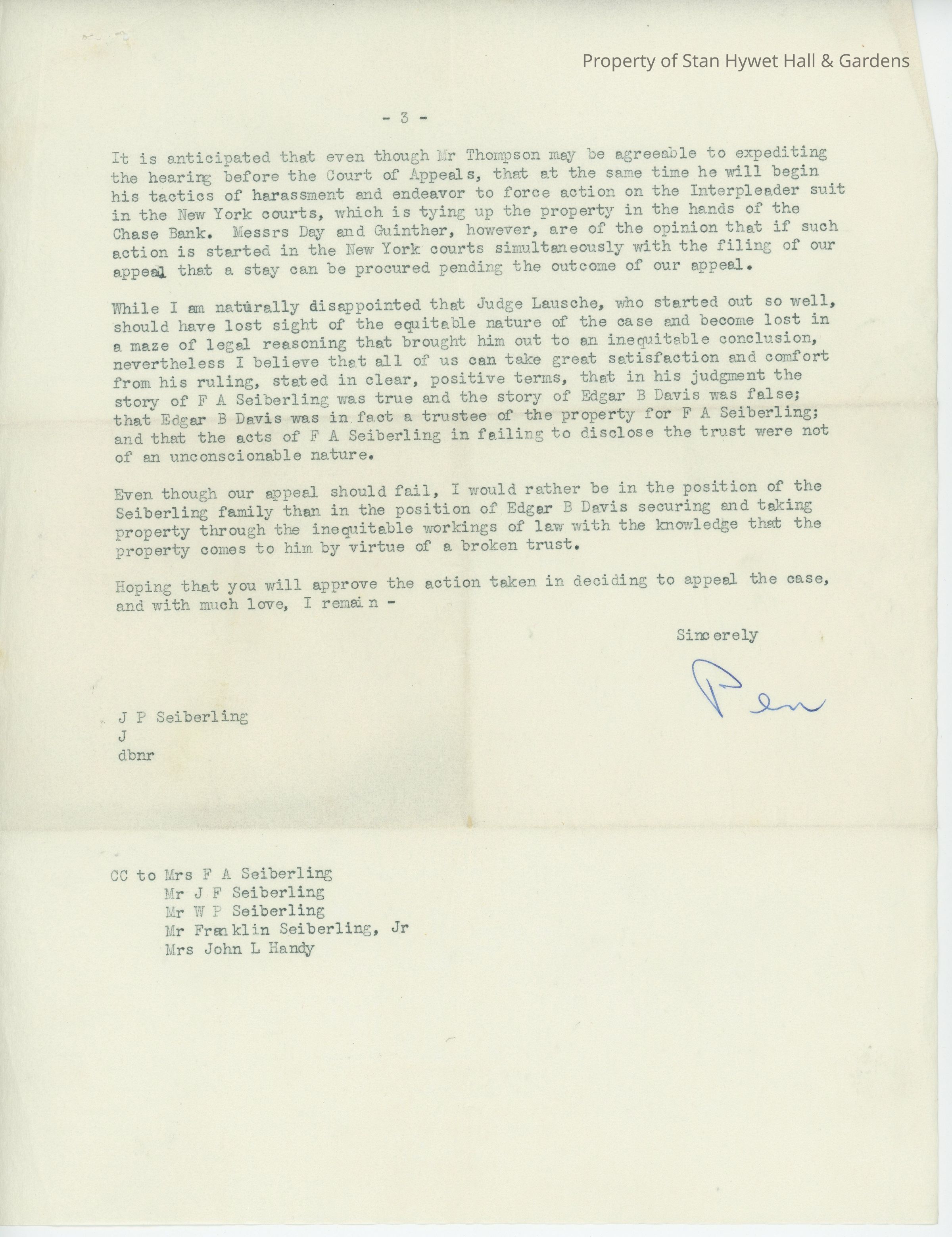
It is anticipated that even though Mr Thompson may be agreeable to expediting the hearing before the Court of Appeals, that at the same time he will begin his tactics of harassment and endeavor to force action on the Interpleader suit in the New York courts, which is tying up the property in the hands of the Chase Bank. Messrs Day and Guinther, however, are of the opinion that if such action is started in the New York courts simultaneously with the filing of our appeal that a stay can be procured pending the outcome of our appeal.
While I am naturally disappointed that Judge Lausche, who started out so well, should have lost sight of the equitable nature of the case and become lost in a maze of legal reasoning that brought him out to an inequitable conclusion, nevertheless I believe that all of us can take great satisfaction and comfort from his ruling, stated in clear, positive terms, that in his judgement the story of F A Seiberling was true and the story of Edgar B Davis was false; that Edgar B Davis was in fact a trustee of the property of F A Seiberling; and that the acts of F A Seiberling in failing to disclose the trust were not of an unconscionable nature.
Even though our appeal should fail, I would rather be in the position of the Seiberling family than in the position of Edgar B Davis securing and taking property through the inequitable workings of law with the knowledge that the property comes to him by virtue of a broken trust.
Hoping that you will approve the action taken in deciding to appeal the case, and with much love, I remain -
Sincerely
Pen
J P Seiberling
J
dbnr
CC to Mrs F A Seiberling
Mr J F Seiberling
Mr W P Seiberling
Mr Franklin Seiberling, Jr
Mrs John L HandyTranscriber
Cindi RokeLanguage
English