Transcription
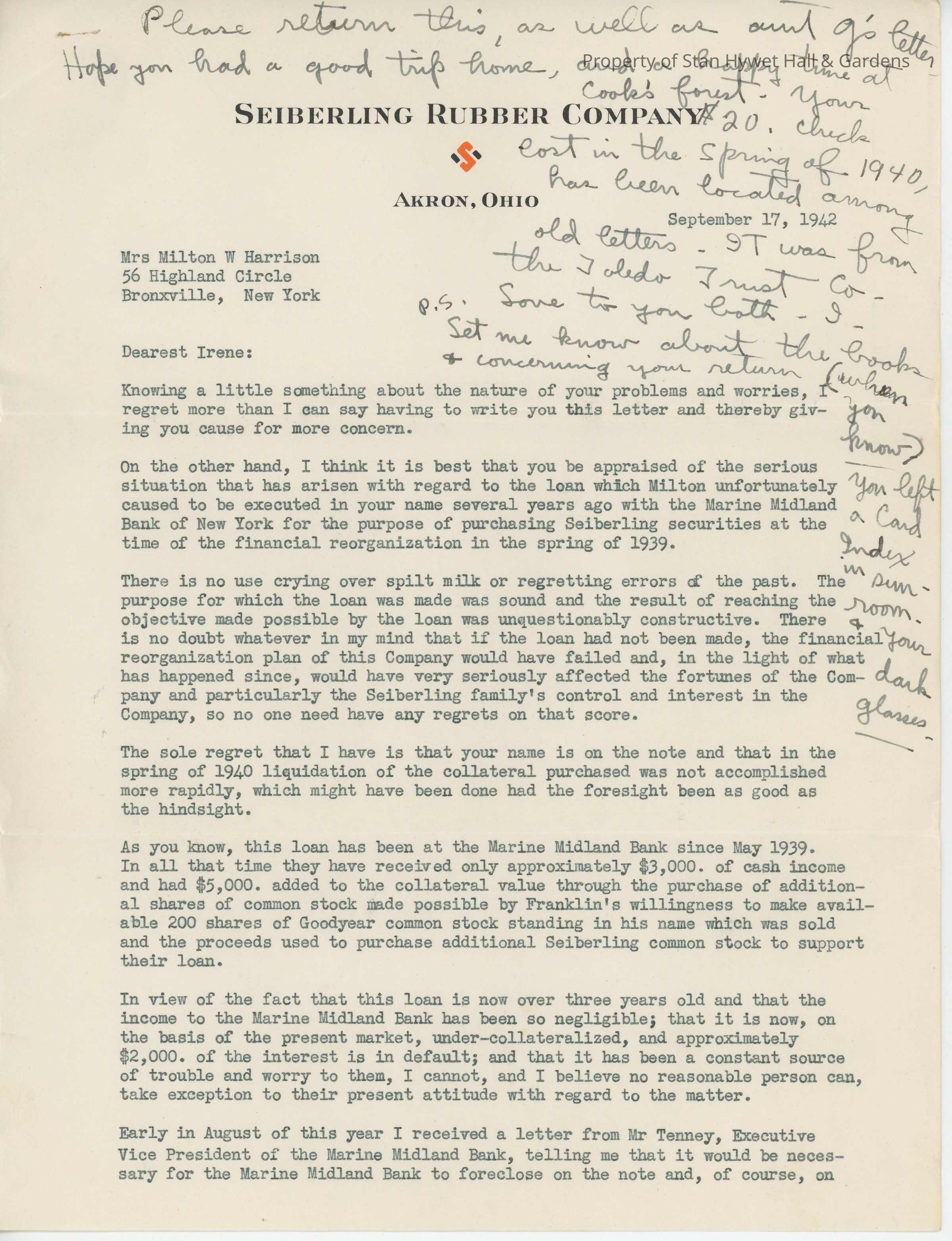
Please return this, as well as aunt G’s letter. Hope you had a good trip home, and a happy time at Cook’s forest. Your $20. check lost in the spring of 1940, has been located among old letters. It was from the Toledo Trust Co. Love to you both. -I-
P.S. Let me know about the books & concerning your return (when you know) You left a Card Index in sunroom & your dark glasses.
September 17, 1942
Mrs Milton W Harrison
56 Highland Circle
Bronxville, New York
Dearest Irene:
Knowing a little something about the nature of your problems and worries, I regret more than I can say having to write you this letter and thereby giving you cause for more concern.
On the other hand, I think it is best that you be appraised of the serious situation that has arisen with regard to the loan which Milton unfortunately caused to be executed in your name several years ago with the Marine Midland Bank of New York for the purpose of purchasing Seiberling securities at the time of the financial reorganization in the spring of 1939.
There is no use crying over spilt milk or regretting errors of the past. The purpose for which the loan was made was sound and the result of reaching the objective made possible by the loan was unquestionably constructive. There is no doubt whatever in my mind that if the loan had not been made, the financial reorganizational plan of this Company would have failed and, in the light of what has happened since, would have very seriously affected the fortunes of the Company and particularly the Seiberling family’s control and interest in the Company, so no one need have any regrets on that score.
The sole regret that I have is that your name is on the note and that in the spring of 1940 liquidation of the collateral purchased was not accomplished more rapidly, which might have been done had the foresight been as good as the hindsight.
As you know, this loan has been at the Marine Midland Bank since May 1939. In all that time they have received only approximately $3,000. of cash income and had $5,000. added to the collateral value through the purchase of additional shares of common stock made possible by Franklin’s willingness to make available 200 shares of Goodyear common stock standing in his name which was sold and the proceeds used to purchase additional Seiberling common stock to support their loan.
I view of the fact that this loan is now over three years old and that the income to the Marine Midland Bank has been so negligible; that it is now, on the basis of the present market, under-collateralized, and approximately $2,000. of the interest is in default; and that it has been a constant source of trouble and worry to them, I cannot, and I believe no reasonable person can, take exception to their present attitude with regard to the matter.
Early in August of this year I received a letter from Mr Tenney, Executive Vice President of the Marine Midland Bank, telling me that it would be necessary for the Marine Midland Bank to foreclose on the note and, of course, on the collateral.
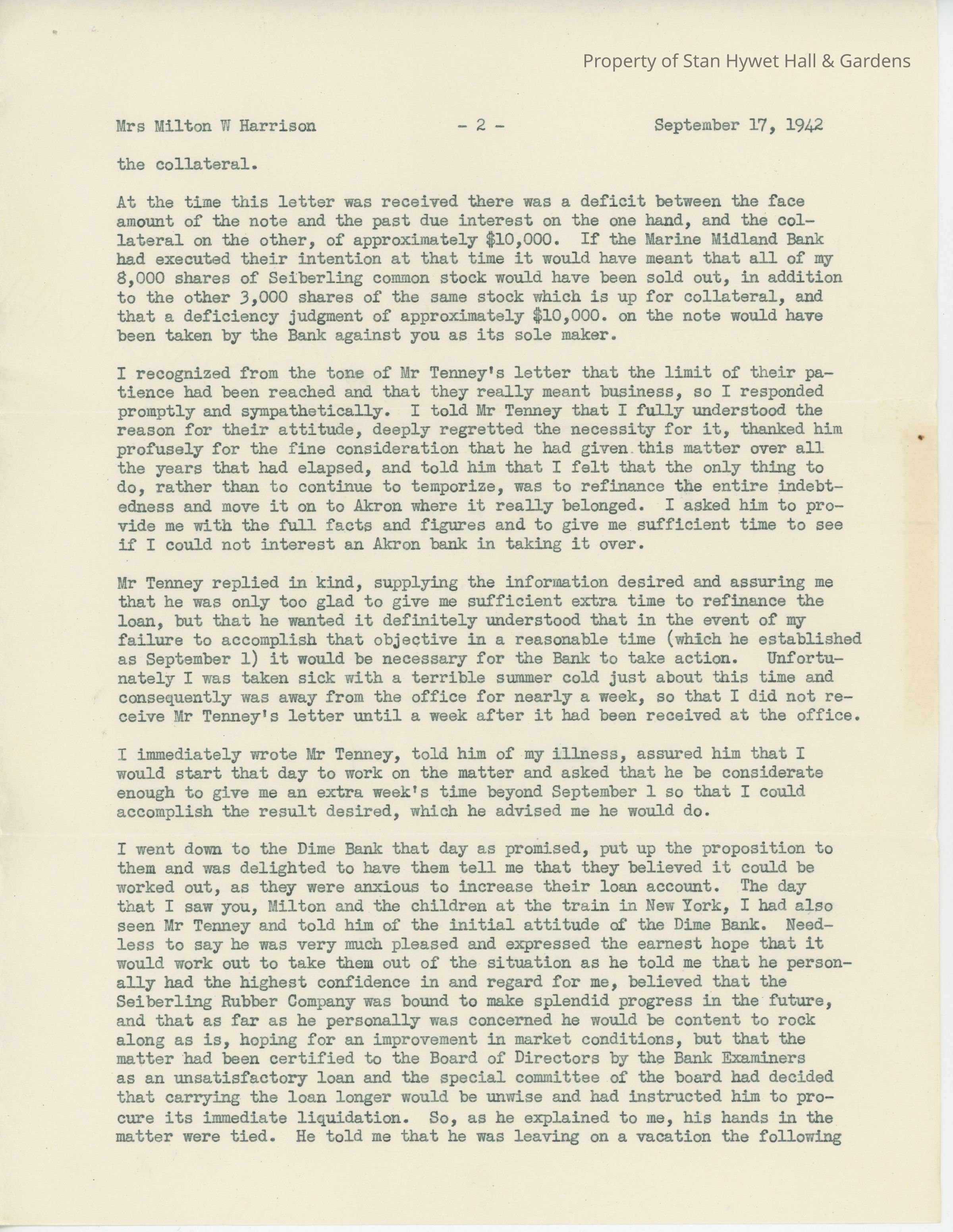
At the time this letter was received there was a deficit between the face amount of the note and the past due interest on the one hand, and the collateral on the other, of approximately $10,000. If the Marine Midland Bank had executed their intention at that time it would have meant that all of my 8,000 shares of Seiberling common stock would have been sold out, in addition to the other 3,000 shares of the same stock which is up for collateral, and that a deficiency judgment [sic] of approximately $10,000. on the note would have been taken by the Bank against you as its sole maker.
I recognized from the tone of Mr Tenney’s letter that the limit of their patience had been reached and that they really meant business, so I responded promptly and sympathetically. I told Mr Tenney that I fully understood the reason for their attitude, deeply regretted the necessity for it, thanked him profusely for the fine consideration that he had given this matter over all the years that had elapsed, and told him that I felt that the only thing to do, rather than to continue to temporize, was to refinance the entire indebtedness and move it on to Akron where it really belonged. I asked him to provide me with the full facts and figures and to give me sufficient time to see if I could not interest an Akron bank in taking it over.
Mr Tenney replied in kind, supplying the information desired and assuring me that he was only too glad to give me sufficient extra time to refinance the loan, but that he wanted it definitely understood that in the event of my failure to accomplish that objective in a reasonable time (which he established as September 1) it would be necessary for the Bank to take action. Unfortunately I was taken sick with a terrible summer cold just about this time and consequently was away from the office for nearly a week, so that I did not receive Mr Tenney’s letter until a week after it had been received at the office.
I immediately wrote Mr Tenney, told him of my illness, assured him that I would start that day to work on the matter and asked that he be considerate enough to give me an extra week’s time beyond September 1 so that I could accomplish the result desired, which he advised me he would do.
I went down to the Dime Bank that day as promised, put up the proposition to them and was delighted to have them tell me that they believed it could be worked out, as they were anxious to increase their loan account. The day that I saw you, Milton and the children at the train in New York, I had also seen Mr Tenney and told him of the initial attitude of the Dime Bank. Needless to say he was very much pleased and expressed the earnest hope that it would work out to take them out of the situation as he told me that he personally had the highest confidence in and regard for me, believed that the Seiberling Rubber Company was bound to make splendid progress in the future, and that as far as he personally was concerned he would be content to rock along as is, hoping for an improvement in market conditions, but that the matter had been certified to the Board of Directors by the Bank Examiners as an unsatisfactory loan and the special committee of the board had decided that carrying the loan longer would be unwise and had instructed him to procure its immediate liquidation. So, as he explained to me, his hands in the matter were tied. He told me that he was leaving on a vacation the following Thursday and that he would like to have definite word from me by then as to whether or not the Akron bank was committed to go ahead.
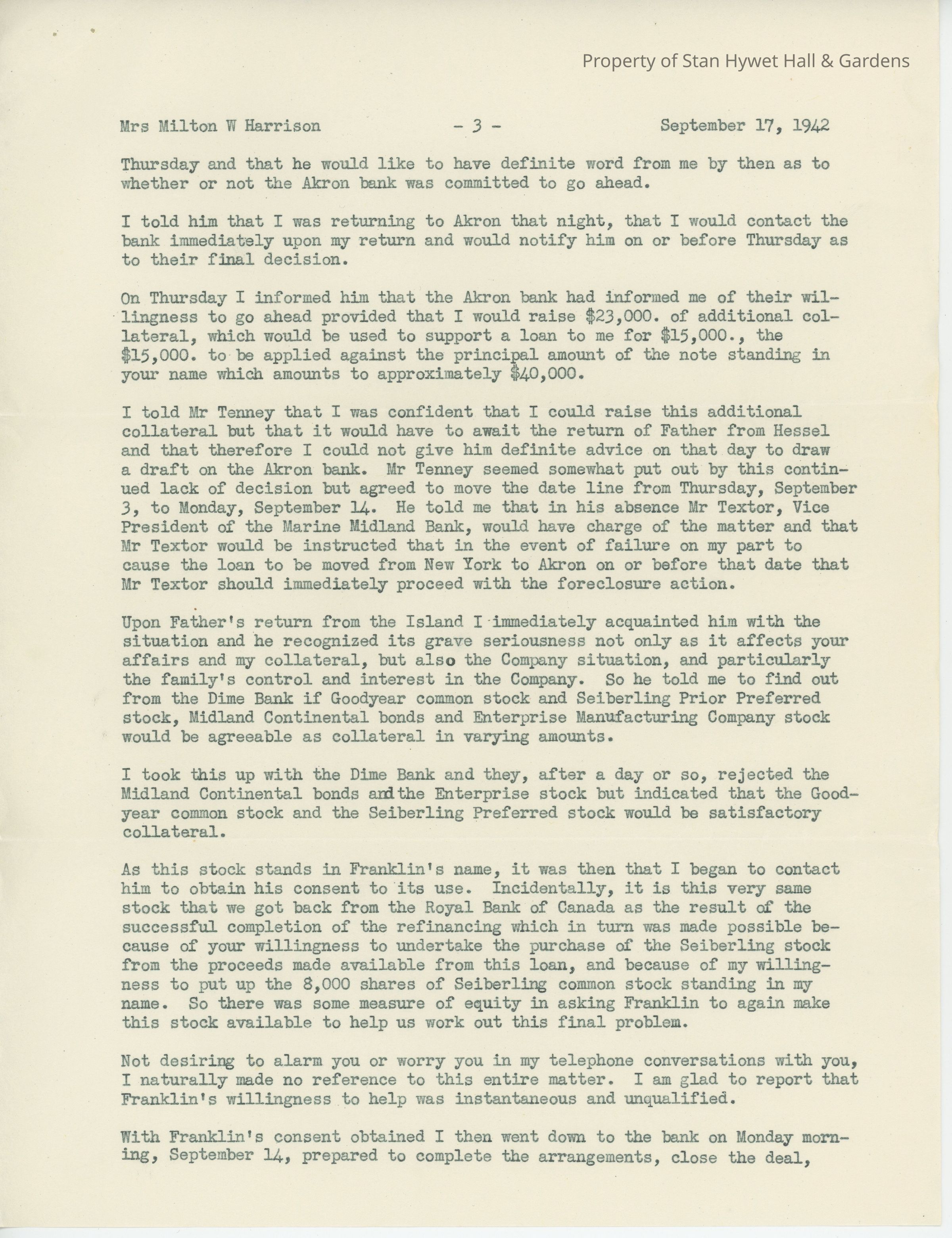
I told him that I was returning to Akron that night, that I would contact the bank immediately upon my return and would notify him on or before Thursday as to their final decision.
On Thursday I informed him that the Akron bank had informed me of their willingness to go ahead provided that I would raise $23,000. of additional collateral, which would be used to support a loan to me for $15,000., the $15,000. to be applied against the principal amount of the note standing in your name which amounts to approximately $40,000.
I told Mr Tenney that I was confident that I could raise this additional collateral but that it would have to await the return of Father from Hessel and that therefore I could not give him definite advice on that day to draw a draft on the Akron bank. Mr Tenney seemed somewhat put out by this continued lack of decision but agreed to move the date line from Thursday, September 3, to Monday, September 14. He told me that in his absence Mr Textor, Vice President of the Marine Midland Bank, would have charge of this matter and that Mr Textor would be instructed that in the event of failure on my part to cause the loan to be moved from New York to Akron on or before that date that Mr Textor should immediately proceed with the foreclosure action.
Upon Father’s return from the Island I immediately acquainted him with the situation and he recognized its grave seriousness not only as it affects your affairs and my collateral, but also the Company situation, and particularly the family’s control and interest in the Company. So he told me to find out from the Dime Bank if Goodyear common stock and Seiberling Prior Preferred stock, Midland Continental bonds and Enterprise Manufacturing Company stock would be agreeable as collateral in varying amounts.
I took this up with the Dime Bank and they, after a day or so, rejected the Midland Continental bonds and the Enterprise stock but indicated that the Goodyear common stock and the Seiberling Preferred stock would be satisfactory collateral.
As this stock stands in Franklin’s name, it was then that I began to contact him to obtain his consent to its use. Incidentally, it is this very same stock that we got back from the Royal Bank of Canada as the result of the successful completion of the refinancing which in turn was made possible because of your willingness to undertake the purchase of the Seiberling stock from the proceeds made available from this loan, and because of my willingness to put up the 8,000 shares of Seiberling common stock standing in my name. So there was some measure of equity in asking Franklin to again make this stock available to help us work out this final problem.
Not desiring to alarm you or worry you in my telephone conversations with you, I naturally made no reference to this entire matter. I am glad to report that Franklin’s willingness to help was instantaneous and unqualified.
With Franklin’s consent obtained I then went down to the bank on Monday morning, September 14, prepared to complete the arrangements, close the deal, and wire the Marine Midland Bank to draw a draft on the Dime Savings Bank for the amount of the loan, of course sending along with the draft your note and the collateral attached.
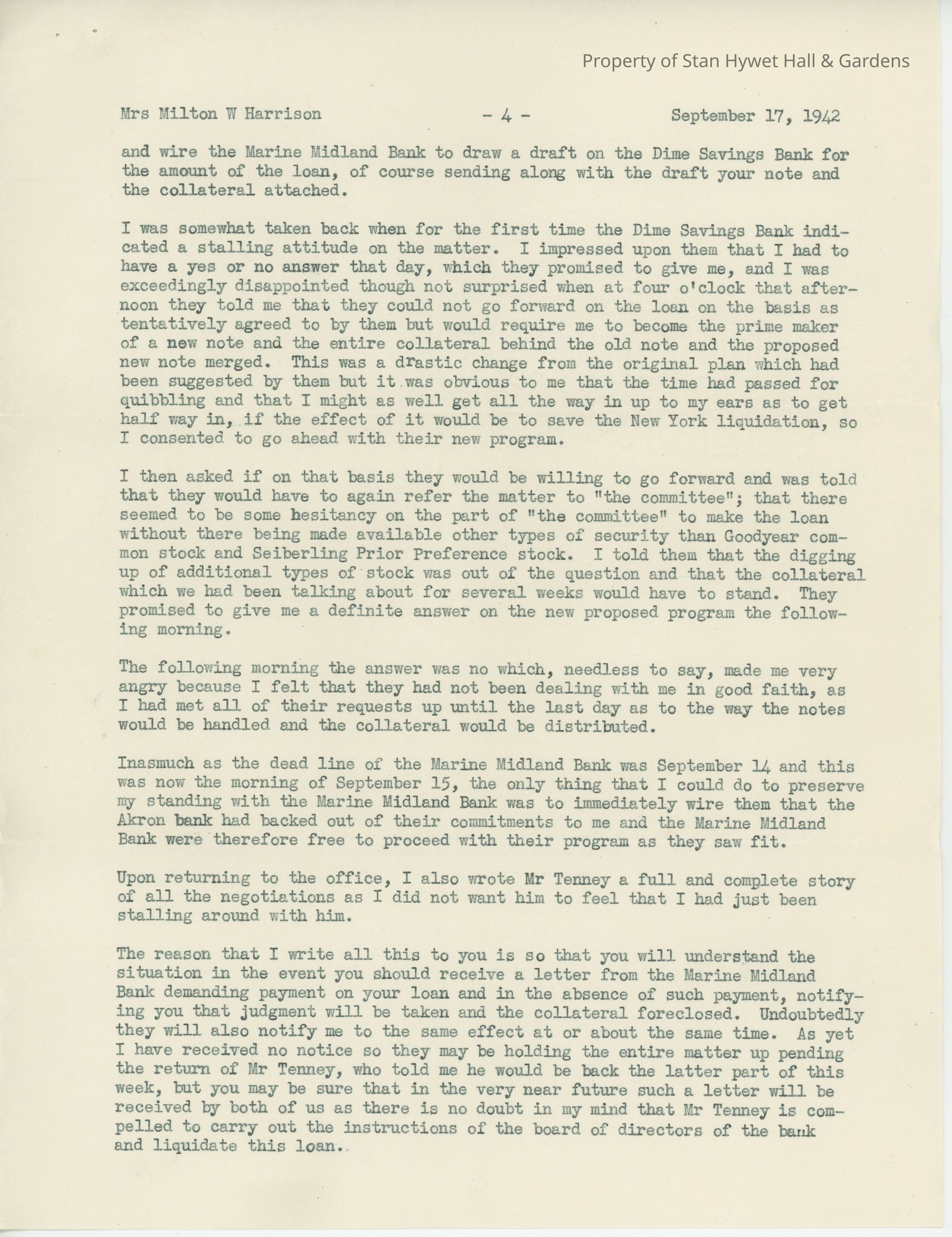
I was somewhat taken back when for the first time the Dime Savings Bank indicated a stalling attitude on the matter. I impressed upon them that I had to have a yes or no answer that day, which they promised to give me, and I was exceedingly disappointed though not surprised when at four o’clock that afternoon they told me that they could not go forward on the loan on the basis as tentatively agreed to by them but would require me to become the prime maker of a new note and the entire collateral behind the old note and the proposed new note merged. This was a drastic change from the original plan which had been suggested by them but it was obvious to me that the time had passed for quibbling and that I might as well get all the way in up to my ears as to get half way in, if the effect of it would be to save the New York liquidation, so I consented to go ahead with their new program.
I then asked if on that basis they would be willing to go forward and was told that they would have to again refer the matter to “the committee”; that there seemed to be some hesitancy on the part of “the committee” to make the loan without there being made available other types of security than Goodyear common stock and Seiberling Prior Preference stock. I told them that the digging up of additional types of stock was out of the question and that the collateral which we had been talking about for several weeks would have to stand. They promised to give me a definite answer on the new proposed program the following morning.
The following morning the answer was no which, needless to say, made me very angry because I felt that they had not been dealing with me in good faith, as I had met all of their requests up until the last day as to the way the notes would be handled and the collateral would be distributed.
Inasmuch as the dead line of the Marine Midland Bank was September 14 and this was now the morning of September 15, the only thing that I could do to preserve my standing with the Marine Midland Bank was to immediately wire them that the Akron bank had backed out of their commitments to me and the Marine Midland Bank were therefore free to proceed with their program as they saw fit.
Upon returning to the office, I also wrote Mr Tenney a full and complete story of all the negotiations as I did not want him to feel that I had just been stalling around with him.
The reason that I write all of this to you is so that you will understand the situation in the event you should receive a letter from the Marine Midland Bank demanding payment on your loan and in the absence of such payment, notifying you that judgement will be taken and the collateral foreclosed. Undoubtedly they will also notify me to the same effect at or about the same time. As yet I have received no notice so they may be holding the entire matter up pending the return of Mr Tenney, who told me he would be back the latter part of this week, but you may be sure that in the very near future such a letter will be received by both of us as there is no doubt in my mind that Mr Tenney is compelled to carry out the instructions of the board of directors of the bank and liquidate this loan.
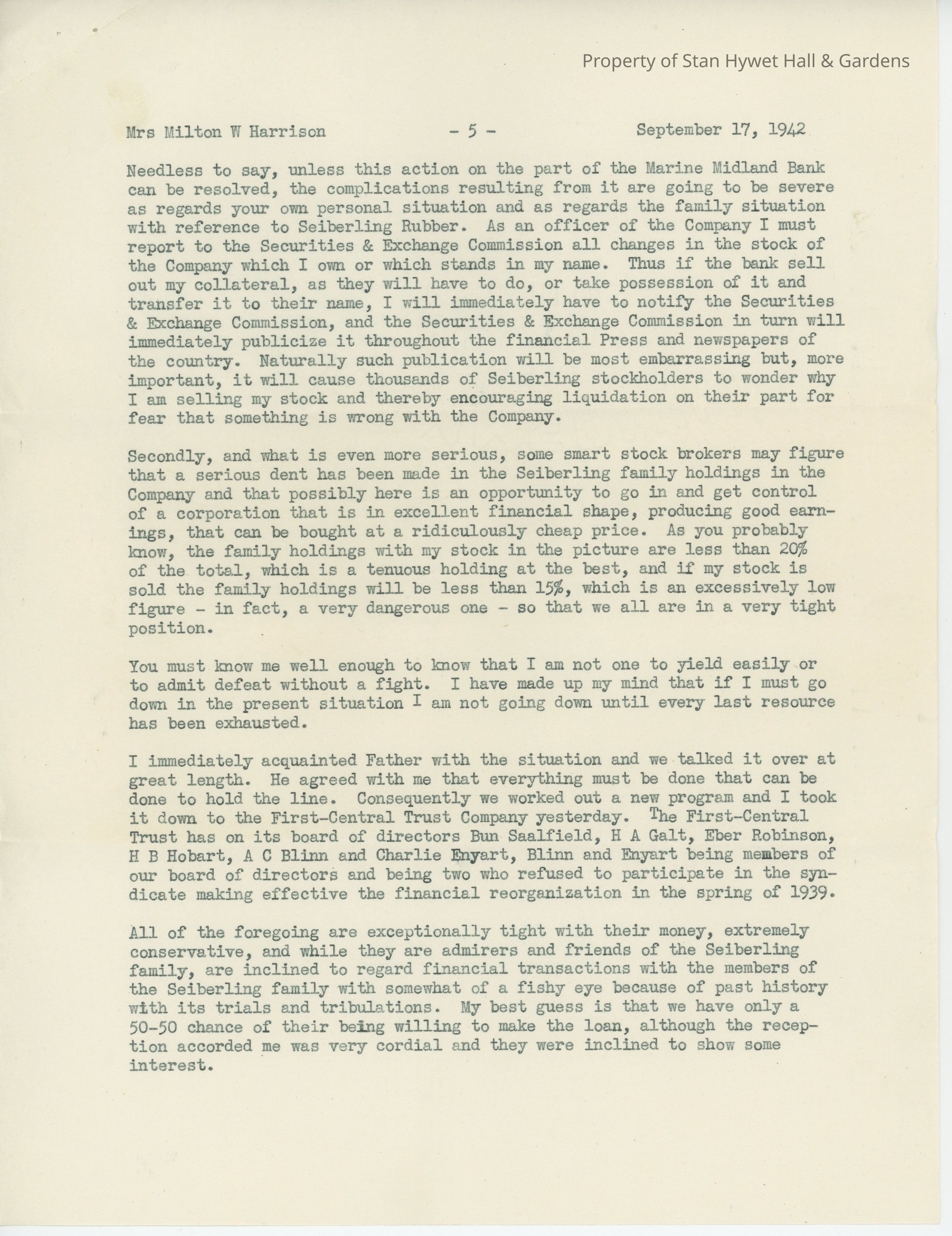
Needless to say, unless this action on the part of the Marine Midland Bank can be resolved, the complications resulting from it are going to be severe as regards your own personal situation and as regards the family situation with reference to Seiberling Rubber. As an officer of the Company I must report to the Securities & Exchange Commission all changes in the stock of the Company which I own or which stands in my name. Thus if the bank sell out my collateral, as they will have to do, or take possession of it and transfer it to their name, I will immediately have to notify the Securities & Exchange Commission, and the Securities & Exchange Commission in turn will immediately publicize it throughout the financial Press and newspapers of the country. Naturally such publication will be most embarrassing but, more important, it will cause thousands of Seiberling stockholders to wonder why I am selling my stock and thereby encouraging liquidation on their part for fear that something is wrong with the Company.
Secondly, and what is even more serious, some smart stock brokers may figure that a serious dent has been made in the Seiberling family holdings in the Company and that possibly here is an opportunity to go in and get control of a corporation that is in excellent financial shape, producing good earnings, that can be bought at a ridiculously cheap price. As you probably know, the family holdings with my stock in the picture are less than 20% of the total, which is a tenuous holding at the best, and if my stock is sold the family holdings will be less than 15%, which is an excessively low figure – in fact, a very dangerous one – so that we all are in a very tight position.
You must know me well enough to know that I am not one to yield easily or to admit defeat without a fight. I have made up my mind that if I must go down in the present situation I am not going down until every last resource has been exhausted.
I immediately acquainted Father with the situation and we talked it over at great length. He agreed with me that everything must be done that can be done to hold the line. Consequently we worked out a new program and I took it down to First-Central Trust Company yesterday. The First-Central Trust has on its board of directors Bun Saalfield, H A Galt, Eber Robinson, H B Hobart, A C Blinn and Charlie Enyart, Blinn and Enyart being members of our board of directors and being two who refused to participate in the syndicate making effective the financial reorganization in the spring of 1939.
All of the foregoing are exceptionally tight with their money, extremely conservative, and while they are admirers and friends of the Seiberling family, are inclined to regard financial transactions with the members of the Seiberling family with somewhat of a fishy eye because of past history with its trials and tribulations. My best guess is that we have only a 50-50 chance of their being willing to make the loan, although the reception accorded me was very cordial and they were inclined to show some interest.
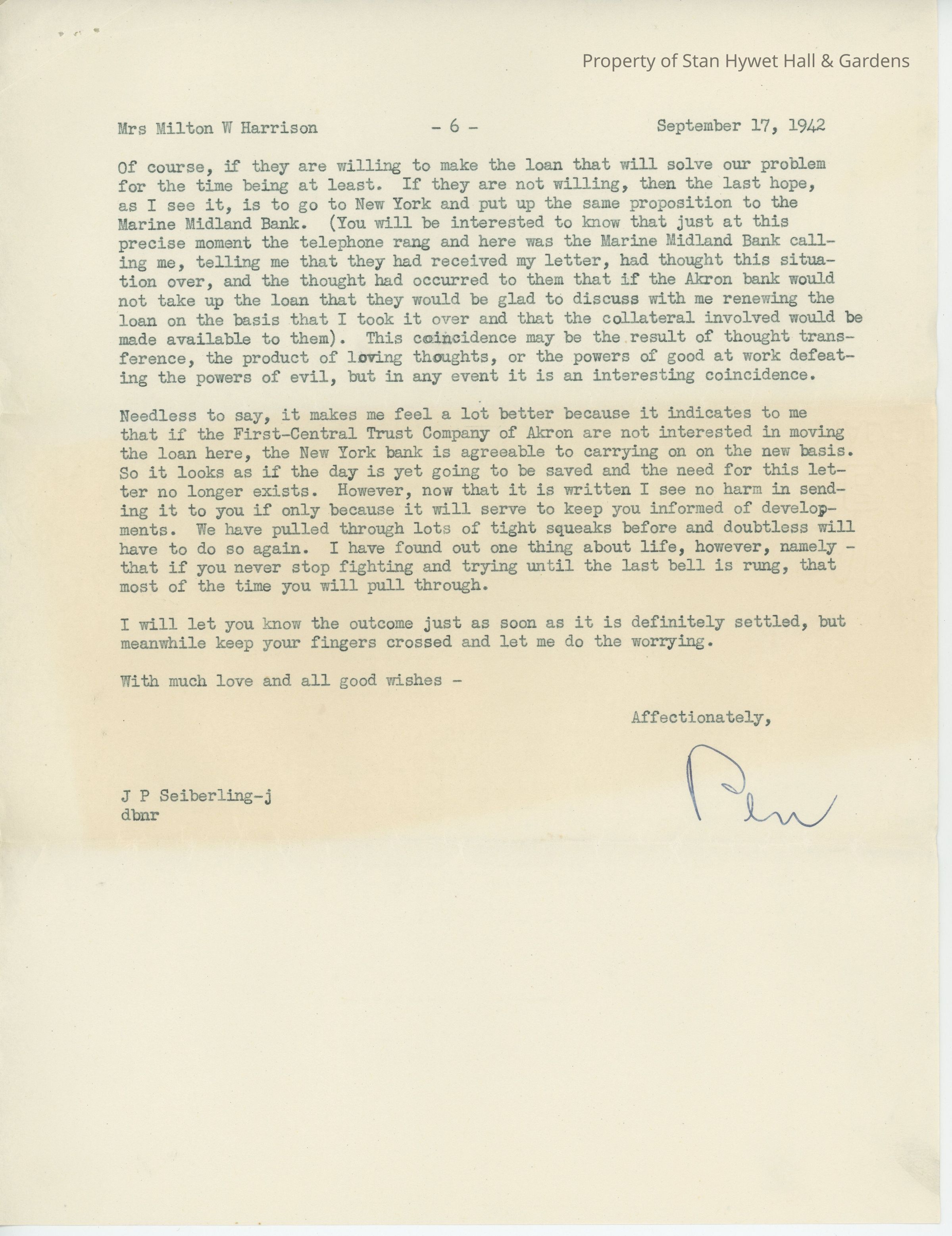
Of course, if they were willing to make the loan that will solve our problem for the time being at least. If they are not willing, then the last hope, as I see it, is to go to New York and put up the same proposition to the Marine Midland bank. (You will be interested to know that just at this precise moment the telephone rang and here was the Marine Midland Bank calling me, telling me that they had received my letter, had thought this situation over, and the thought had occurred to them that if the Akron bank would not take up the loan that they would be glad to discuss with me renewing the loan on the basis that I took it over and that the collateral involved would be made available to them). This coincidence may be the result of thought transference, the product of loving thoughts, or the powers of good at work defeating the powers of evil, but in any event it is an interesting coincidence.
Needless to say, it makes me feel a lot better because it indicates to me that if the First-Central Trust Company of Akron are not interested in moving the loan here, the New York bank is agreeable to carrying on on [sic] the new basis. So it looks as if the day is yet going to be saved and the need for this letter no longer exists. However, now that it is written I see no harm in sending it to you if only because it will serve to keep you informed of developments. We have pulled through lots of tight squeaks before and doubtless will have to do so again. I have found out one thing about life, however, namely - that if you never stop fighting and trying until the last bell is rung, that most of the time you will pull through.
I will let you know the outcome just as soon as it is definitely settled, but meanwhile keep your fingers crossed and let me do the worrying.
With much love and all good wishes –
Affectionately,
Pen
J P Seiberling-j
dbnrTranscriber
Cindi RokeLanguage
English