Transcription
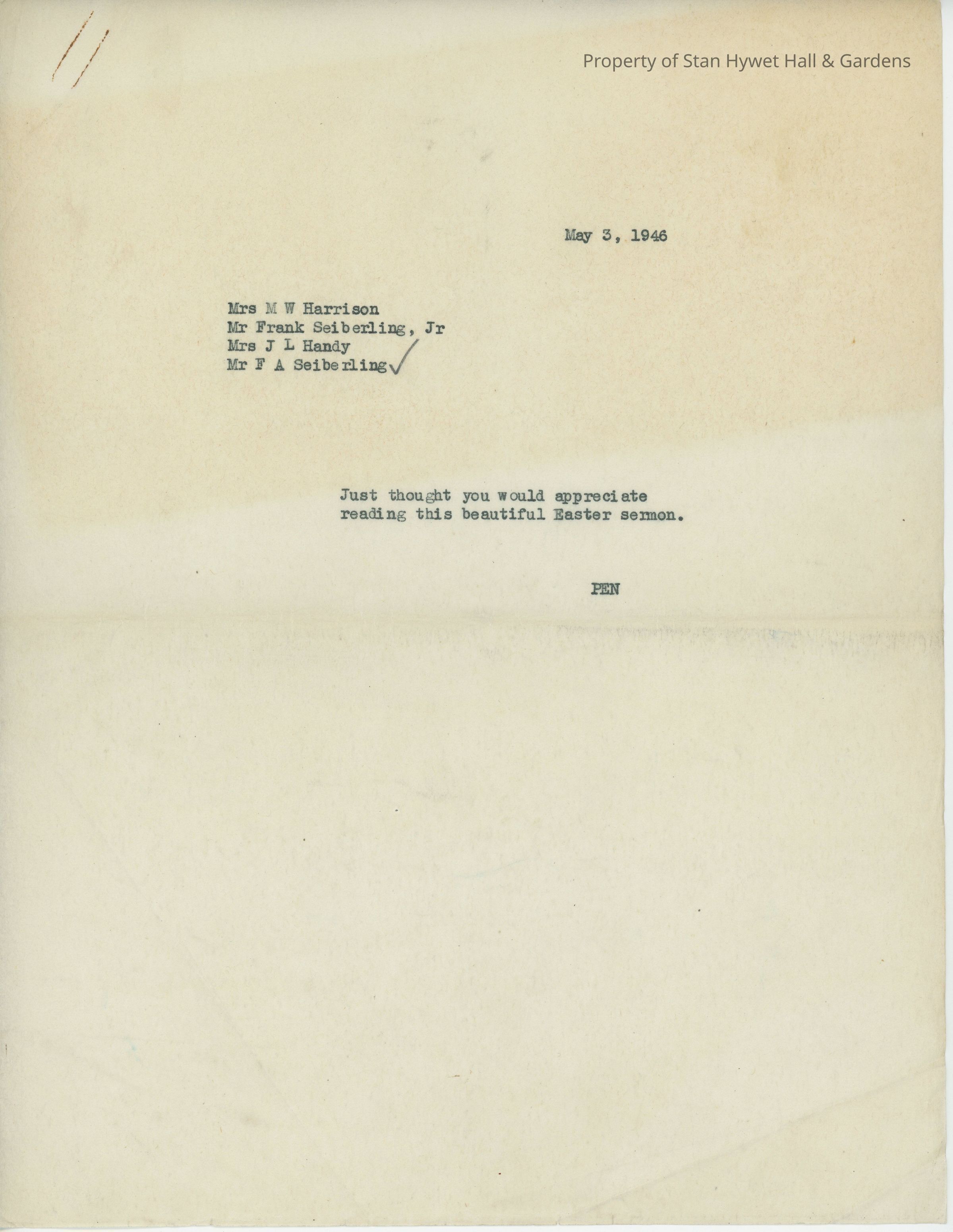
May 3, 1946
Mrs M W Harrison
Mr Frank Seiberling, Jr
Mrs J L Handy
Mr F A Seiberling
Just thought you would appreciate
reading this beautiful Easter sermon.
PENTranscriber
Cindi RokeLanguage
EnglishNotes
aTranscription
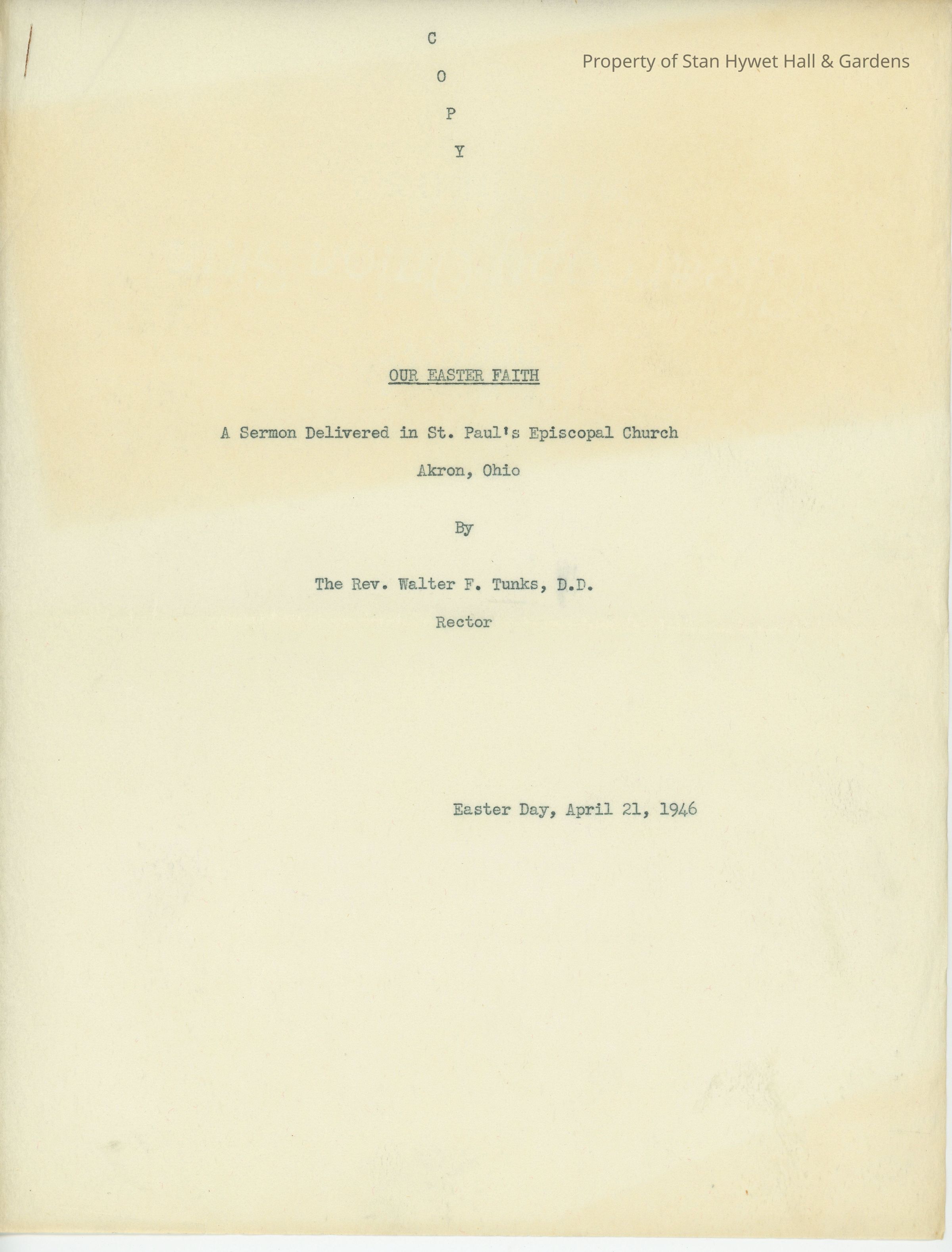
OUR EASTER FAITH
A Sermon Delivered in St. Paul’s Episcopal Church
Akron, Ohio
By
The Rev. Walter F. Tunks, D.D.
Rector
Easter Day, April 21, 1946
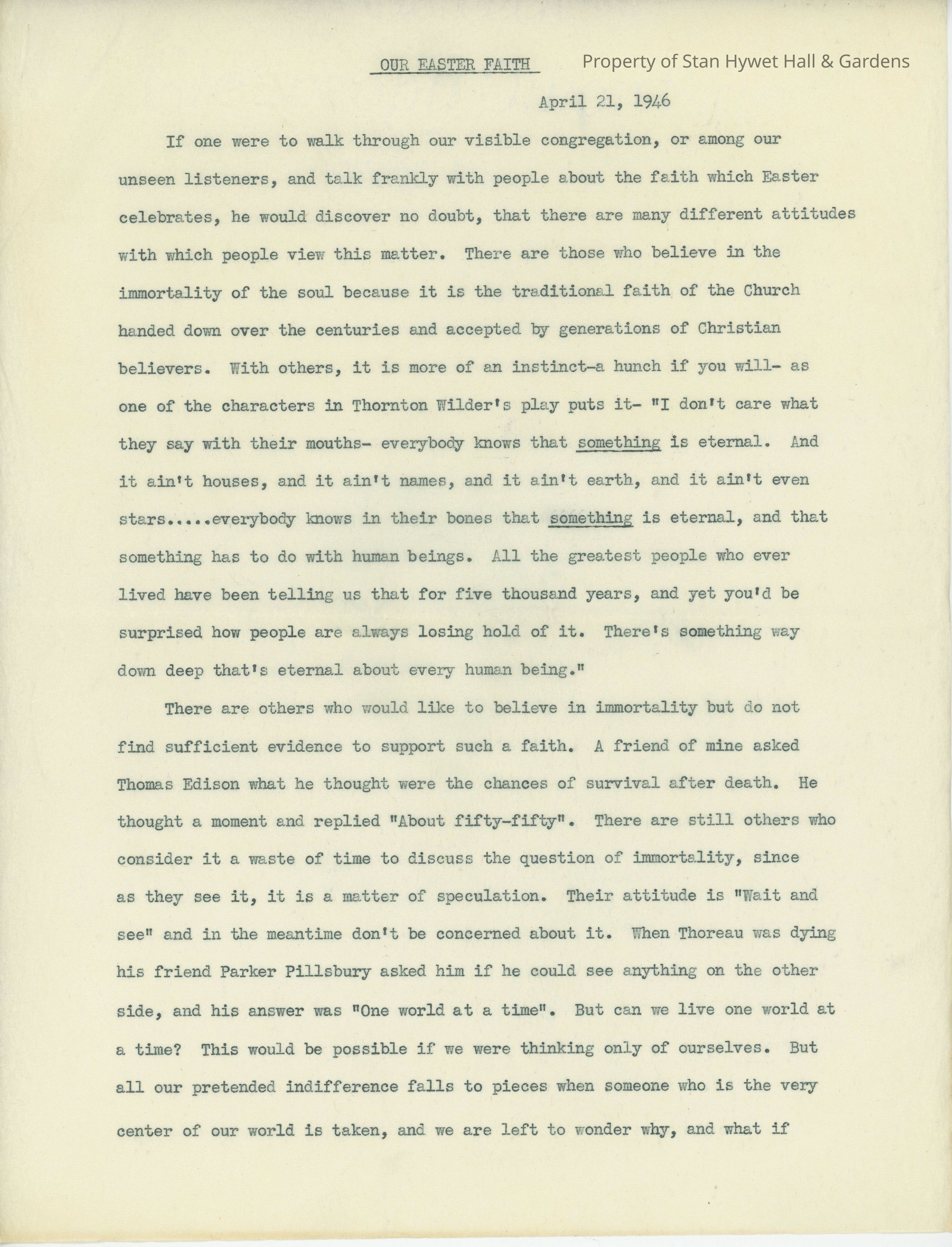
OUR EASTER FAITH
April 21, 1946
If one were to walk through our visible congregation, or among our unseen listeners, and talk frankly with people about the faith which Easter celebrates, he would discover no doubt, that there are many different attitudes with which people view this matter. There are those who believe in the immortality of the soul because it is the traditional faith of the Church handed down over the centuries and accepted by generations of Christian believers. With others, it is more of an instinct-a hunch if you will- as one of the characters in Thornton Wilder’s play puts it- “I don’t care what they say with their mouths- everyone knows that something is eternal. And it ain’t houses, and it ain’t names, and it ain’t earth, and it ain’t even stars…. everybody knows in their bones that something is eternal, and that something has to do with human beings. All the greatest people who ever lived have been telling us that for five thousand years, and yet you’d be surprised how people are always losing hold of it. There’s something way down deep that’s eternal about every human being.”
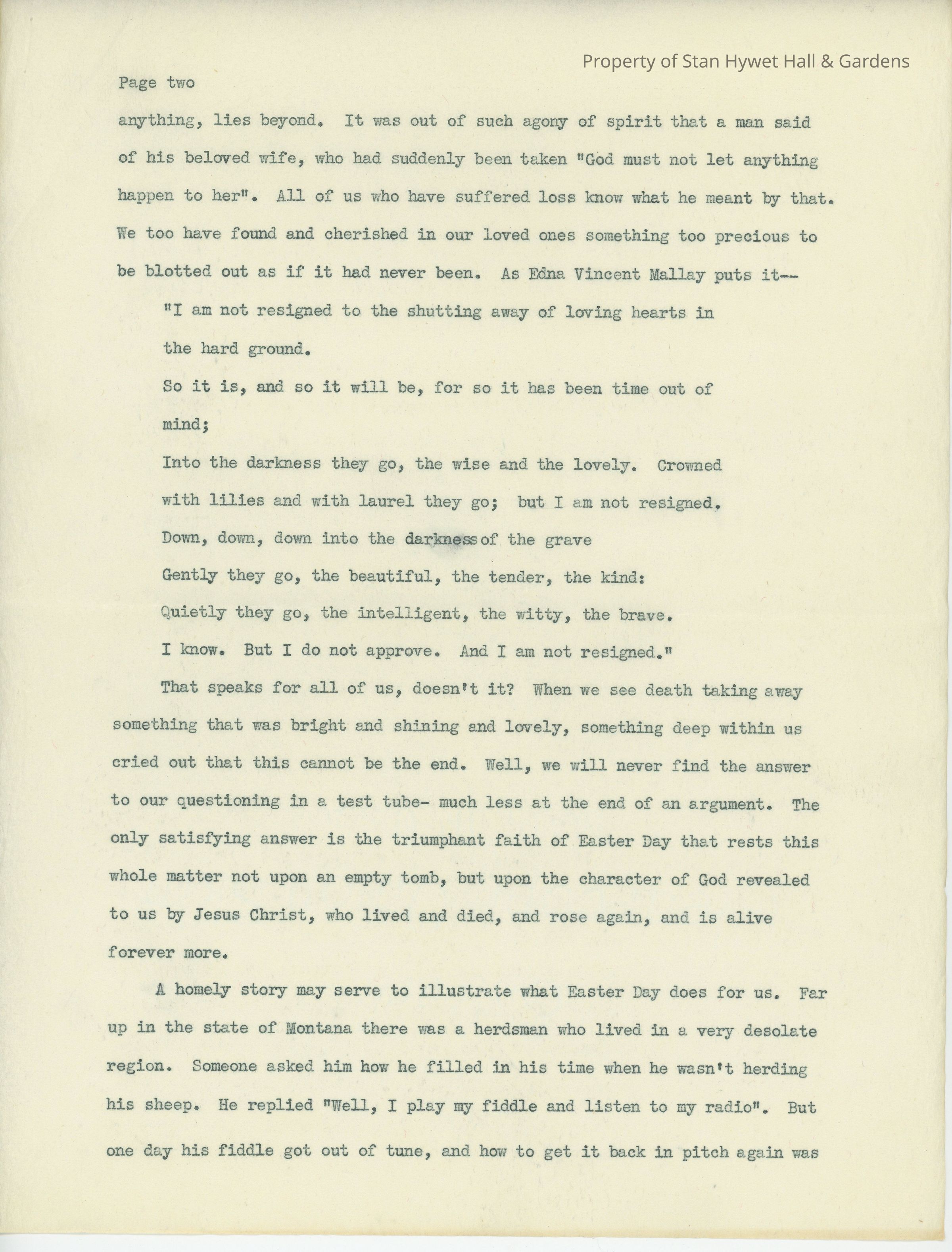
There are others who would like to believe in immortality but do not find sufficient evidence to support such a faith. A friend of mine asked Thomas Edison what he thought were the chances of survival after death. He thought a moment and replied “About fifty-fifty”. There are still others who consider it a waste of time to discuss the question of immortality, since as they see it, it is a matter of speculation. Their attitude is “Wait and see” and in the meantime don’t be concerned about it. When Thoreau was dying his friend Parker Pillsbury asked him if he could see anything on the other side, and his answer was “One world at a time”. But can we live one world at a time? This would be possible if we were thinking only of ourselves. But all our pretended indifference falls to pieces when someone who is the very center of our world is taken, and we are left to wonder why, and what if anything, lies beyond. It was out of such agony of spirit that a man said of his beloved wife, who had suddenly been taken “God must not let anything happen to her”. All of us who have suffered loss know what he meant by that. We too have found and cherished in our loved ones something too precious to be blotted out as if it had never been. As Edna Vincent Mallay puts it–
“I am not resigned to the shutting away of loving hearts in the hard ground.
So it is, and so it will be, for so it has been time out of mind;
Into the darkness they go, the wise and the lovely. Crowned with lilies and with laurel they go; but I am not resigned.
Down, down, down into the darkness of the grave
Gently they go, the beautiful, the tender, the kind:
Quietly they go, the intelligent, the witty, the brave.
I know. But I do not approve. And I am not resigned.”
That speaks for all of us, doesn’t it? When we see death taking away something that was bright and shining and lovely, something deep within us cried out that this cannot be the end. Well, we will never find the answer to our questioning in a test tube- much less at the end of an argument. The only satisfying answer is the triumphant faith of Easter Day that rest this whole matter not upon an empty tomb, but upon the character of God revealed to us by Jesus Christ, who lived and died, and rose again, and is alive forever more.
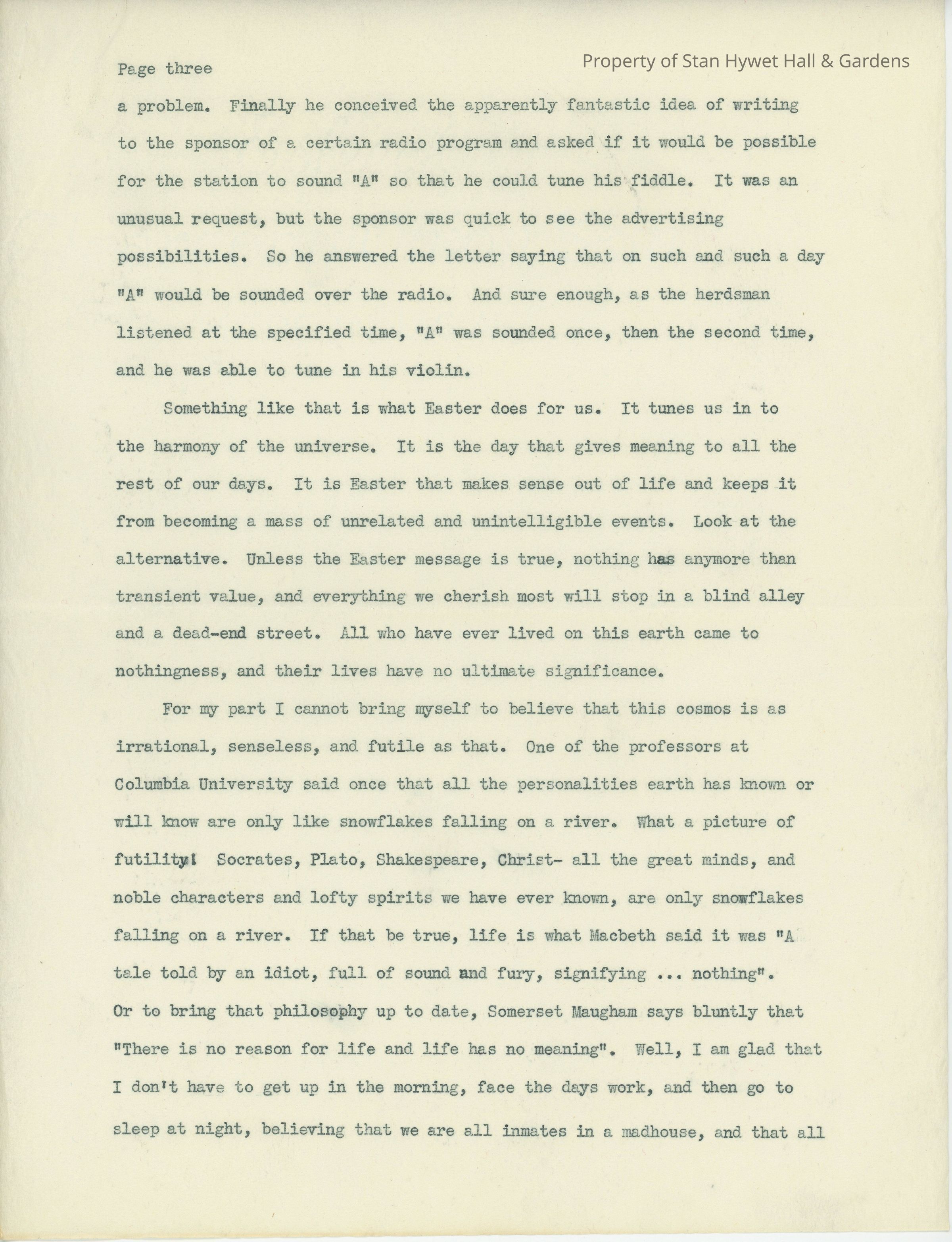
A homely story may serve to illustrate what Easter Day does for us. Far up in the state of Montana there was a herdsman who lived in a very desolate region. Someone asked him how he filled in his time when he wasn’t herding his sheep. He replied “Well, I play my fiddle and listen to my radio”. But one day his fiddle got out of tune, and how to get it back in pitch again was a problem. Finally he conceived the apparently fantastic idea of writing to the sponsor of a certain radio program and asked if it would be possible for the station to sound “A” so that he could tune his fiddle. It was an unusual request, but the sponsor was quick to see the advertising possibilities. So he answered the letter saying that on such and such a day “A” would sound over the radio. And sure enough, as the herdsman listened at the specified time, “A” was sounded once, then the second time, and he was able to tune in his violin.
Something like that is what Easter does for us. It tunes us in to the harmony of the universe. It is the day that gives meaning to all the rest of our days. It is Easter that makes sense out of life and keeps it from becoming a mass of unrelated and unintelligible events. Look at the alternative. Unless the Easter message is true, nothing has anymore than transient value, and everything we cherish most will stop in a blind alley and a dead-end street. All who have ever lived on this earth came to nothingness, and their lives have no ultimate significance.
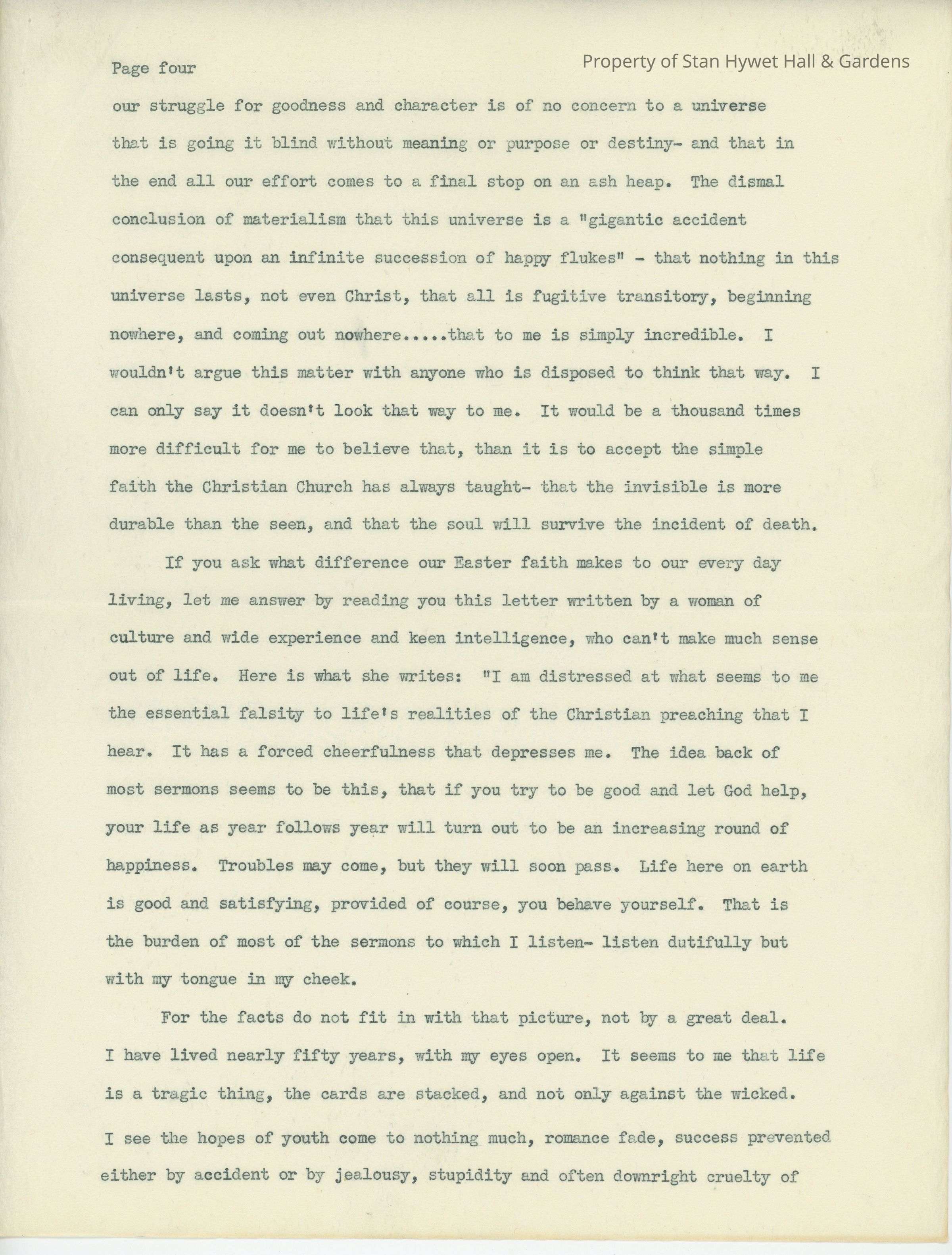
For my part I cannot bring myself to believe that this cosmos is as irrational, senseless, and futile as that. One of the professors at Columbia University said once that all the personalities earth has known or will know are only like snowflakes falling on a river. What a picture of futility: Socrates, Plato, Shakespeare, Christ- all the great minds, and noble characters and lofty spirits we have ever known, are only snowflakes falling on a river. If that be true, life is what Macbeth said it was “A tale told by an idiot, full of sound and fury, signifying …nothing”. Or to bring that philosophy up to date, Somerset Maugham says bluntly that “There is no reason for life and life has no meaning”. Well, I am glad that I don’t have to get up in the morning, face the days work, and then go to sleep at night, believing that we are all inmates in a madhouse, and that all our struggle for goodness and character is of no concern to a universe that is going it [sic] blind without meaning or purpose or destiny- and that in the end all our effort comes to a final stop on an ash heap. The dismal conclusion of materialism that this universe is a “gigantic accident consequent upon an infinite succession of happy flukes”- that nothing in this universe lasts, not even Christ, that all is fugitive transitory, beginning nowhere, and coming out nowhere…. that to me is simple incredible. I wouldn’t argue this matter with anyone who is disposed to think that way. I can only say it doesn’t look that way to me. It would be a thousand times more difficult for me to believe that, than it is to accept the simple faith the Christian Church has always taught- that the invisible is more durable than the seen, and that the soul will survive the incident of death.
If you ask what difference our Easter faith makes to our every day living, let me answer by reading you this letter written by a woman of culture and wide experience and keen intelligence, who can’t make much sense out of life. Here is what she writes: “I am distressed at what seems to me the essential falsity to life’s realities of the Christian preaching that I hear. It has a forced cheerfulness that depresses me. The idea back of most sermons seems to be this, that if you try to be good and let God help, your life as year follows year will turn out to be an increasing round of happiness. Troubles may come, but they will soon pass. Life here on earth is good and satisfying, provided of course, you behave yourself. That is the burden of most of the sermons to which I listen- listen dutifully but with my tongue in my cheek.
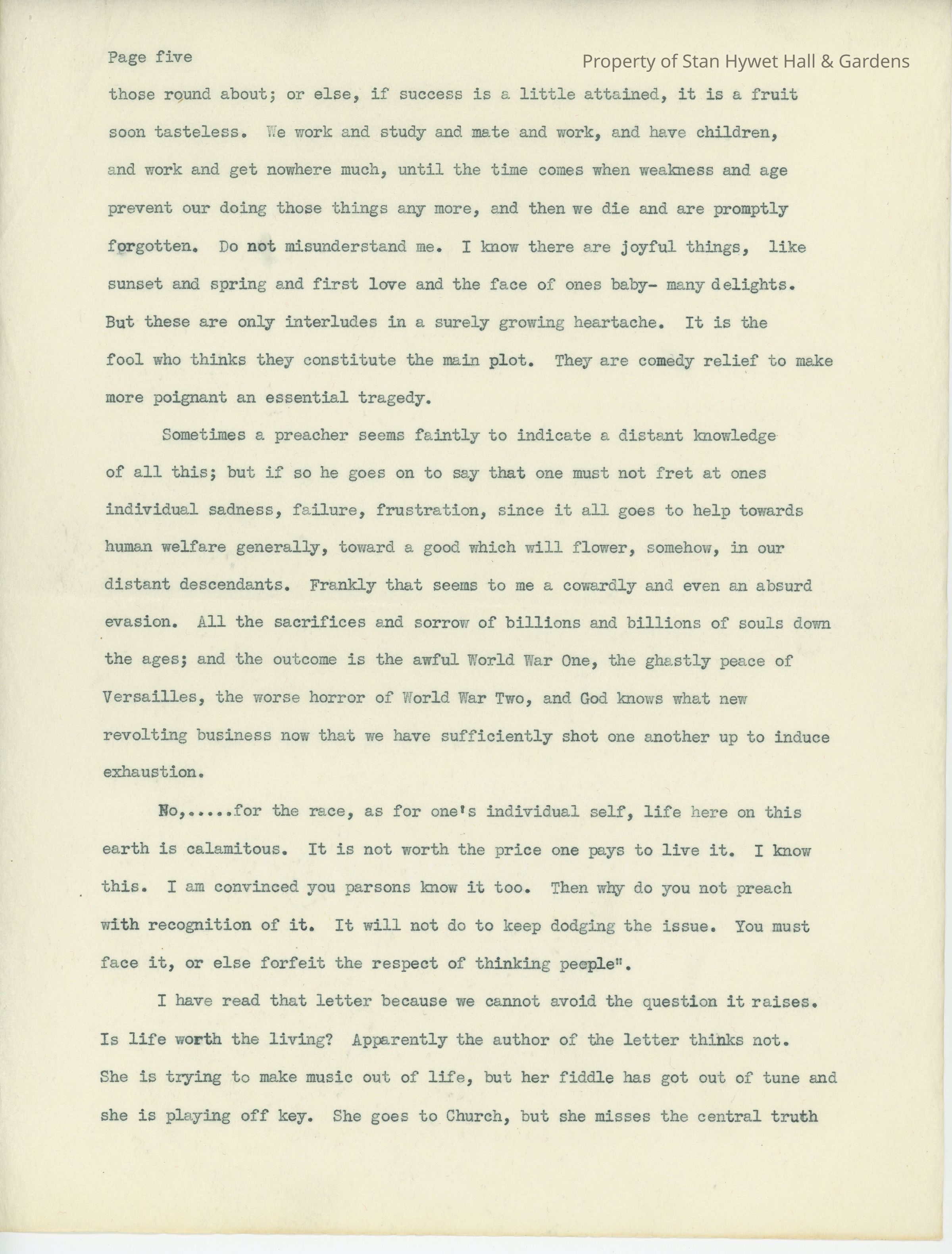
For the facts do not fit in with that picture, not by a great deal. I have lived nearly fifty years, with my eyes open. It seems to me that life is a tragic thing, the cards are stacked, and not only against the wicked. I see the hopes of youth come to nothing much, romance fade, success prevented either by accident or jealousy, stupidity and often downright cruelty of those round about; or else, if success is a little attained, it is a fruit soon tasteless. We work and study and mate and work, and have children, and work and get nowhere much, until the time comes when weakness and age prevent our doing those things any more, and then we die and are promptly forgotten. Do not misunderstand me. I know there are joyful things, like sunset and spring and first love and the face of ones baby- many delights. But these are only interludes in a surely growing heartache. It is the fool who thinks they constitute the main plot. They are comedy relief to make more poignant an essential tragedy.
Sometimes a preacher seems faintly to indicate a distant knowledge of all this; but if so he goes on to say that one must not fret at ones individual sadness, failure, frustration, since it all goes to help towards human welfare generally, toward a good which will flower, somehow, in our distant descendants. Frankly that seems to me a cowardly and even an absurd evasion. All the sacrifices and sorrow of billions and billions of souls down the ages; and the outcome is the awful World War One, the ghastly peace of Versailles, the worse horror of World War Two, and God knows what new revolting business now that we have sufficiently shot one another up to induce exhaustion.
No,…… for the race, as for one’s individual self, life here on this earth is calamitous. It is not worth the price one pays to live it. I know this. I am convinced you parsons know it too. Then why do you not preach with recognition of it. It will not do to keep dodging the issue. You must face it, or else forfeit the respect of thinking people”.
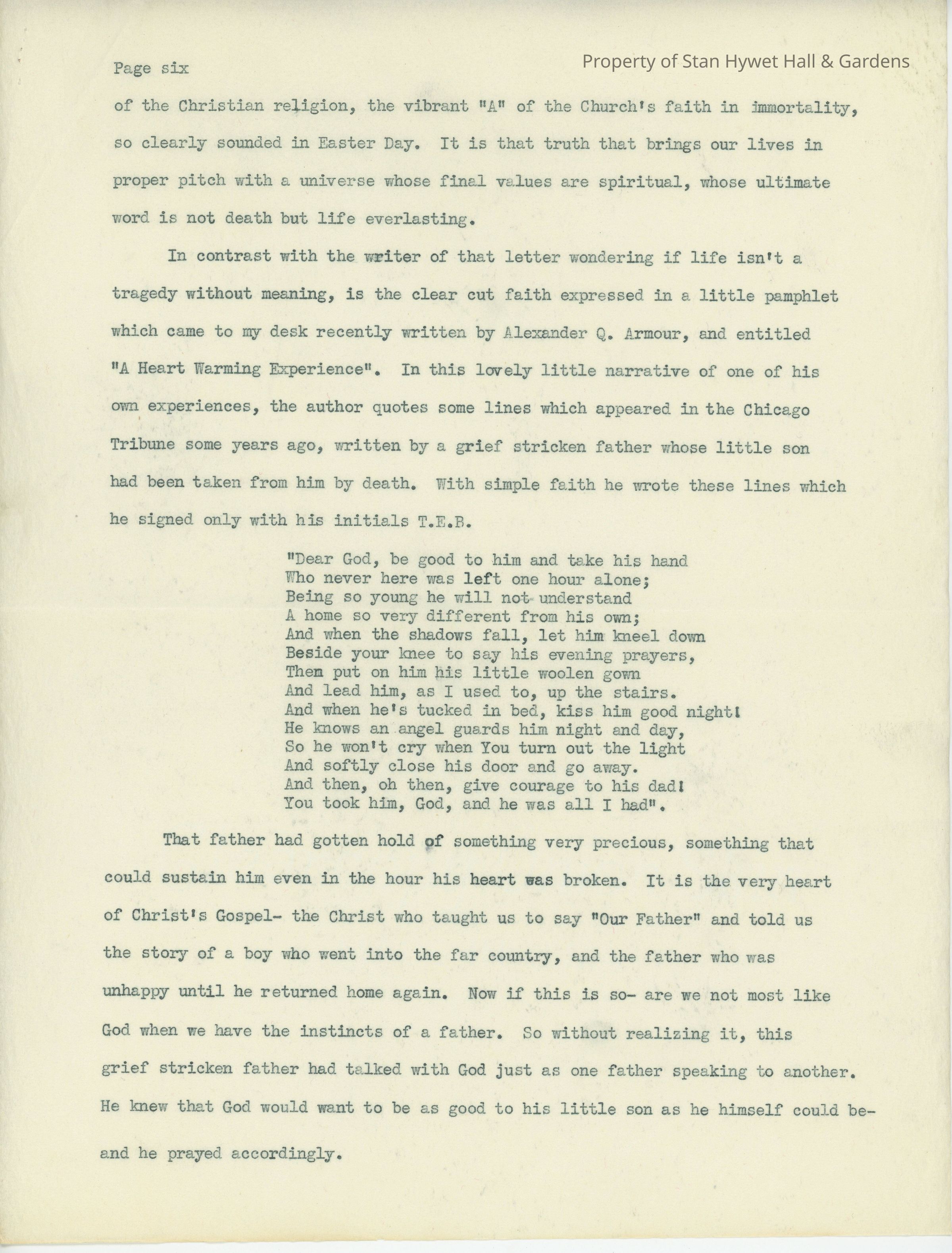
I have read that letter because we cannot avoid the question it raises. Is life worth the living? Apparently the author of the letter thinks not. She is trying to make music out of life, but her fiddle has got out of tune and she is playing off key. She goes to Church, but she misses the central truth of the Christian religion, the vibrant “A” of the Church’s faith in immortality, so clearly sounded in Easter Day. It is that truth that brings our lives in proper pitch with a universe whose final values are spiritual, whose ultimate word is not death but life everlasting.
In contrast with the writer of that letter wondering if life isn’t a tragedy without meaning, is the clear cut faith expressed in a little pamphlet which came to my desk recently written by Alexander Q. Armour, and entitled “A Heart Warming Experience”. In this lovely little narrative of one of his own experiences, the author quotes some lines which appeared in the Chicago Tribune some years ago, written by a grief stricken [sic] father whose little son had been taken from him by death. With simple faith he wrote these lines which he signed only with his initials T.E.B.
“Dear God, be good to him and take his hand
Who never here was left one hour alone;
Being so young he will not understand
A home so very different from his own;
And when the shadows fall, let him kneel down
Beside your knee to say his evening prayers,
Then put on him his little woolen gown
And lead him, as I used to, up the stairs.
And when he’s tucked in bed, kiss him good night:
He knows an angel guards him night and day,
So he won’t cry when You turn out the light
And softly close his door and go away.
And then, oh then, give courage to his dad:
You took him, God, and he was all I had”.
That father had gotten hold of something very precious, something that could sustain him even in the hour his heart was broken. It is the very heart of Christ’s Gospel- the Christ who taught us to say “Our Father” and told us the story of a boy who went into the far country, and the father who was unhappy until he returned home again. Now if this is so- are we not most like God when we have the instincts of a father. So without realizing it, this grief stricken father had talked with God just as one father speaking to another. He knew that God would want to be as good to his little son as he himself could be- and he prayed accordingly.
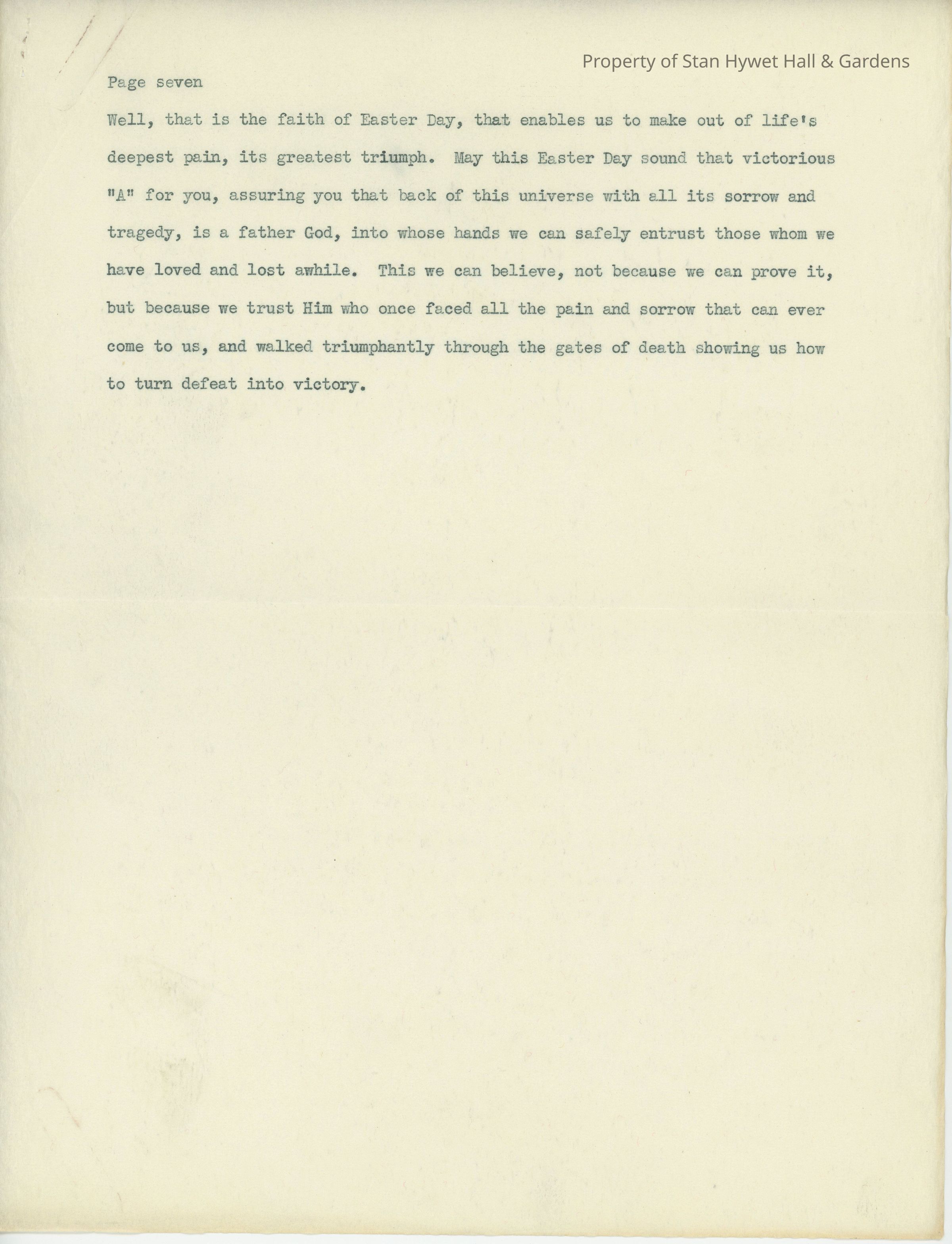
Well, that is the faith of Easter Day, that enables us to make out of life’s deepest pain, its greatest triumph. May this Easter Day sound that victorious “A” for you, assuring you that back of this universe with all of its sorrow and tragedy, is a father God, into whose hands we can safely entrust those whom we have loved and lost awhile. This we can believe, not because we can prove it, but because we trust Him who once faced all the pain and sorrow that can ever come to us, and walked triumphantly through the gates of death showing us how to turn defeat into victory.Transcriber
Cindi RokeLanguage
EnglishNotes
b