Transcription
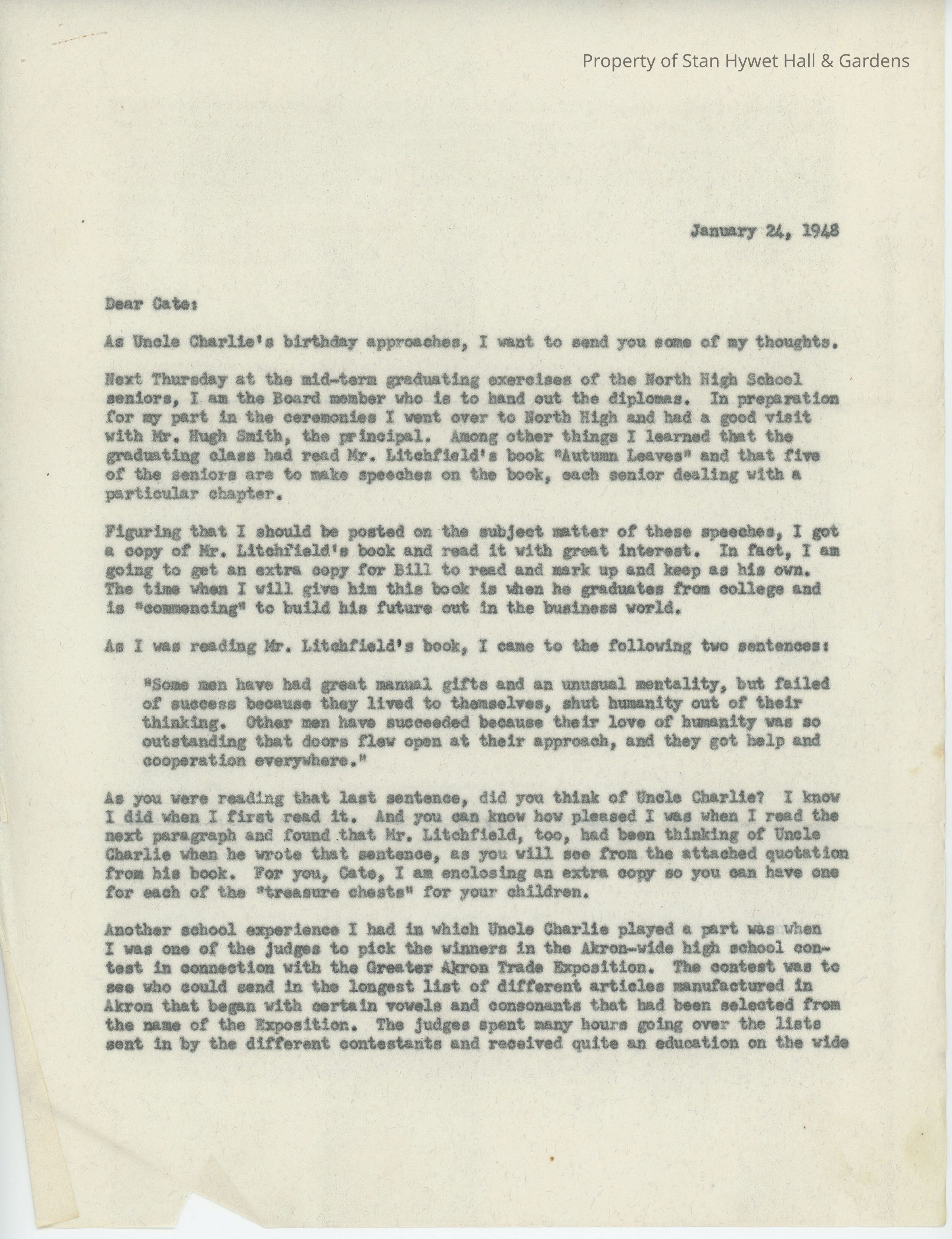
January 24, 1948
Dear Cate:
As Uncle Charlie’s birthday approaches, I want to send you some of my thoughts.
Next Thursday at the mid-term graduating exercises of the North High School seniors, I am the Board member who is to hand out the diplomas. In preparation for my part in the ceremonies I went over to North High and had a good visit with Mr. Hugh Smith, the principal. Among other things I learned that the graduating class had read Mr. Litchfield’s book “Autumn Leaves” and that five of the seniors are to make speeches on the book, each senior dealing with a particular chapter.
Figuring that I should be posted on the subject matter of these speeches, I got a copy of Mr. Litchfield’s book and read it with great interest. In fact, I am going to get an extra copy for Bill to read and mark up and keep as his own. The time when I will give him this book is when he graduates from college and is “commencing” to build his future out in the business world.
As I was reading Mr. Litchfield’s book, I came to the following two sentences:
“Some men have had great manual gifts and an unusual mentality, but failed of success because they lived to themselves, shut humanity out of their thinking. Other men have succeeded because their love of humanity was so outstanding that doors flew open at their approach, and they got help and cooperation everywhere.”
As you were reading that last sentence, did you think of Uncle Charlie? I know I did when I first read it. And you can know how pleased I was when I read the next paragraph and found that Mr. Litchfield, too, had been thinking of Uncle Charlie when he wrote that sentence, as you will see from the attached quotation from his book. For you, Cate, I am enclosing an extra copy so you can have one for each of the “treasure chests” for your children.
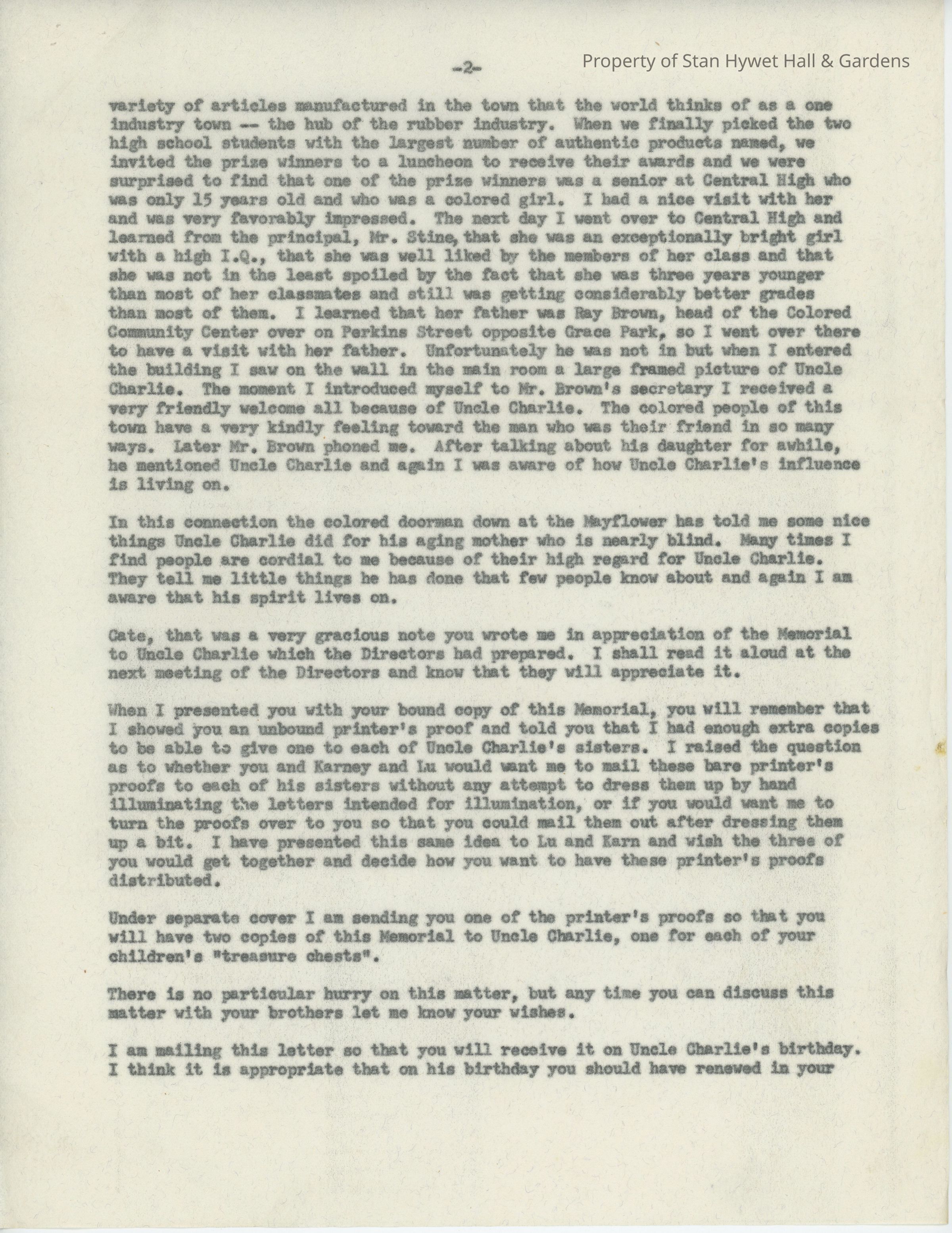
Another school experience I had in which Uncle Charlie played a part was when I was one of the judges to pick the winners in the Akron-wide high school contest in connection with the Greater Akron Trade Exposition. The contest was to see who could send in the longest list of different articles manufactured in Akron that began with certain vowels and consonants that had been selected from the name of the Exposition. The judges spent many hours going over the lists sent in by the different contestants and received quite an education on the wide variety of articles manufactured in the town that the world thinks of as a one industry town – the hub of the rubber industry. When we finally picked the two high school students with the largest number of authentic products named, we invited the prize winners to a luncheon to receive their awards and we were surprised to find that one of the prize winners was a senior at Central High who was only 15 years old and who was a colored girl. I had a nice visit with her and was very favorably impressed. The next day I went over to Central High and learned from the principal, Mr. Stine, that she was an exceptionally bright girl with a high I.Q., that she was well liked by the members of her class and that she was not in the least spoiled by the fact that she was three years younger than most of her classmates and still was getting considerably better grades than most of them. I learned that her father was Ray Brown, head of the Colored Community Center over on Perkins Street opposite Grace Park, so I went over there to have a visit with her father. Unfortunately he was not in but when I entered the building I saw on the wall in the main room a large framed picture of Uncle Charlie. The moment I introduced myself to Mr. Brown’s secretary I received a very friendly welcome all because of Uncle Charlie. The colored people of this town have a very kindly feeling toward the man who was their friend in so many ways. Later Mr. Brown phoned me. After talking about his daughter for awhile, he mentioned Uncle Charlie and again I was aware of how Uncle Charlie’s influence is living on.
In this connection the colored doorman down at the Mayflower has told me some nice things Uncle Charlie did for his aging mother who is nearly blind. Many times I find people are cordial to me because of their high regard for Uncle Charlie. They tell me little things he has done that few people know about and again I am aware that his spirit lives on.
Cate, that was a very gracious note you wrote me in appreciation of the Memorial to Uncle Charlie which the Directors had prepared. I shall read it aloud at the next meeting of the Directors and know that they will appreciate it.
When I presented you with your bound copy of this Memorial, you will remember that I showed you an unbound printer’s proof and told you that I had enough extra copies to be able to give one to each of Uncle Charlie’s sisters. I raised the question as to whether you and Karney and Lu would want me to mail these bare printer’s proofs to each of his sisters without any attempt to dress them up by hand illuminating the letters intended for illumination, or if you would want me to turn the proofs over to you so that you could mail them out after dressing them up a bit. I have presented this same idea to Lu and Karn and wish the three of you would get together and decide how you want to have these printer’s proofs distributed.
Under separate cover I am sending you one of the printer’s proofs so that you will have two copies of this Memorial to Uncle Charlie, one for each of your children’s “treasure chests”.
There is no particular hurry on this matter, but any time you can discuss this matter with your brothers let me know your wishes.
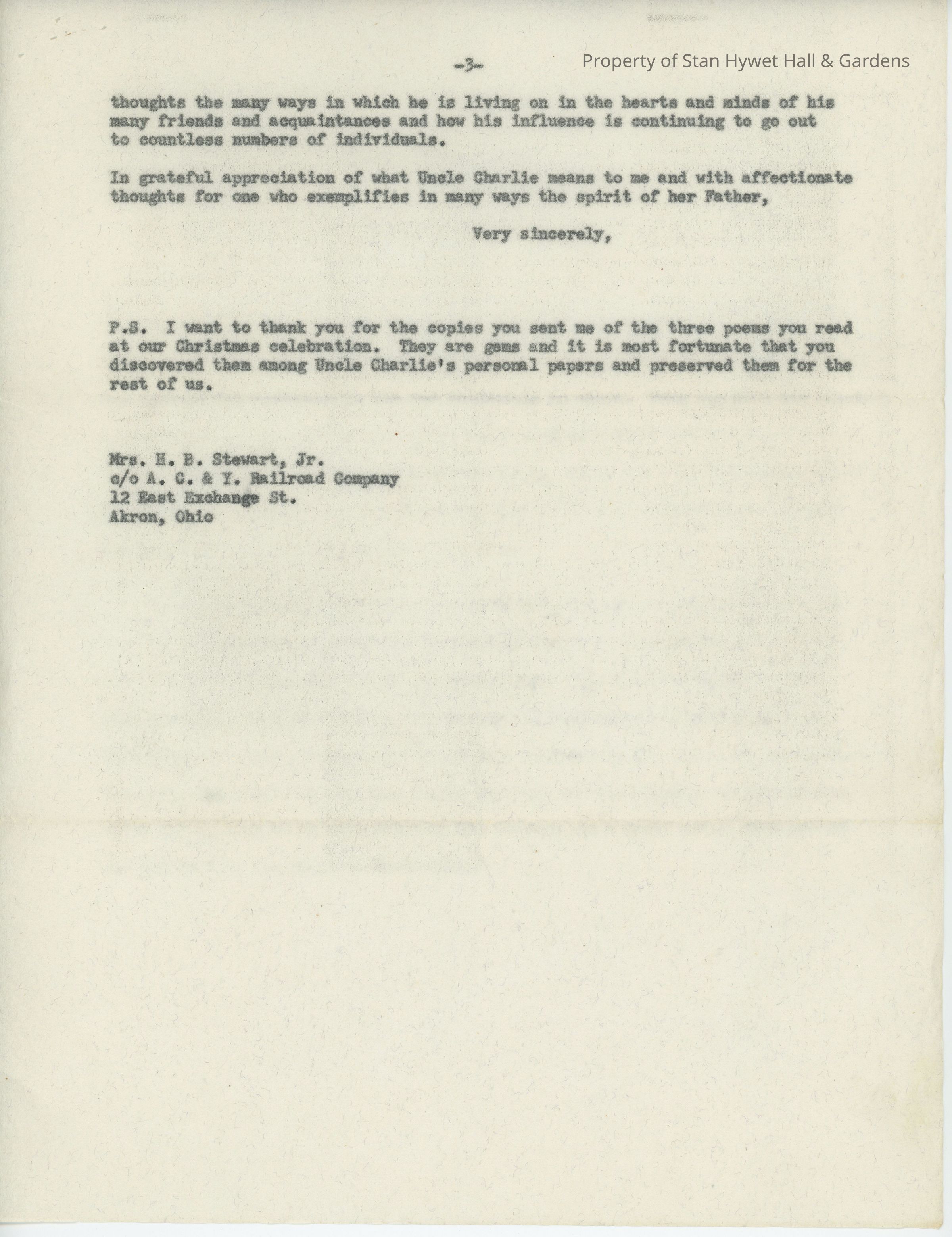
I am mailing this letter so that you will receive it on Uncle Charlie’s birthday. I think it is appropriate that on his birthday you should have renewed in your thoughts the many ways in which he is living on in the hearts and minds of his many friends and acquaintances and how his influence is continuing to go out to countless numbers of individuals.
In grateful appreciation of what Uncle Charlie means to me and with affectionate thoughts for one who exemplifies in many ways the spirit of her Father,
Very sincerely,
P.S. I want to thank you for the copies you sent me of the three poems you read at our Christmas celebration. They are gems and it is most fortunate that you discovered them among Uncle Charlie’s personal papers and preserved them for the rest of us.
Mrs. H. B. Stewart, Jr.
c/o A. C. & Y. Railroad Company
12 East Exchange St.
Akron, OhioTranscriber
Cindi RokeLanguage
EnglishNotes
aTranscription
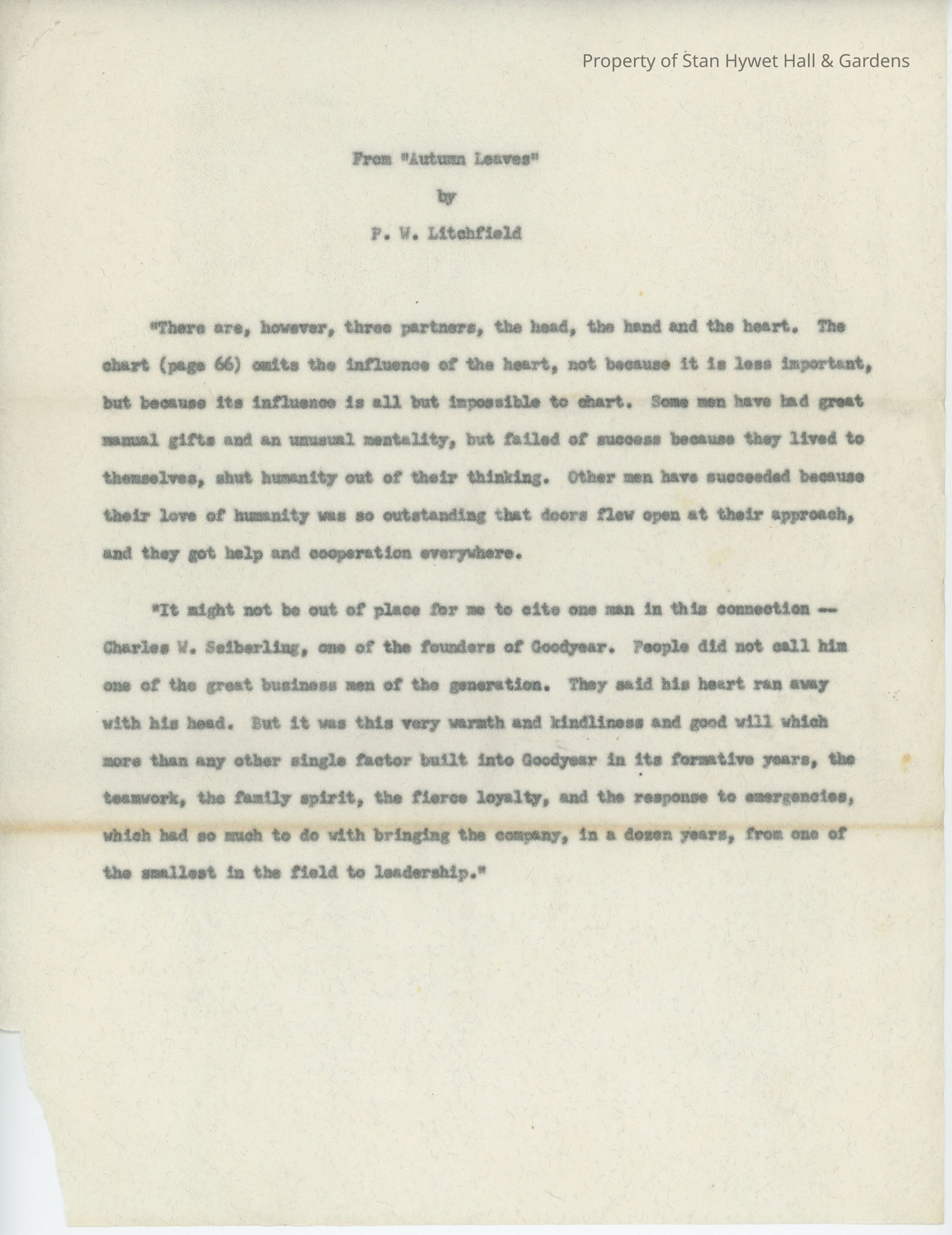
From “Autumn Leaves”
by
P.W. Litchfield
“There are, however, three partners, the head, the hand and the heart. The chart (page 66) omits the influence of the heart, not because it is less important, but because its influence is all but impossible to chart. Some men have had great manual gifts and an unusual mentality, but failed of success because they lived to themselves, shut humanity out of their thinking. Other men have succeeded because their love of humanity was so outstanding that doors flew open at their approach, and they got help and cooperation everywhere.
“It might not be out of place for me to cite one man in this connection – Charles W. Seiberling, one of the founders of Goodyear. People did not call him one of the great business men [sic] of the generation. They said his heart ran away with his head. But it was this very warmth and kindliness and good will which more than any other factor built into Goodyear in its formative years, the teamwork, the family spirit, the fierce loyalty, and the response to emergencies, which had so much to do with bringing the company, in a dozen years, from one of the smallest in the field to leadership.”Transcriber
Cindi RokeLanguage
EnglishNotes
c