Name/Title
Letter: Willard Seiberling to the Seiberling FamilyEntry/Object ID
A 2025.16.b1.f5.16Description
The letter is a copy addressed to "Family." The letter is titled "No. 12." The writer opens the letter stating tomorrow they start the last week of their memorable tour. The writer shares they have had a strenous sixth week, arriving in France three days behind schedule, and recaps their visits to St. Gilles, Pont-du-Gard, Nimes, Roman gardens, Greek Temple, Aigues-Nortes, Carcassonne, and Albi. The writer mentions that covers the first half of the week and that Judy is writing about the last half of the week, then writing final letters next week. The writer closes the letter sharing that Judy and John leave on the 24th via the Queen Mary and the writer will fly from Paris. The writer ends the letter with "Love to all, Willard."Subject Person/Organization
Seiberling, Willard Penfield, Shaw, Julia Seiberling, Shaw, John BurnhamSubject Place
Country
FranceContinent
EuropeCollection
PERMANENT COLLECTIONCataloged By
Katrina NeffAcquisition
Accession
A 2025.16Source or Donor
UnknownAcquisition Method
FoundLetter Details
Letter Date
Apr 15, 1951Sender
Name
Willard SeiberlingAddress
Tours, FrancePrimary Language
EnglishTranscription
Transcription
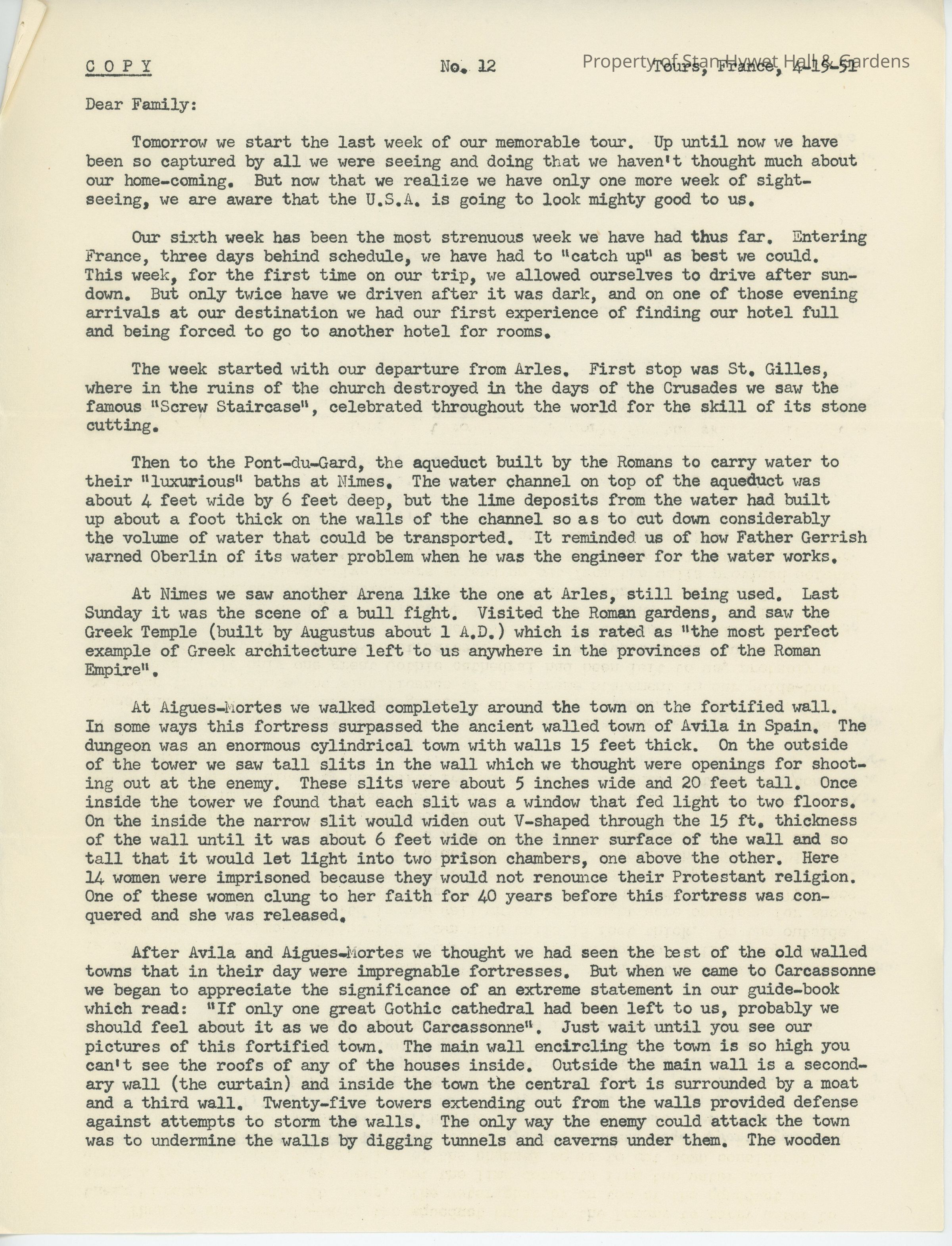
C O P Y No. 12 Tours, France, 4-15-51
Dear Family:
Tomorrow we start the last week of our memorable tour. Up until now we have been so captured by all we were seeing and doing that we haven’t thought much about our home-coming. But now that we realize we have only one more week of sight-seeing, we are aware that the U.S.A. is going to look mighty good to us.
Our sixth week has been the most strenuous week we have had thus far. Entering France, three days behind schedule, we have had to “catch up” as best we could. This week, for the first time on our trip, we allowed ourselves to drive after sundown. But only twice have we driven after it was dark, and on one of those evening arrivals at our destination we had our first experience of finding our hotel full and being forced to go to another hotel for rooms.
The week started with our departure from Arles. First stop was St. Gilles, where in the ruins of the church destroyed in the days of the Crusades we saw the famous “Screw Staircase”, celebrated throughout the world for the skill of its stone cutting.
Then on to the Pont-du-Gard, the aqueduct built by the Romans to carry water to their “luxurious” baths at Nimes. The water channel on top of the aqueduct was about 4 feet wide by 6 feet deep, but the lime deposits from the water had built up about a foot thick on the walls of the channel so as to cut down considerably the volume of water that could be transported. It reminded us of how Father Gerrish warned Oberlin of its water problem when he was the engineer for the water works.
At Nimes we saw another Arena like the one at Arles, still being used. Last Sunday it was the scene of a bull fight. Visited the Roman gardens, and saw the Greek Temple (built by Augustus about 1 A.D.) which is rated as “the most perfect example of Greek architecture left to us anywhere in the provinces of the Roman Empire”.
At Aigues-Mortes we walked completely around the town on the fortified wall. In some ways this fortress surpassed the ancient walled town of Avila in Spain. The dungeon was an enormous cylindrical town with walls 15 feet thick. On the outside of the tower we saw tall slits in the wall which we thought were openings for shooting out at the enemy. These slits were about 5 inches wide and 20 feet tall. Once inside the tower we found that each slit was a window that fed light to two floors. On the inside the narrow slit would widen out V-shaped through the 15 ft. thickness of the wall until it was about 6 feet wide on the inner surface of the wall and so tall that it would let light into two prison chambers, one above the other. Here 14 women were imprisoned because they would not renounce their Protestant religion. One of these women clung to her faith for 40 years before this fortress was conquered and she was released.
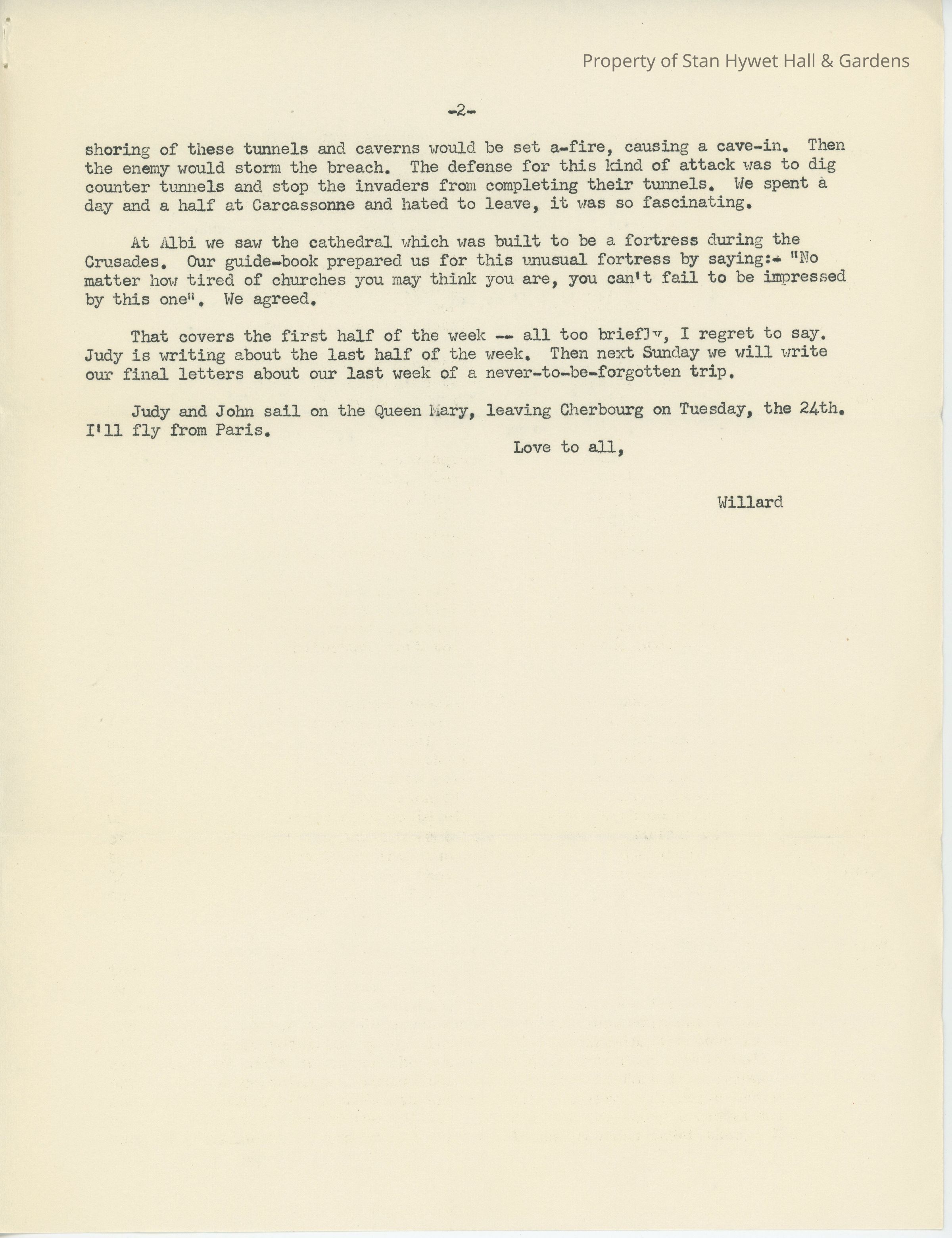
After Avila and Aigues-Mortes we thought we had seen the best of the old walled towns that in their day were impregnable fortresses. But when we came to Carcassonne we began to appreciate the significance of an extreme statement in our guide-book which read: “If only one great Gothic cathedral had been left to us, probably we should feel about it as we do about Carcassonne”. Just wait until you see our pictures of this fortified town. The main wall encircling the town is so high you can’t see the roofs of any of the houses inside. Outside the main wall is a secondary wall (the curtain) and inside the town the central fort is surrounded by a moat and a third wall. Twenty-five towers extending out from the walls provided defense against attempts to storm the walls. The only way the enemy could attack the town was to undermine the walls by digging tunnels and caverns under them. The wooden shoring of these tunnels and caverns would be set a-fire, causing a cave-in. Then the enemy would storm the breach. The defense for this kind of attack was to dig counter tunnels and stop the invaders from completing their tunnels. We spent a day and a half at Carcassonne and hated to leave, it was so fascinating.
At Albi we saw the cathedral which was built to be a fortress during the Crusades. Our guide-book prepared us for this unusual fortress by saying:- “No matter how tired of churches you may think you are, you can’t fail to be impressed by this one”. We agreed.
That covers the first half of the week – all too briefly, I regret to say. Judy is writing about the last half of the week. Then next Sunday we will write our final letters about our last week of a never-to-be-forgotten trip.
Judy and John sail on the Queen Mary, leaving Cherbourg on Tuesday, the 24th. I’ll fly from Paris.
Love to all,
WillardTranscriber
Cindi RokeLanguage
EnglishResearch Notes
Research Type
Content ResearchPerson
Katrina NeffDate
Sep 30, 2026Notes
Believe the "Greek Temple" they are referring to in Nimes, France is the Maison Carree, a Roman temple constructed by Augustus in 2 A.D.Create Date
April 27, 2026Update Date
September 30, 2026