Transcription
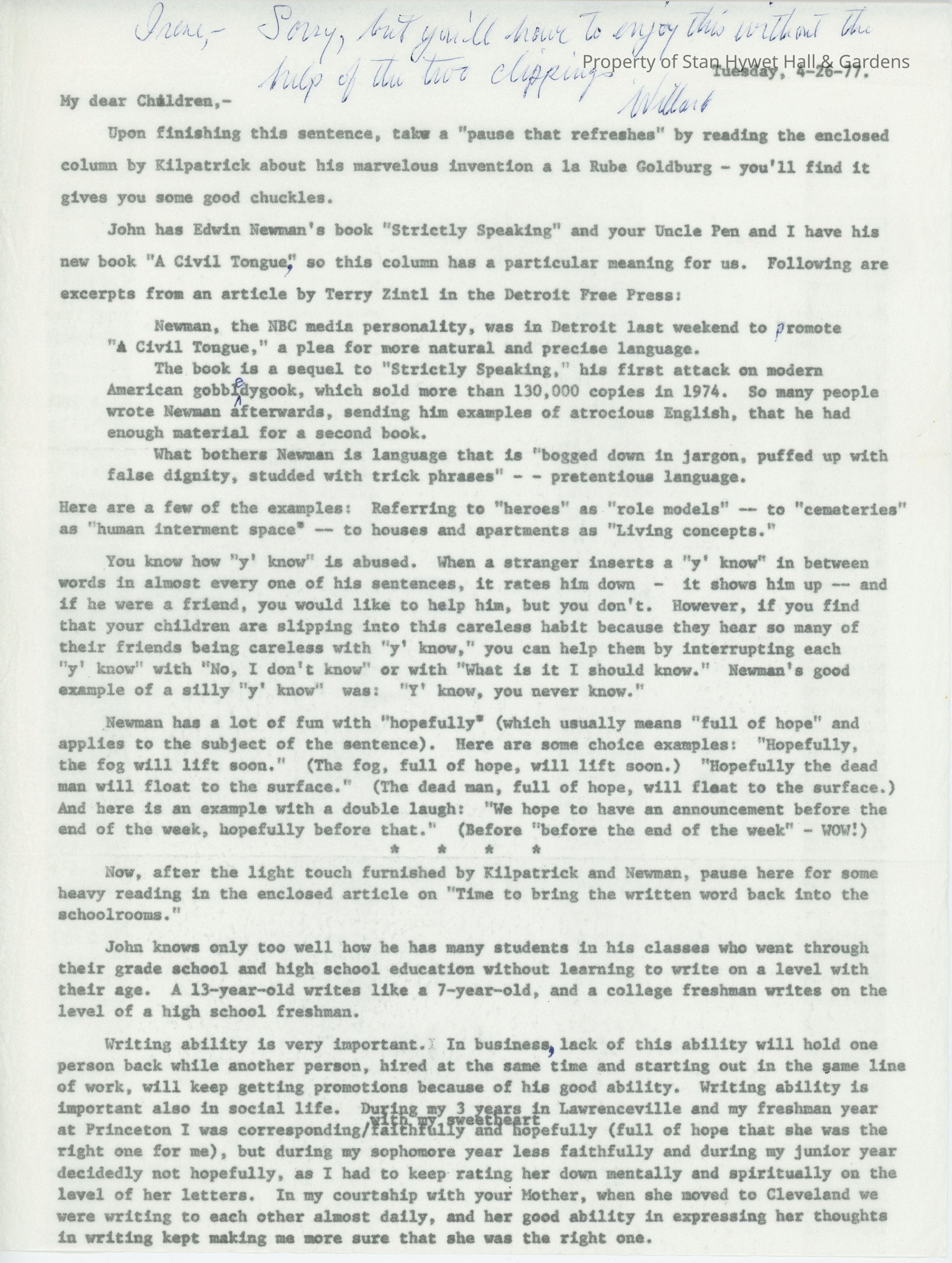
Irene,- Sorry, but you’ll have to enjoy this without the help of the two clippings.
Willard
Tuesday, 4-26-77.
My dear Children, -
Upon finishing this sentence, takw [sic] a “pause that refreshes” by reading the enclosed column by Kilpatrick about his marvelous invention a la Rube Goldburg - you’ll find it gives you some good chuckles.
John has Edwin Newman’s book “Strictly Speaking” and your Uncle Pen and I have his new book “A Civil Tongue,” so this column has a particular meaning for us. Following are excerpts from an article by Terry Zintl in the Detroit Free Press:
Newman, the NBC media personality, was in Detroit last weekend to promote “A Civil Tongue”, a plea for more natural and precise language.
The book is a sequel to “Strictly Speaking”, his first attack on modern American gobbledygook, which sold more than 130,000 copies in 1974. So many people wrote Newman afterwards, sending him examples of atrocious English, that he had enough material for a second book.
What bothers Newman is language that is “bogged down in jargon, puffed up with false dignity, studded with trick phrases” - - pretentious language.
Here are a few of the examples: Referring to “heroes” as “role models” – to “cemeteries” as “human interment space” -- to houses and apartments as “Living concepts.”
You know how “y’ know” is abused. When a stranger inserts a “y’ know” in between words in almost every one of his sentences, it rates him down - it shows him up – and if he were a friend, you would like to help him, but you don’t. However, if you find that your children are slipping into this careless habit because they hear so many of their friends being careless with “y’ know,” you can help them by interrupting each “y’ know” with “No, I don’t know” or “What is it I should know.” Newman’s good example of a silly “y’ know” was: “Y’ know, you never know.”
Newman has a lot of fun with “hopefully” (which usually means “full of hope” and applies to the subject of the sentence). Here are some choice examples: “Hopefully, the fog will lift soon.” (The fog, full of hope, will lift soon.) “Hopefully the dead man will float to the surface.” (The dead man, full of hope, will float to the surface.) And here is an example with a double laugh: “We hope to have an announcement before the end of the week, hopefully before that.” (Before “before the end of the week” – WOW!)
* * * *
Now, after the light touch furnished by Kilpatrick and Newman, pause here for some heavy reading in the enclosed article on “Time to bring the written word back into the schoolrooms.”
John knows only too well how he has many students in his classes who went through their grade school and high school education without learning to write on a level with their age. A 13-year-old writes like a 7-year-old, and a college freshman writes on the level of a high school freshman.
Writing ability is very important. In business, lack of this ability will hold one person back while another person, hired at the same time and starting out in the same line of work, will keep getting promotions because of his good ability. Writing ability is important also in social life. During my 3 years in Lawrenceville and my freshman year at Princeton I was corresponding/with my sweetheart faithfully and hopefully (full of hope that she was the right one for me), but during my sophomore year less faithfully and during my junior year decidedly not hopefully, as I had to keep rating her down mentally and spiritually on the level of her letters. In my courtship with your Mother, when she moved to Cleveland we were writing to each other almost daily, and her good ability in expressing her thoughts in writing kept making me more sure that she was the right one.Transcriber
Cindi RokeLanguage
English