Transcription
Irene
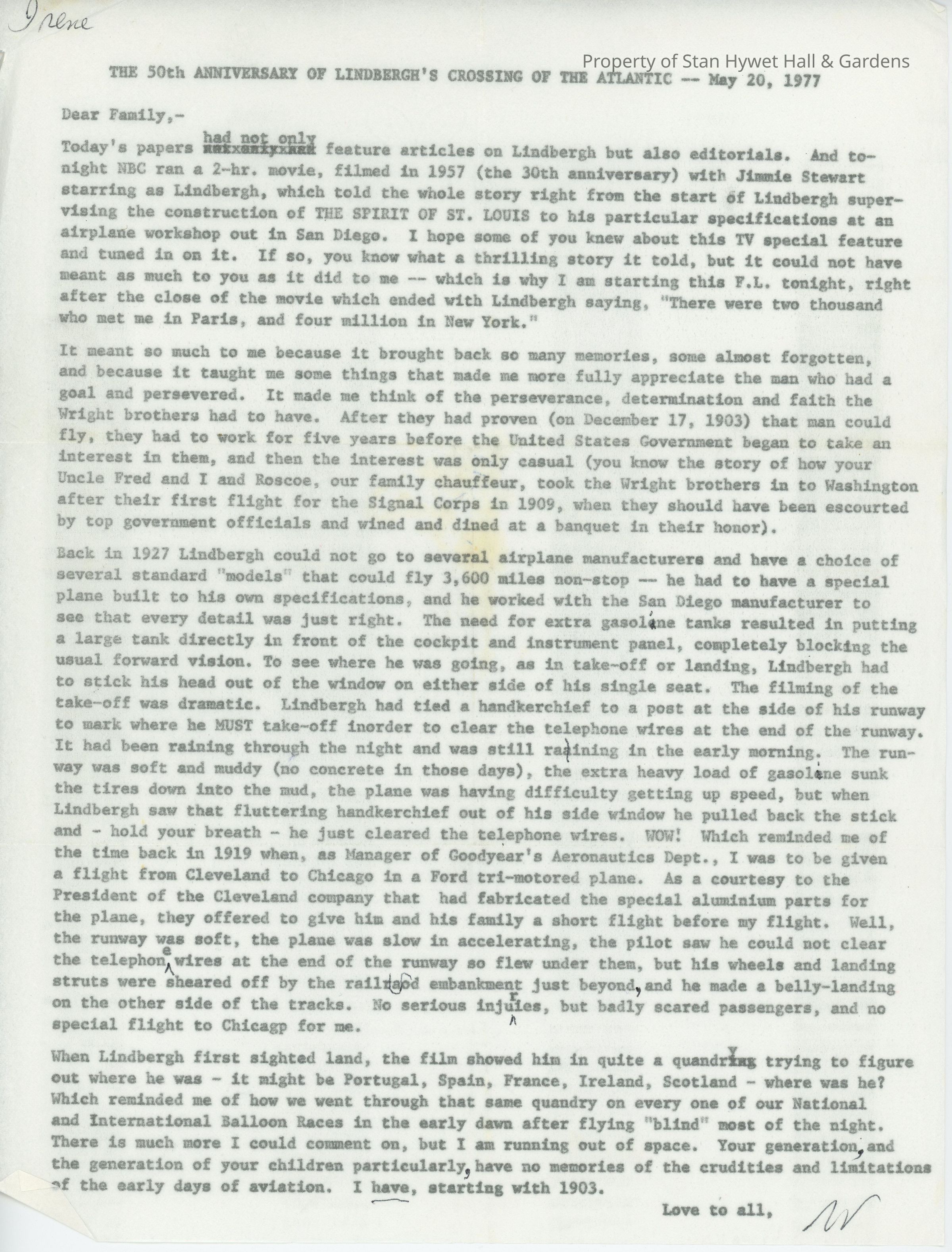
THE 50th ANNIVERSARY OF LINDBERGH’S CROSSING OF THE ATLANTIC – May 20, 1977
Dear Family,-
Today’s papers xxxxxxx had not only feature articles on Lindbergh but also editorials. And tonight NBC ran a 2-hr. movie, filmed in 1957 (the 30th anniversary) with Jimmie Stewart starring as Lindbergh, which told the whole story right from the start of Lindbergh supervising the construction of THE SPIRIT OF ST. LOUIS to his particular specifications at an airplane workshop out in San Diego. I hope some of you knew about this TV special feature and tuned in on it. If so, you know what a thrilling story it told, but it could not have meant as much to you as it did to me – which is why I am starting this F.L. tonight, right after the close of the movie which ended with Lindbergh saying, “There were two thousand who met me in Paris, and four million in New York.”
It meant so much to me because it brought back so many memories, some almost forgotten, and because it taught me some things that made me more fully appreciate the man who had a goal and persevered. It made me think of the perseverance, determination and faith the Wright brothers had to have. After they had proven (on December 17, 1903) that man could fly, they had to work for five years before the United States Government began to take an interest in them, and then the interest was only casual (you know the story of how your Uncle Fred and I and Roscoe, our family chauffeur, took the Wright brothers in to Washington after their first flight for the Signal Corps in 1909, when they should have been escourted [sic] by top government officials and wined and dined at a banquet in their honor).
Back in 1927 Lindbergh could not go to several airplane manufacturers and have a choice of several standard “models” that could fly 3,600 miles non-stop – he had to have a special plane built to his own specifications, and he worked with the San Diego manufacturer to see that every detail was just right. The need for extra gasoline tanks resulted in putting a large tank directly in front of the cockpit and instrument panel, completely blocking the usual forward vision. To see where he was going, as in take-off or landing, Lindbergh had to stick his head out of the window on either side of his single seat. The filming of the take-off was dramatic. Lindbergh had tied a handkerchief to a post at the side of his runway to mark where he MUST take-off inorder [sic] to clear the telephone wires at the end of the runway. It had been raining through the night and was still raaining [sic] in the early morning. The runway was soft and muddy (no concrete in those days), the extra heavy load of gasoline sunk the tires down into the mud, the plane was having difficulty getting up speed, but when Lindbergh saw that fluttering handkerchief out of his side window he pulled back the stick and - hold your breath - he just cleared the telephone wires. WOW! Which reminded me of the time back in 1919 when, as Manager of Goodyear’s Aeronautics Dept., I was to be given a flight from Cleveland to Chicago in a Ford tri-motored plane. As a courtesy to the President of the Cleveland company that had fabricated the special aluminium [sic] parts for the plane, they offered to give him and his family a short flight before my flight. Well, the runway was soft, the plane was slow in accelerating, the pilot saw he could not clear the telephone wires at the end of the runway so flew under them, but his wheels and landing struts were sheared off by the railroad embankment just beyond, and he made a belly-landing on the other side of the tracks. No serious injuries, but badly scared passengers, and no special flight to Chicago for me.
When Lindbergh first sighted land, the film showed him in quite a quandryxxx trying to figure out where he was - it might be Portugal, Spain, France, Ireland, Scotland - where was he? Which reminded me of how we went through that same quandry [sic] on every one of our National and International Balloon Races in the early dawn after flying “blind” most of the night. There is much more I could comment on, but I am running out of space. Your generation, and the generation of your children particularly, have no memories of the crudities and limitations of the early days of aviation. I have, starting with 1903.
Love to all,
WTranscriber
Cindi RokeLanguage
English