Transcription
Irene
F.L. #23
Friday, 6-3-77.
Dear Family,-
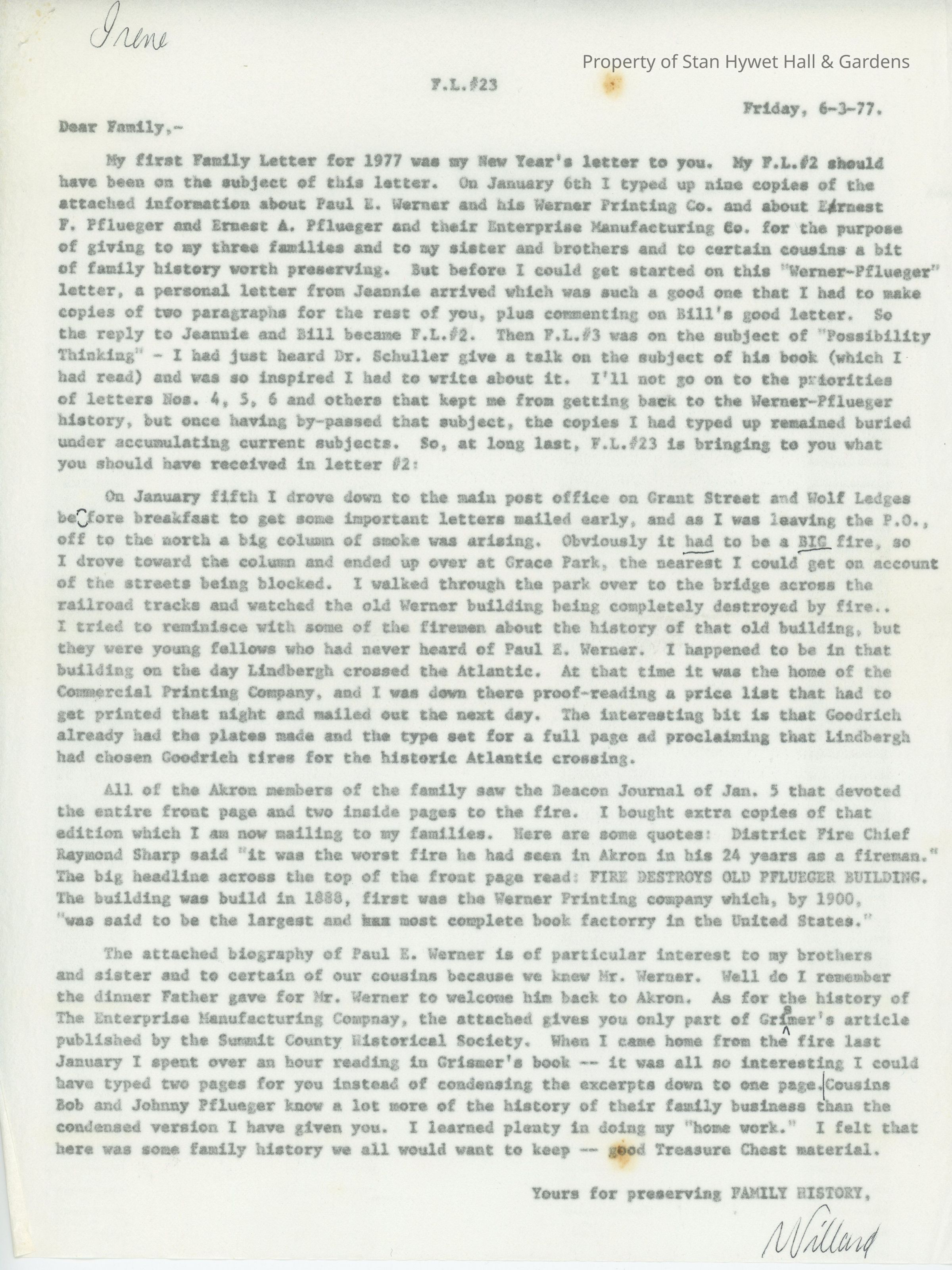
My first Family Letter for 1977 was my New Year’s letter to you. My F.L.#2 should have been on the subject of this letter. On January 6th I typed up nine copies of the attached information about Paul E. Werner and his Werner Printing Co. and about Earnest F. Pflueger and Ernest A. Pflueger and their Enterprise Manufacturing Co. for the purpose of giving to my three families and to my sister and brothers and to certain cousins a bit of family history worth preserving. But before I could get started on this “Werner-Pflueger” letter, a personal letter from Jeannie arrived which was such a good one that I had to make copies of two paragraphs for the rest of you, plus commenting on Bill’s good letter. So the reply to Jeannie and Bill became F.L.#2. Then F.L.#3 was on the subject of “Possibility Thinking” - I had just heard Dr. Schuller give a talk on the subject of his book (which I had read) and was so inspired I had to write about it. I’ll not go on to the priorities of letters Nos. 4, 5, 6 and others that kept me from getting back to the Werner-Pflueger history, but once having by-passed that subject, the copies I had typed up remained buried under accumulating current subjects. So, at long last, F.L.#23 is bringing to you what you should have received in letter #2:
On January fifth I drove down to the main post office on Grant Street and Wolf Ledges before breakfast to get some important letters mailed early, and as I was leaving the P.O., off to the north a big column of smoke was arising. Obviously it had to be a BIG fire, so I drove toward the column and ended up over at Grace Park, the nearest I could get on account of the streets being blocked. I walked through the park over to the bridge across the railroad tracks and watched the old Werner building being completely destroyed by fire.. I tried to reminisce with some of the firemen about the history of that old building, but they were young fellows who had never heard of Paul E. Werner. I happened to be in that building on the day Lindbergh crossed the Atlantic. At that time it was the home of the Commercial Printing Company, and I was down there proof-reading a price list that had to get printed that night and mailed out the next day. The interesting bit is that Goodrich already had the plates made and the type set for a full page ad proclaiming that Lindbergh had chosen Goodrich tires for the historic Atlantic crossing.
All of the Akron members of the family saw the Beacon Journal of Jan. 5 that devoted the entire front page and two inside pages to the fire. I bought extra copies of that edition which I am now mailing to my families. Here are some quotes: District Fire Chief Raymond Sharp said “it was the worst fire he had seen in his 24 years as a fireman.” The big headline across the top of the front page read: FIRE DESTROYS OLD PFLUEGER BUILDING. The building was build [sic] in 1888, first was the Werner Printing company which, by 1900, “was said to be the largest and xxx most complete book factory [sic] in the United States.”
The attached biography of Paul E. Werner is of particular interest to my brothers and sister and to certain of our cousins because we knew Mr. Werner. Well do I remember the dinner Father gave for Mr. Werner to welcome him back to Akron. As for the history of The Enterprise Manufacturing Compnay [sic], the attached gives you only part of Grismer’s article published by the Summit County Historical Society. When I came home from the fire last January I spent over an hour reading in Grismer’s book – it was all so interesting I could have typed two pages for you instead of condensing the excerpts down to one page./Cousins Bob and Johnny Pflueger know a lot more of the history of their family business than the condensed version I have given you. I learned plenty in doing my “home work.” I felt that here was some family history we all would want to keep – good Treasure Chest material.
Yours for preserving FAMILY HISTORY,
WillardTranscriber
Cindi RokeLanguage
EnglishNotes
aTranscription
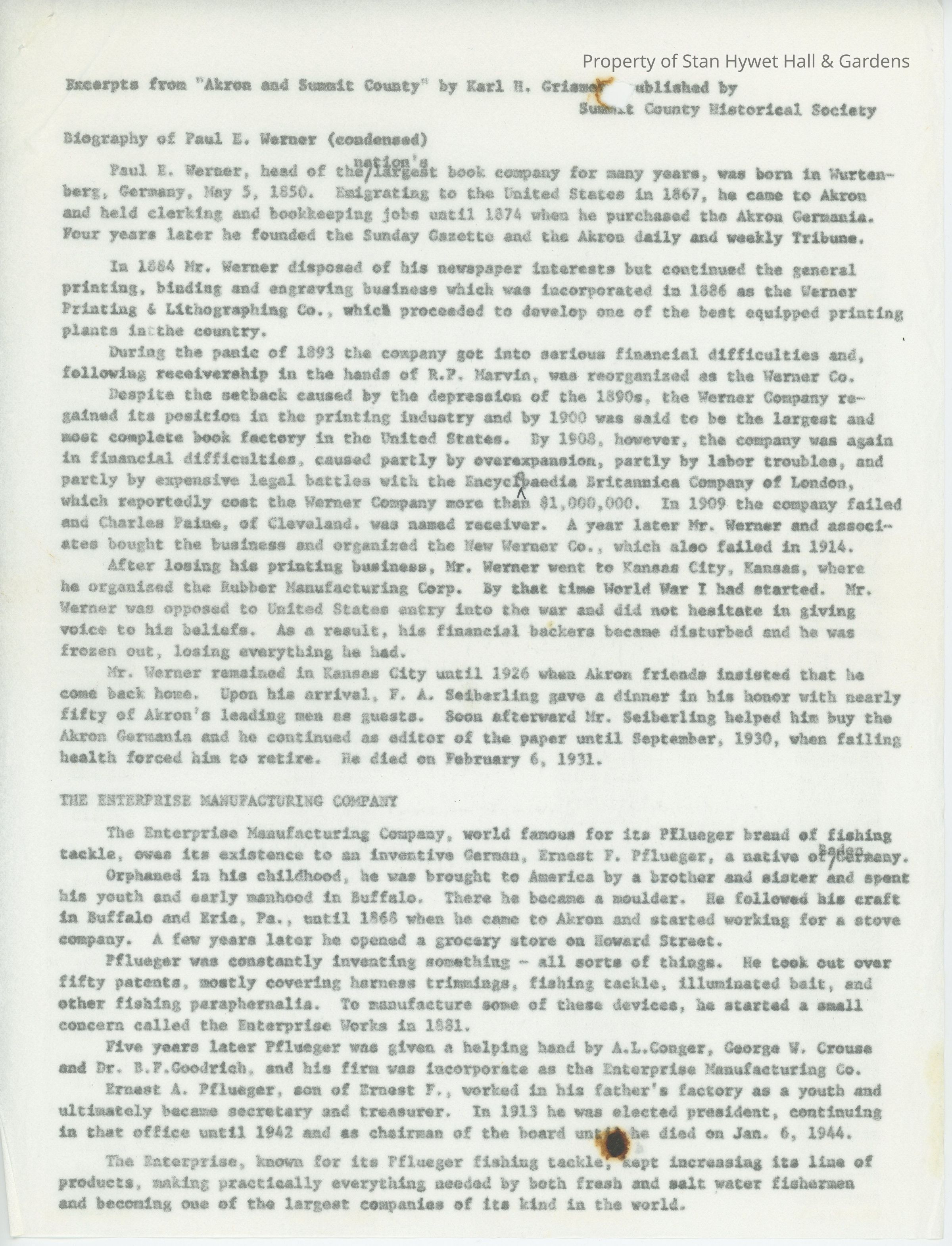
Excerpts from “Akron and Summit County” by Karl H. Grismer published by
Summit County Historical Society
Biography of Paul E. Werner (condensed)
Paul E. Werner, head of the nation’s largest book company for many years, was born in Wurtanberg, Germany, May 5, 1850. Emigrating to the United States in 1867, he came to Akron and held clerking and bookkeeping jobs until 1874 when he purchased the Akron Germania. Four years later he founded the Sunday Gazette and the Akron daily and weekly Tribune.
In 1884 Mr. Werner disposed of his newspaper interests but continued the general printing, binding and engraving business which was incorporated in 1886 as the Werner Printing & Lithographing Co., which proceeded to develop one of the best equipped printing plants in the country.
During the panic of 1893 the company got into serious financial difficulties and, following receivership in the hands of R.P. Marvin, was reorganized as the Werner Co.
Despite the setback caused by the depression of the 1890s, the Werner Company regained its position in the printing industry and by 1900 was said to be the largest and most complete book factory in the United States. By 1908, however, the company was again in financial difficulties, caused partly by overexpansion, partly by labor troubles, and partly by expensive legal battles with the Encyclopaedia [sic] Britannica Company of London, which reportedly cost the Werner Company more than $1,000,000. In 1909 the company failed and Charles Paine, of Cleveland, was named receiver. A year later Mr. Werner and associates bought the business and organized the New Werner Co., which also failed in 1914.
After losing his printing business, Mr. Werner went to Kansas City, Kansas, where he organized the Rubber Manufacturing Corp. By that time World War I had started. Mr. Werner was opposed to United States entry into the war and did not hesitate in giving voice to his beliefs. As a result, his financial backers became disturbed and he was frozen out, losing everything he had.
Mr. Werner remained in Kansas City until 1926 when Akron friends insisted that he come back home. Upon his arrival, F.A. Seiberling gave a dinner in his honor with nearly fifty of Akron’s leading men as guests. Soon afterward Mr. Seiberling helped him buy the Akron Germania and he continued as editor of the paper until September, 1930, when failing health forced him to retire. He died on February 6, 1931.
THE ENTERPRISE MANUFACTURING COMPANY
The Enterprise Manufacturing Company, world famous for its Pflueger brand of fishing tackle, owes its existence to an inventive German, Ernest F. Pflueger, a native of Baden, Germany.
Orphaned in his childhood, he was brought to America by a brother and sister and spent his youth and early manhood in Buffalo. There he became a moulder. He followed his craft in Buffalo and Erie, Pa., until 1868 when he came to Akron and started working for a stove company. A few years later he opened a grocery store on Howard Street.
Pflueger was constantly inventing something - all sorts of things. He took out over fifty patents, mostly covering harness trimmings, fishing tackle, illuminated bait, and other fishing paraphernalia. To manufacture some of these devices, he started a small concern called the Enterprise Works in 1881.
Five years later Pflueger was given a helping hand by A.L.Conger, George W. Crouse and Dr. B.F.Goodrich, and his firm was incorporate [sic] as the Enterprise Manufacturing Co.
Ernest A. Pflueger, son of Ernest F., worked in his father’s factory as a youth and ultimately became secretary and treasurer. In 1913 he was elected president, continuing in that office until 1942 and as chairman of the board until he died on Jan. 6, 1944.
The Enterprise, known for its Pflueger fishing tackle, kept its line of products, making practically everything needed by both fresh and salt water fishermen and becoming one of the largest companies of its kind in the world.Transcriber
Cindi RokeLanguage
EnglishNotes
b