Transcription
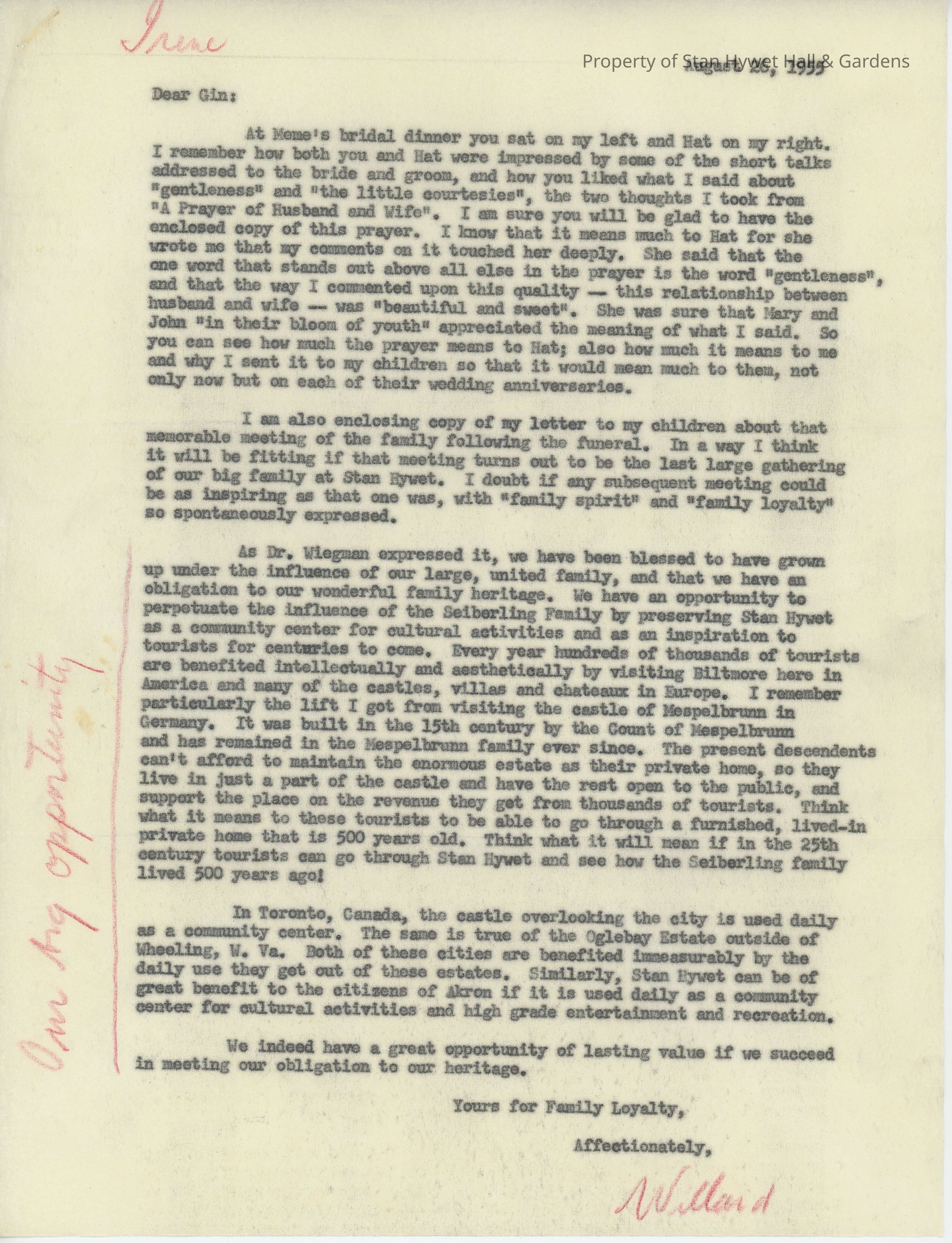
Irene
August 26, 1955
Dear Gin:
At Meme’s bridal dinner you sat on my left and Hat on my right. I remember how both you and Hat were impressed by some of the short talks addressed to the bride and groom, and how you liked what I said about “gentleness” and “the little courtesies”, the two thoughts I took from “A Prayer of Husband and Wife”. I am sure you will be glad to have the enclosed copy of this prayer. I know that it means much to Hat for she wrote me that my comments on it touched her deeply. She said that the one word that stands out above all else in the prayer is the word “gentleness”, and that the way I commented upon this quality—this relationship between husband and wife—was “beautiful and sweet”. She was sure that Mary and John “in their bloom of youth” appreciated the meaning of what I said. So you can see how much the prayer means to Hat; also how much it means to me and why I sent it to my children so that it would mean much to them, not only now but on each of their wedding anniversaries.
I am also enclosing copy of my letter to my children about that memorable meeting of the family following the funeral. In a way I think it will be fitting if that meeting turns out to be the last large gathering of our big family at Stan Hywet. I doubt if any subsequent meeting could be as inspiring as that one was, with “family spirit” and “family loyalty” so spontaneously expressed.
As Dr Wiegman expressed it, we have been blessed to have grown up under the influence of our large, united family, and that we have an obligation to our wonderful family heritage. We have an opportunity to perpetuate the influence of the Seiberling Family by preserving Stan Hywet as a community center for cultural activities and as an inspiration to tourists for centuries to come. Every year hundreds of thousands of tourists are benefited intellectually and aesthetically by visiting Biltmore here in America and many of the castles, villas and chateaux in Europe. I remember particularly the lift I got from visiting the castle of Mespelbrunn in Germany. It was built in the 15th century by the Count of Mespelbrunn and has remained in the Mespelbrunn family ever since. The present descendents [sic] can’t afford to maintain the enormous estate as their private home, so they live in just part of the castle and have the rest open to the public, and support the place on the revenue they get from thousands of tourists. Think what it means to these tourists to be able to go through a furnished, lived-in private home that is 500 years old. Think what it will mean if in the 25th century tourists can go through Stan Hywet and see how the Seiberling family lived 500 years ago !
In Toronto, Canada, the castle overlooking the city is used daily as a community center. The same is true of the Oglebay Estate outside of Wheeling, W. Va. Both of these cities are benefited immeasurably by the daily use they get out of these estates. Similarly, Stan Hywet can be of great benefit to the citizens of Akron if it is used daily as a community center for cultural activities and high grade entertainment and recreation.
We indeed have a great opportunity of lasting value if we succeed in meeting our obligation to our heritage.
Yours for Family Loyalty,
Affectionately,
Willard
On left margin written sideways in red pencil— Our big opportunityTranscriber
Cindi RokeLanguage
EnglishNotes
aTranscription
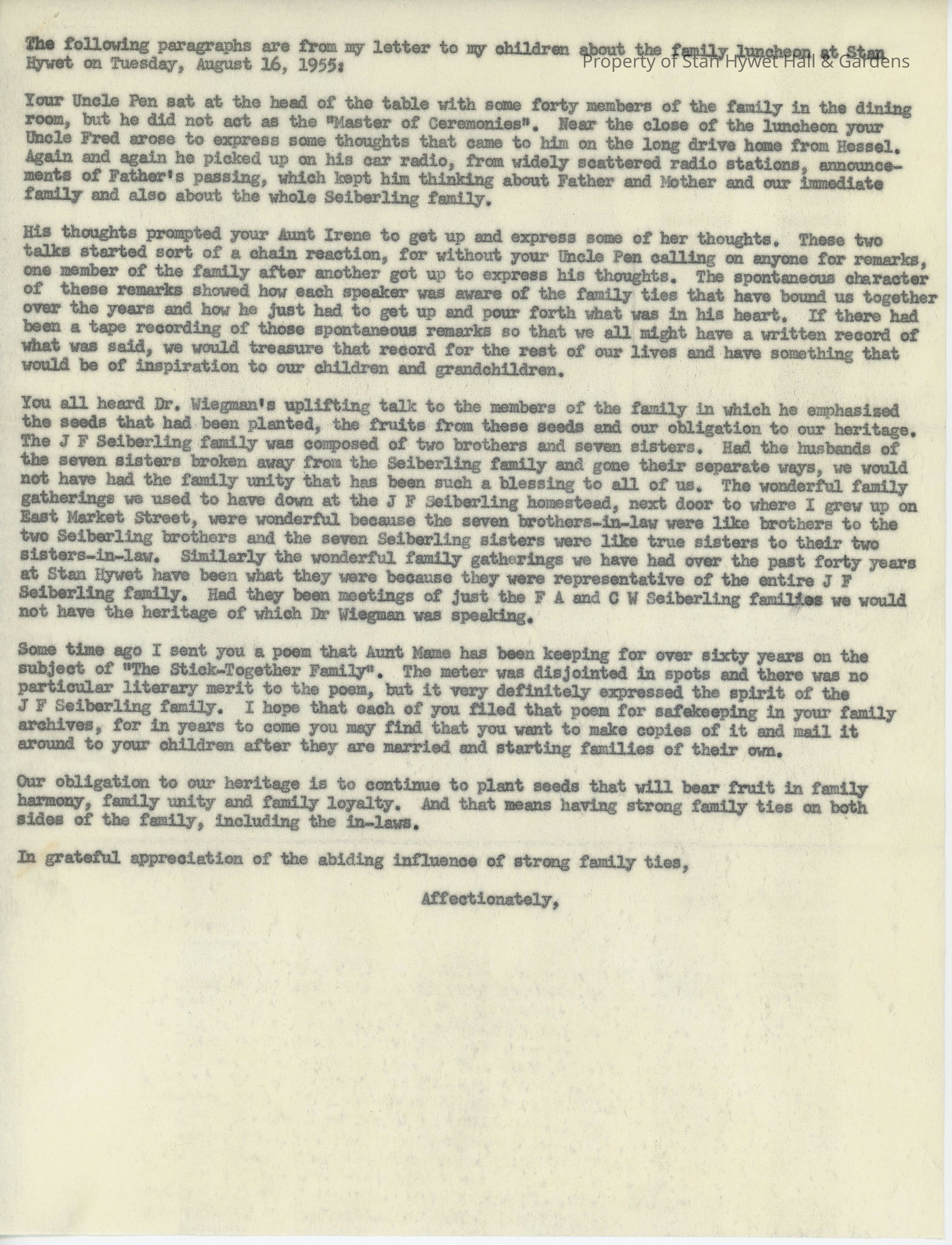
The following paragraphs are from my letter to my children about the family luncheon at Stan Hywet on Tuesday, August 16, 1955:
Your Uncle Pen sat at the head of the table with some forty members of the family in the dining room, but he did not act as the “Master of Ceremonies”. Near the close of the luncheon your Uncle Fred arose to express some thoughts that came to him on the long drive home from Hessel. Again and again he picked up on his car radio, from widely scattered radio stations, announcements of Father’s passing, which kept him thinking about Father and Mother and our immediate family and also about the whole Seiberling family.
His thoughts prompted your Aunt Irene to get up and express some of her thoughts. These two talks started sort of a chain reaction, for without your Uncle Pen calling on anyone for remarks, one member of the family after another got up to express his thoughts. The spontaneous character of these remarks showed how each speaker was aware of the family ties that have bound us together over the years and how he just had to get up and pour forth what was in his heart. If there had been a tape recording of those spontaneous remarks so that we all might have a written record of what was said, we would treasure that record for the rest of our lives and have something that would be of inspiration to our children and grandchildren.
You all heard Dr. Wiegman’s uplifting talk to the members of the family in which he emphasized the seeds that had been planted, the fruits from these seeds and our obligation to our heritage. The J F Seiberling family was composed of two brothers and seven sisters. Had the husbands of the seven sisters broken away from the Seiberling family and gone their separate ways, we would not have had the family unity that has been such a blessing to all of us. The wonderful family gatherings we used to have down at the J F Seiberling homestead, next door to where I grew up on East Market Street, were wonderful because the seven brothers-in-law were like brothers to the two Seiberling brothers and the seven Seiberling sisters were like true sisters to their two sisters-in-law. Similarly the wonderful family gatherings we have had over the past forty years at Stan Hywet have been what they were because they were representative of the entire J F Seiberling family. Had they been meetings of just the F A and C W Seiberling families we would not have the heritage of which Dr Wiegman was speaking.
Some time ago I sent you a poem that Aunt Mame has been keeping for over sixty years on the subject of “The Stick-Together Family”. The meter was disjointed in spots and there was no particular literary merit to the poem, but it very definitely expressed the spirit of the J F Seiberling family. I hope that each of you filed that poem for safekeeping in your family archives, for in years to come you may find that you want to make copies of it and mail it around to your children after they are married and starting families of their own.
Our obligation to our heritage is to continue to plant seeds that will bear fruit in family harmony, family unity and family loyalty. And that means having strong family ties on both sides of the family, including the in-laws.
In grateful appreciation of the abiding influence of strong family ties,
Affectionately,Transcriber
Cindi RokeLanguage
EnglishNotes
b