Description
Painting
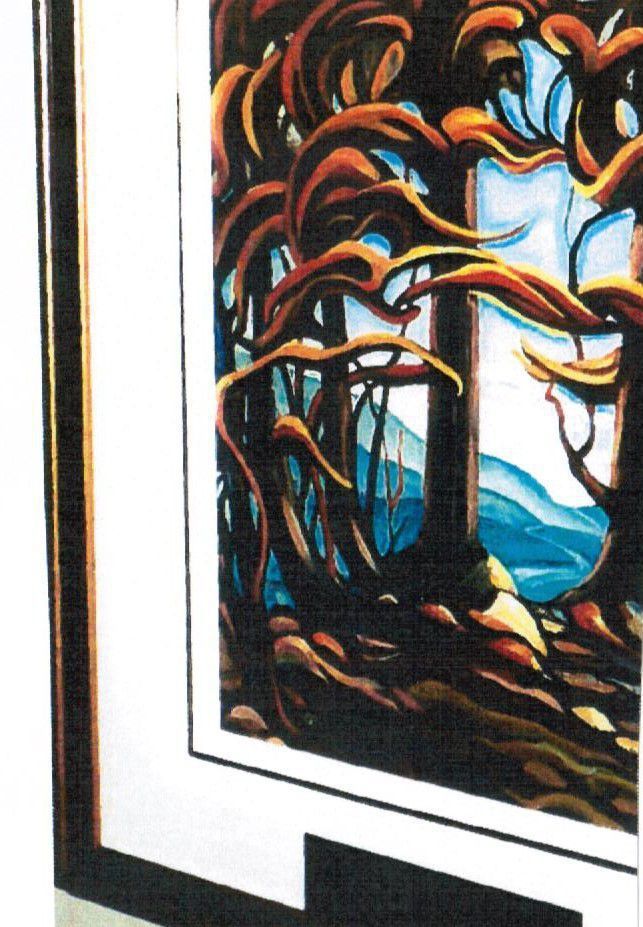
This Modernist landscape depicts sunlit blue-green hills and sky viewed through a dark and shadowed forest of arbutus trees. The peeling reddish-brown bark strips of the foreground trees form a repetitive and flowing curvilinear pattern, almost like moving wallpaper, echoed in part in the forest floor. The location is Galiano Island where the artist lived for a number of years.Type of Painting
EaselContext
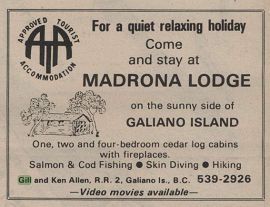
Galiano Island is one of the Southern Gulf Islands located between Vancouver Island and the Lower Mainland of B.C. Located on the west side of the Strait of Georgia, the island is bordered by Mayne Island, Salt Spring Island and Valdes Island. Galiano Island takes its name from the Spanish explorer Dionisio Alcalá Galiano (1760-1805), who explored the area in 1792.
_____________________
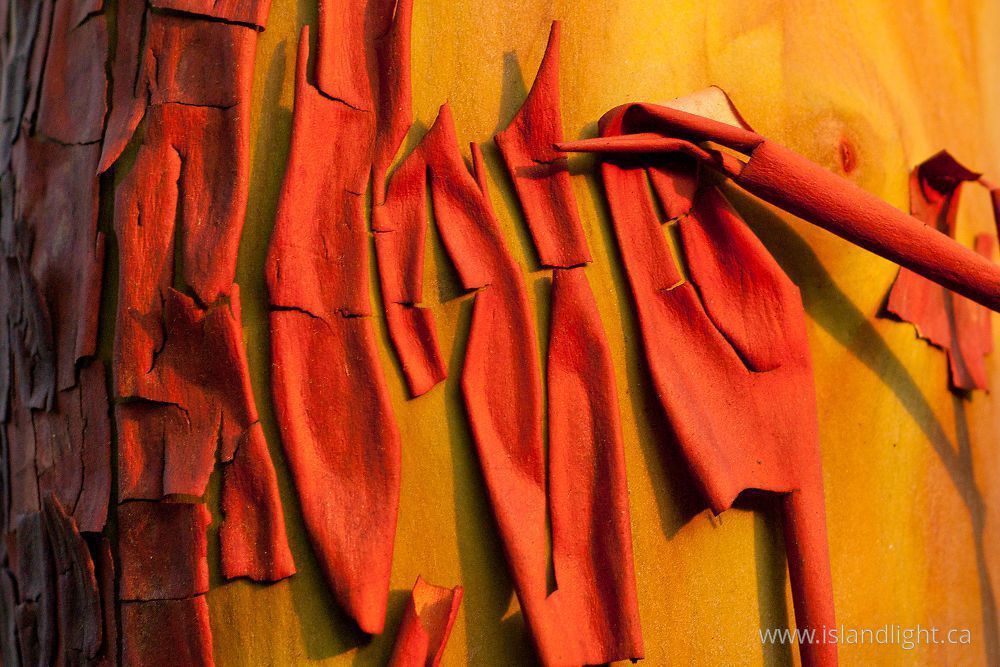
Canada's only broad-leafed evergreen tree, the arbutus species native to the Pacific Northwest is Arbutus menziesii (Pacific madrone), important to a variety of First Nations people of B.C. in their myths and also for the creation of various medicines. The bark is also very rich in a substance used for tanning hides. Arbutus wood is hard and beautifully grained, making it suitable for woodworking and carving.
Arbutus is found from southwestern B.C. to northern Mexico on a narrow band along the coast, most often within 8 km of the Pacific Ocean. Frequently, it thrives on exposed rocky bluffs overlooking the water. They are tough, sun-loving trees that weather summer drought conditions well and can grow up to 30 m high. They are striking trees and the bark is thin, smooth, and reddish-brown, peeling in thin strips to expose younger, smooth, greenish to cinnamon-red bark underneath. In addition to Arbutus, the most common trees found on the Gulf Islands are Douglas fir, Western red cedar, Grand fir, Red alder and Big leaf maple.