Description
Painting
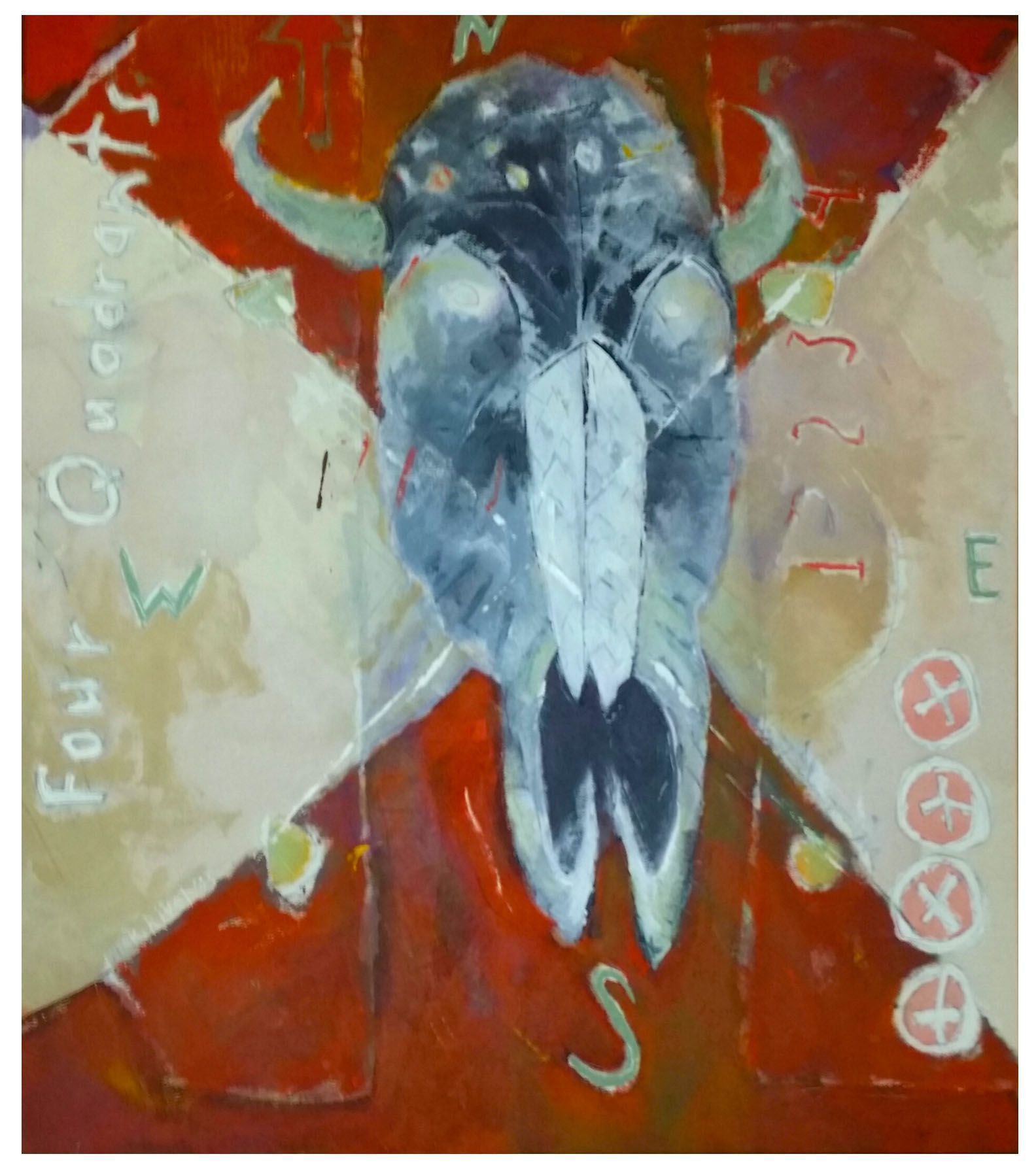
This striking image depicts a Modernist stylized bison mask set against a textured collage-type red and taupe background divided into triangular quadrants. The term FOUR QUADRANTS and the numbers 1234 appear in the image as do the four points of the compass (NEWS) and other symbols whose meaning is not understood, although the four lower right circular x-images could be a reference to Pacific Northwest Coast First Nations ceremonial button blankets. The bison was considered a sacred animal to Métis and First Nations peoples and was absolutely essential to their survival and income in the 18th century and into the 19th century.Type of Painting
EaselContext
From the early 1800s until the 1870s, plains bison were the main source of subsistence (food, clothing and household articles) and income for the Métis, known as the "Buffalo Hunters". The Métis are an Indigenous people whose historical homelands include Canada's three Prairie Provinces, as well as parts of B.C. and the Northwest Territories, with smaller populations in northwest Ontario and the northern U.S.
The Métis dominated in the lucrative pemmican* trade in the late 1700s into the 1800s, beginning with their organization of the buffalo hunt and the institution of "Laws of the Prairies" in order to try to protect this finite resource. The Métis Nation's gross national product from this source was reportedly larger than that of either the fledgling nation of Canada or the United States. Of note, there was a custom called "dancing the buffalo" reported to have been used when hunters had difficulty finding buffalo (reported in the The Weekly Republican Cherryvale, Kansas, USA, July 22, 1887). Later in the 19th century, bison nearly became extinct through hunting and disease. However, recovery efforts in North America have been successful with a resurgence of populations in national parks and in the wild.
The number "four" referenced in the painting is sacred to many First Nations and Métis peoples as it represents the four seasons, the four human needs (physical, mental, emotional and spiritual), the four kingdoms (animal, mineral, plant, and human) and the four sacred medicines (sweetgrass, tobacco, cedar, and sage). This image may also reference the four quadrants (needs) of an Indigenous medicine wheel seen to be the most basic elements of health and wellness common to all human beings and essential to the balance of interdependence within oneself and all living things. Or the quadrants may represent the four corners of the world or four quarters of the world corresponding approximately to the four points of the compass, or alternatively, have astrological, celestial or astronomical meanings. This painting seems both a tribute and a cry for lost worlds, expressed with reference to various mythologies, symbols, spirits and shamanistic beliefs. Rivet blends the traditions of Modernist art with ancient cultures in both realistic and abstract ways.
Of note, the artist's early years were spent in the Canadian Arctic's Mackenzie River Delta in a Métis family which made its living by trapping, hunting and fishing. The Métis are a people of mixed heritage, descended from French, Scottish and English traders from the Hudson’s Bay and Northwest Companies who intermixed with Native peoples in the prairies and elsewhere in Canada. The town where the artist was born, Aklavik, was multi-ethnic, a trading centre for the region, with people from varied backgrounds including Métis, Gwich'in First Nation, Inuvialuit and European. For much of the 20th century the town served as the administrative, transportation and commercial capital of the western Arctic. Because of repeated flooding in this area, the government developed Inuvik to the east. Altogether this background speaks to the artist's exposure to and subsequent interest in and insights into the diversity and juxtaposition of a variety of cultures.
*Pemmican is a calorie-rich mixture of tallow, dried meat (traditionally buffalo), and sometimes dried berries, herbs, spices and honey.