Description
Photograph
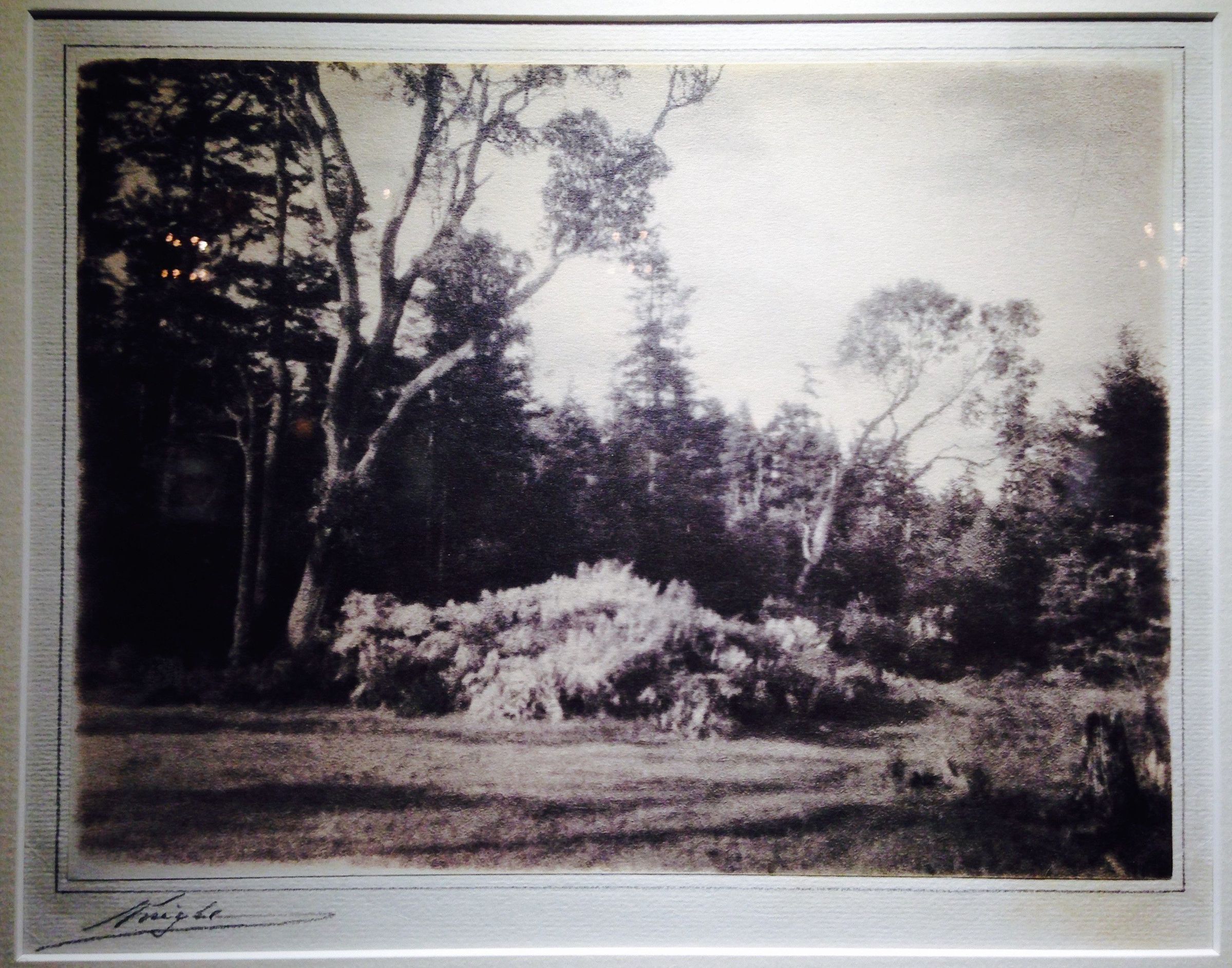
This black and white Pictorial-style landscape shows shrubbery, identified as [Scotch] Broom, and several Arbutus trees, the only native broadleaf evergreen tree in Canada. The location is unknown, but could well be Victoria, B.C.Context
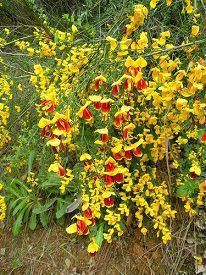
Native to the British Isles and the Mediterranean areas of Europe, Scotch broom (Cytisus scopariuswas) with its bright yellow flowers, sometimes with red detailing, and leathery stems, was introduced to Vancouver Island in the 1850s as an ornamental shrub. Its spread continued following planting as a bank stabilizer during road building, and as discarded whiskey crate packing for the gold camps. It now grows prolifically throughout southwestern B.C. including Vancouver Island and the Gulf Islands, as well as P.E.I. and Nova Scotia.
Growing to 3m in height, Broom is considered an invasive species, a serious threat to biodiversity, eliminating native plant communities and destroying wildlife habitat. Broom is also particularly flammable, increasing the fire hazard of properties.
____________________
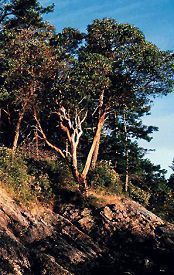
In B.C., Arbutus (Arbutus menzeisii) is found in the dry southeast regions of Vancouver Island, as well as the Gulf Islands, and the lower mainland. Arbutus is found as far south as Mexico, giving this tree one of the longest north-south ranges of any North American tree. It is Canada's only native broad-leafed evergreen tree, and of note, is found no farther than 8 km from the Pacific Ocean.
These striking looking trees have waxy green leaves, drooping white flower clusters, orange-red berries and smooth reddish-orange bark which curls up and falls off, revealing a fresh new greenish layer. They are tough, sun-loving trees that weather summer drought conditions well and can grow up to 30 m high. The wood is hard and beautifully grained, making it very suitable for woodworking and carving. Various First Nations peoples have also used arbutus bark and leaves for medicinal purposes and arbutus was important in their myths.