Description
Drawing
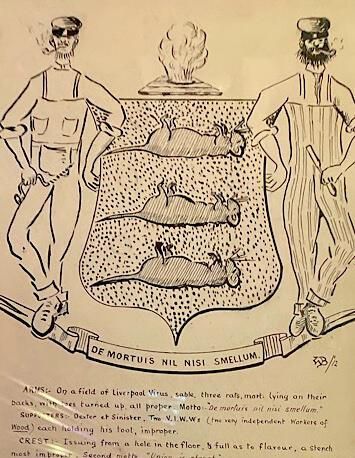
This is a humourous cartoon related to rodent infestations at The Union Club of British Columbia, at its second venue on Douglas Street, drawn by the then Club Secretary, ca. 1912. This image depicts a "Coat of Arms" with three rats, deceased, on their backs on a shield with two workman supporters, a crest at the top and a motto as follows, “DE MORTUIS NIL NISI SMELLUM”. This motto is a play on the Latin phrase, "De mortuis nil nisi bonum", roughly equivalent in English to "Speak no ill of the dead". The explanatory text at the bottom follows traditional heraldic description of the components - shield, supporters, a crest, and a motto.
Founded in 1879, the Union Club is a landmark institution in the heart of downtown Victoria, considered the foremost business, social and cultural club in the city. It is now located in its third venue on Gordon Street at Humboldt. In 2017, the building was declared a National Historic Site by the Government of Canada.Context
Members using the Club's facilities were responsible for paying their dues and any applicable board bills or surcharges. For example, members using the card room after 1:30 a.m. ca. 1910 were required to pay a substantial surcharge (five dollars/hour for the room) and after 2:30 a.m. the charge was applied on a per person basis. This is in contrast to the four-legged "members", who enjoyed the entire Club for free, paying no dues, bills, fees or surcharges. These infestations are said to have significantly contributed to the Club’s decision to build its new home on Gordon Street.
See Susan Mayse, "The Union Club of British Columbia - Our First 125 Years" (Victoria, B.C.: The Union Club of British Columbia, 2004), and Paul L. Bissley, "Early and Late Victorians: A History of the Union Club of British Columbia" (Sidney, B.C.: Review Printing and Publishing Co. Ltd., 1969). Both publications are available in the UCBC Library.
___________________
A coat of arms is traditionally unique to a person, family, state, organization, school or corporation. Originally appearing on shields or flags, coats of arms were once used as a way of distinguishing one knight from another on a battlefield. There are strict formal rules governing which colors and symbols are depicted on coats of arms and how they are arranged. The coat of arms on an escutcheon or shield forms the central element of the full heraldic achievement, or display, of all the components to which the bearer of a coat of arms is entitled, which consists of a shield, supporters, a crest, and a motto.
From the The Public Register of Arms, Flags, and Badges of Canada, Canadian Heraldic Authority, The Governor General of Canada (see Web Links below).