Description
Watercolour on paper
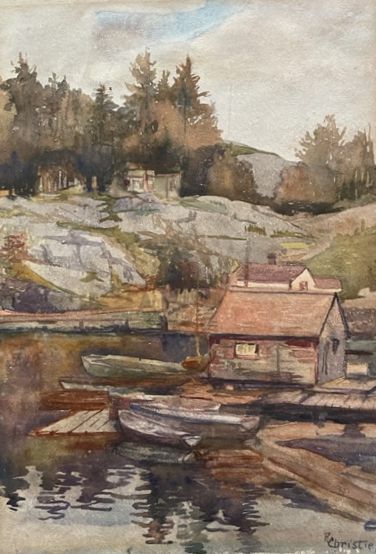
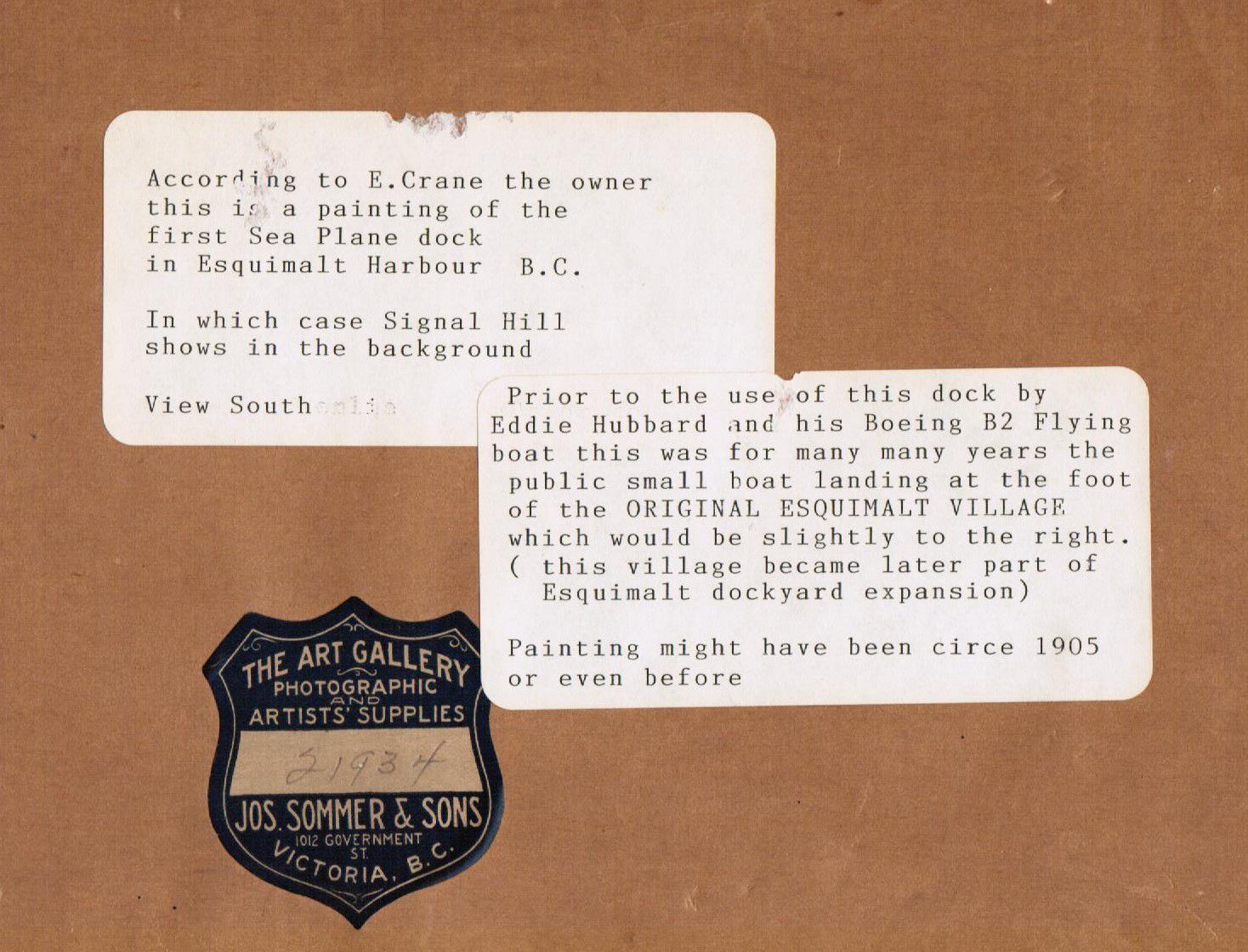
This painting depicts the first sea plane dock in Esquimalt Harbour, B.C. It is a muted brown/grey/green image showing a small wooden wharf with boats and several buildings on the edge of a cove.
Esquimalt Harbour is a natural harbour in Greater Victoria on the southern tip of Vancouver Island, located east of the capital city Victoria's harbour. Signal Hill is shown in the background as a rocky slope with trees and several buildings. It is not known if any of the buildings is Building No. 508 constructed as part of the Victoria-Esquimalt coastal artillery defense system .Context
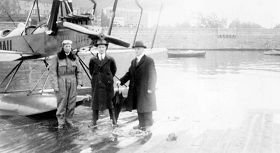
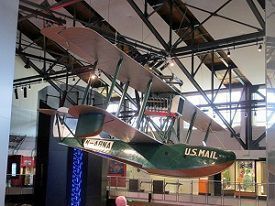
This 1921 painting depicts the first sea plane dock in Esquimalt Harbour's Constance Cove, B.C., reportedly constructed by Edward (Eddie) Willits Hubbard (1889-1928) and used for his Boeing B-1 Flying Boat, an all wood biplane. The Boeing B-1 was the first commercial design for Boeing, and only a single aircraft was built, as the market was flooded with post WWI-surplus aircraft. The plane was purchased by Hubbard, the first pilot to land in Victoria’s harbour, and who initiated an air mail service between Seattle, Washington and Victoria, B.C. on December 27, 1919, and continued for eight years on what became the first regular international airmail route. The plane was decommissioned in 1930 and later put on display at Seattle's Museum of History and Industry.
Prior to this air mail service use, the dock served as the public small boat landing at the foot of the then Esquimalt Village. Reportedly, Canadian Airways also later established a seaplane airmail and passenger service in Esquimalt Harbour, operating out of the Esquimalt Hotel.*
The current Victoria Inner Harbour Water Airport, located downtown adjacent to the city is now used by both floatplanes and seaplanes. There is also a separate heliport in the harbour, that also serves as a cruise ship and ferry destination, and is home to numerous marine-based industries. Larger planes operate out of Victoria International Airport north of the city.
_____________________
The Esquimalt region now known as the municipality of Esquimalt was settled by First Nations people, now known as the Esquimalt Nation, approximately 4000 years before the arrival of Europeans. The word Esquimalt is a transliteration of "Ess-whoy-malth," a phrase usually translated as "place of the shoaling waters." The Songhees people, originally on the western shore of Victoria Harbour, now have a reserve in Esquimalt.
First used by the British Royal Navy as early as 1837, Esquimalt is the home of Canada's naval presence on the West Coast. The original Esquimalt townsite is now within the borders of the Canadian Forces Base (CFB), now the community's largest employer. The townsite also became part of Esquimalt's dockyard expansion. Of note, its Graving Dock is the largest non-military ship building and repair facility on the West Coast of the Americas.
Signal Hill, depicted in this painting, is located on the south side of Constance Cove in CFB Esquimalt. Signal Hill Building No. 508, built in 1898 and perhaps depicted in this image, was part of the Victoria-Esquimalt coastal artillery system designed to defend the dockyards and the coastline. It is a Recognized Federal Heritage Building designated by Parks Canada in 1991.
* Gregory Evans. 2015. "Old village foundation of Esquimalt" in "Victoria News" Jan. 28, 2015