Description
Print
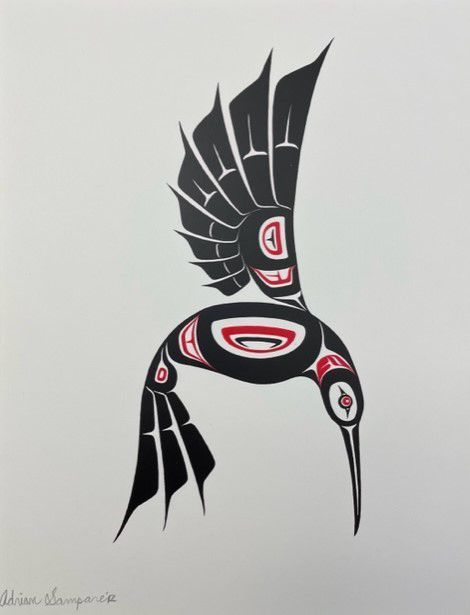
This image depicts a hummingbird, with its body elegantly curved, wings and tail outstretched showcasing its long curved bill, perfectly designed to sip the nectar from deep inside trumpet-shaped flowers. Known as hummingbirds because of the audible humming sound created by their beating wings they are recognized as the most talented of all birds in flight. These tiny birds have many specialized communications and metabolic characteristics to enable rapid, maneuverable flight, adaptations to high altitude and long-distance migration.
This hummingbird is portrayed in "formline", a Pacific Northwest Coast First Nations art form distinguished by the use of characteristic shapes, such as ovoids, U forms and trigons used for figure outlines, design elements and composition. In traditional formline, the main design elements are black, and the secondary elements are red. This First Nations art form was based on structured design traditions; however, regional characteristics reflecting style, complexity and colour variances evolved over time.
Note: The term "formline", first used by art historian Bill Holm in his 1965 book "Northwest Coast Indian Art: An Analysis of Form", is still in common use by artists and educators today. See: Bill Holm, “Northwest Coast Indian Art: An Analysis of Form” 50th Anniversary Edition (Seattle: University of Washington Press, 2014).Context
The hummingbird, known as "Sah Sen", is one of the important symbols in Pacific Northwest Coast art. The hummingbird with its grace and energy, teaches you to appreciate and love the miracle of living and to help you focus on the positivity in your life. These birds are often seen as joyful messengers and healers, also symbolizing friendship and playfulness, and is a sign of good luck. Hummingbirds can have different meanings across First Nations tribes and families although it is always a positive sign to see Sah Sen prior to any major event.
Found only in North and South America, there are 338 species of hummingbirds, of which we see five in B.C. - the Rufous, Anna's, Calliope, Black-chinned and occasionally the Ruby-throated. The Rufous has one of the longest migrations among all birds, traveling twice per year between the Pacific Northwest rainforests and Mexico, a distance of some 6,000 km. Sadly, many hummingbird populations are threatened and waning, and the Rufous and the Calliope are deemed to be in significant decline.