Name/Title
Inner Harbour, Victoria, B.C.Entry/Object ID
2026.10.03Description
In process
Drawing
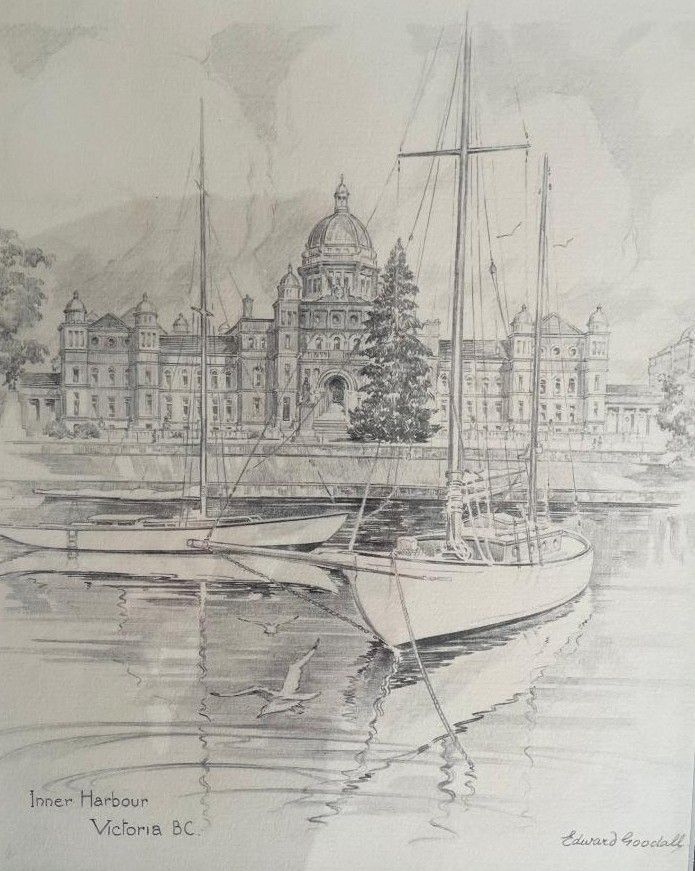
This image depicts Victoria's Inner Harbour, highlighting British Columbia's Parliament Buildings, home to the lieutenant governor and the Legislative Assembly. This scenic waterfront is the location of Victoria's many tourist and cultural attractions, hotels, recreational activities, restaurants and shopping.
This drawing depicts several sailboats in the foreground with the Parliament Buildings serving as the backdrop. It has a realistic illustration quality with a careful design and softly-created detail. The image is quite spare and precise presented as an architectural rendering.Context
Victoria was built on the traditional territories of the Lekwungen peoples, today known as the Esquimalt and Songhees Nations. Victoria is Western Canada's second oldest city, incorporated in 1862. This image showcases the city as the seat of provincial government and the Inner Harbour as the gateway to the city.
The B.C. Parliament Buildings were completed in 1897 by noted architect Francis M. Rattenbury (1867-1935). They were built in a Neo-Baroque design on a grand scale with a central dome and two end pavilions, rich white marble, exterior sculptures and rusticated Renaissance-style stonework. Inside is equally impressive, with fine mosaics, carvings, marble, woodwork, and stained glass. The project came in well over budget at the then-shocking cost of almost $1 million.
Also depicted in this image is part of the Inner Harbour Causeway consisting of a granite retaining wall and lower concrete promenade (the "lower causeway") that defines the edge of the Inner Harbour waterfront in front of Government Street in downtown Victoria. More recently, the David Foster Harbour Pathway (also known as David Foster Way) was developed. Named in 2013 after the famed Victoria-raised musician and producer David Foster, the pathway celebrates his artistic achievements and provides a scenic, roughly 5-km pedestrian and cycling waterfront route from Ogden Point in the south to Rock Bay in the north along the Inner Harbour.
Of note, "The Inner Harbour Causeway is a monument to the development of tourism in the Inner Harbour Precinct. Constructed in 1903, the causeway's granite retaining wall allowed for the development of the James Bay mud flats and the subsequent construction of the Empress Hotel by the Canadian Pacific Railway, which established Victoria as a primary tourist destination on the west coast of Canada."
Extract from the The Register Canada's Historic Places (See Web Links)Made/Created
Artist Information
Artist
Edward Goodall (1909-1982)Role
ArtistDate made
n.d.Time Period
20th CenturyNotes
ARTIST BIOGRAPHY
Born in Somerset, England, Edward Goodall was a Canadian artist known for his meticulous drawings, and later his paintings of Vancouver Island, B.C. and beyond. With a natural talent, he came from a family of successful artists (great grandfather, grandfather and more), and he studied art in Wales under the guidance of art master Marcus Holmes (1875-1951) of the Herkomer school. He then traveled, working on a tea plantation in India, later on to China and Japan, and then to Canada earning money for his trips by selling his drawings. He worked at many jobs, cutting ice blocks in Alberta, working on a cattle drive and in Victoria selling stocks and bonds. When World War II broke out, Goodall enlisted with the Royal Canadian Engineers. His art career really started after his discharge from the army, and his purchase of a house in Oak Bay, Victoria with a home studio.
In 1942 he applied for the copyright to “Goodall’s Pencil Postcard Series” and began drawing scenes of Vancouver Island creating more than 500 scenes for postcards. Through the 1950s he drew a series of west coast scenes for a British Columbia calendar, turning to painting later that decade. Other commercial commissions followed, including the Powell River pulp mill, Canadian Pacific Railway ships, the Kitimat smelter, a series on education facilities in Canada, and scenes for British Columbia’s 1958 centennial celebrations. As a member of the Alpine Club of Canada he climbed many mountains and turned his watercolours and sketches into calendars. By the 1960s he started to paint large watercolours on commission, and by the 1970s he was well known. He painted people’s homes, did personal Christmas cards for the Premier, Lieutenant-Governor, and others and also selling his photographs. Goodall rarely exhibited in galleries due to the nature of his production work, but in the early 1980s he had a solo gallery show in Victoria, selling out in an hour. Goodall was a member of the Island Arts and Crafts Society and later the Victoria Sketch Club.Inscription/Signature/Marks
Type
Title, SignatureLocation
Titled lower left: Victoria Harbour, B.C.
Signed lower right: Edward GoodallAcquisition
Acquisition Method
GiftDate
Oct 2026Notes
Grace Van den Brink (1956-2026) was the 72nd and first woman president of the Union Club (2019 to 2021).Copyright
Notes
Images are provided for research and reference use only. Permission to publish, copy, or otherwise use these images must be obtained from the copyright holder. It is the sole responsibility of the applicant to determine the copyright holder and to obtain permission(s) as needed.