Description
Print
This colourful work is a tribute to Sir John A. Macdonald, the first Prime Minister of Canada (serving 1867 -1873 and 1878 -1891). He was the dominant figure of Canadian Confederation, and his political career spanned almost half a century. Without doubt, one of the most influential and important Canadians in history who achieved many successes, Macdonald was not without flaws, and in more recent years, his legacy, particularly in relation to Indigenous policies and his approach to Chinese immigration, is being re-examined.Context
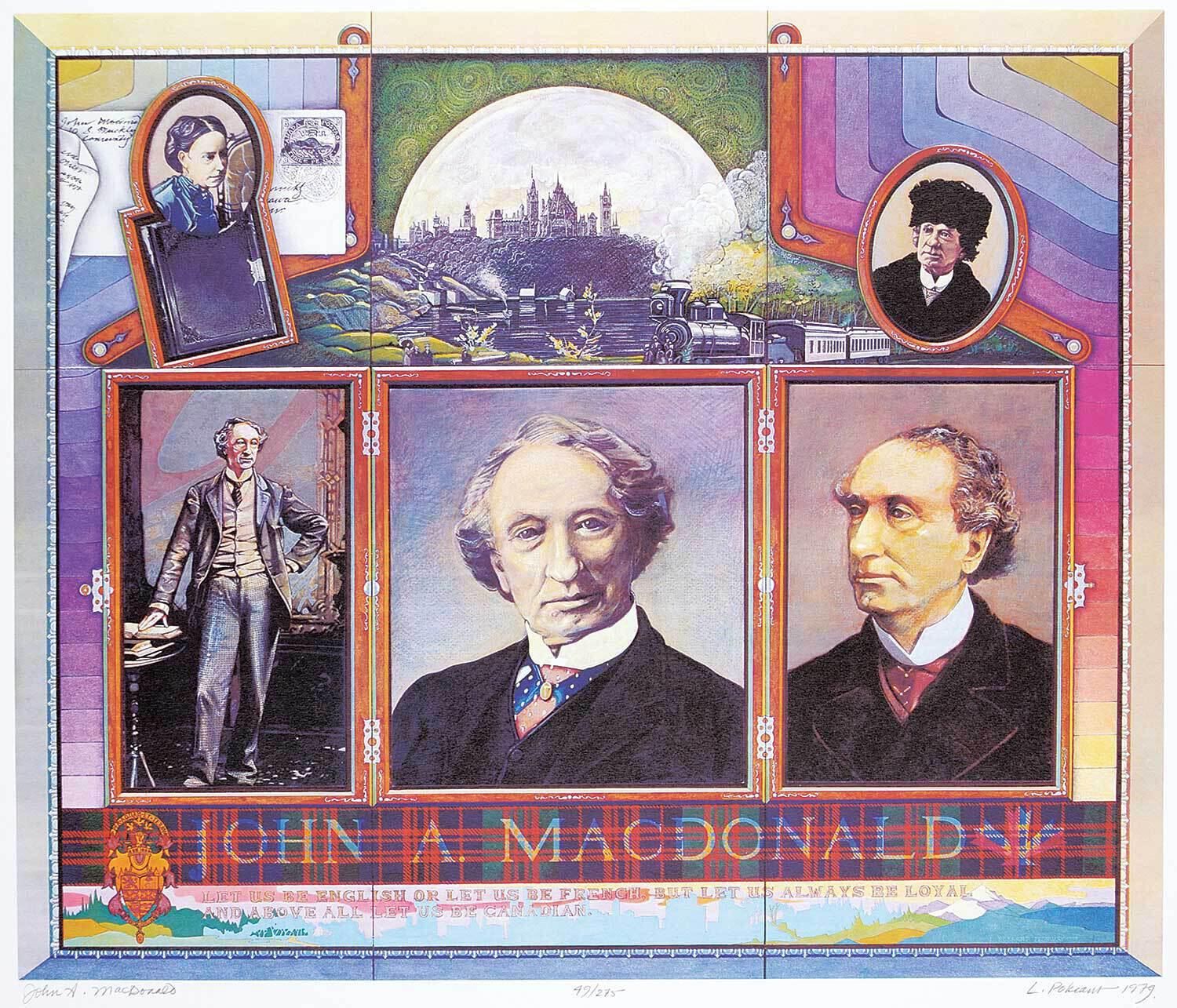
This print has a compound design that reflects illustration of the later 19th and earlier 20th centuries. It is layered with a richness of images, shapes, colours and textures, replicating in part, commercial promotional publications of the day that documented and celebrated people, places and events. Included are a number of references and symbols to Canada and unity.
There are six frames in a quasi triptych (presented in foldable 3D with wood hinges and clasps) within a larger frame with images of several people: Macdonald's second wife Lady Agnes (1836-1920)? with a letter and envelope; a fellow Father of Confederation politician, Sir George-Étienne Cartier (1814-1873)?; an image of Parliament Hill with a train representing Macdonald's Confederation achievement in 1867 and the completion of the transcontinental railway; plus three images of Macdonald himself. A Macdonald tartan banner (overlaid with a crest and a maple leaf) at the bottom reflects Macdonald's association with one of the most powerful clans and Macdonald's birthplace of Scotland. The inscription "LET US BE ENGLISH OR LET US BE FRENCH BUT LET US ALWAYS BE LOYAL, AND ABOVE ALL LET US BE CANADIAN." is a quote of Macdonald's. Underneath is a silhouette band of landscapes and cities, likely intended to represent Canada and its national motto, "From sea to sea" from the Latin phrase "A mari usque ad mare". Of note, an expanded informal version of the motto ("From sea to sea to sea") is sometimes now used to reflect Canada's territory with its coastlines on the Arctic, Atlantic and Pacific Oceans.