Description
Print
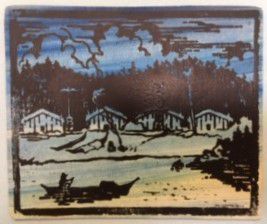
This colourful image depicting a First Nations Kwakiutl village was likely near Fort Rupert located on Beaver Harbour near present-day Port Hardy on Vancouver Island, B.C. The image shows plank longhouses on the ocean front with bird-topped totem poles and beached boats, as well as a fisherman in a boat in the foreground.
Today, the name Kwakiutl only refers to those from the village of Fort Rupert. Previously, it was a term that applied to all the Kwakwaka'wakw—that is, all of the people who speak the language Kwak’wala from a much larger geographic area.Context
The First Nations of the Pacific Northwest Coast built their houses facing the ocean, using cedar wood logs and planks. Each plank longhouse contained a number of booths along both sides of the central hallway, separated by wooden containers (like modern drawers). Each booth also had its own individual fire, and there was also a large communal fire. There was one doorway, usually facing the shore. The housefronts were often elaborately decorated with murals. The size of a home depended on the wealth of the owner, with the larger houses providing living quarters for up to 100 people.
_________________________
The word 'totem' comes from Ojibwa, an Algonquian language spoken by First Nations around Lake Superior, for the word 'odoodem' or 'ototeman'. Specifically, totem refers to an emblematic depiction of an animal, plant or being that gives a family or clan its name and serves as a reminder of its ancestry.
The original totem poles were created by six First Nations of the Pacific Northwest: the Haida, the Nuxalt, the Kwakwaka'wakw, the Tlingit, the Tsimshian and the Coast Salish. These totem poles are carved and painted monumental poles (or posts or pillars) that feature different symbols or figures (birds, frogs, bears, people, supernatural beings and sea creatures). There are seven types of poles (memorials, grave markers, house posts, portal house poles, welcoming poles, mortuary poles and ridicule or shame poles). Similar to other forms of heraldry, they may function as crests of families or chiefs, recount stories owned by those families or chiefs, commemorate special occasions and more. The poles are usually made from large trees, mostly western red cedar, and their stories are usually read from the bottom of the pole to the top.