Description
Painting
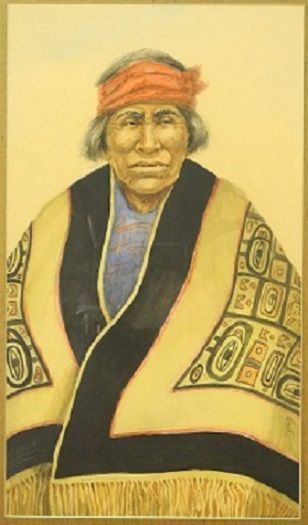
This frontal portrait depicts a dignified elderly First Nations man of the Pacific Northwest Coast. He is introspective with his eyes looking to his left. It is a head and shoulders plus view and the man is wrapped in a richly designed blanket, likely a woven Chilkat dancing blanket, traditionally used in important ceremonies and dances and/or worn as a demonstration of wealth and prestige. Slightly visible under the blanket is a blue no-collar shirt with decorative buff-coloured detail. The man's gray hair is wrapped in part with a red head scarf, knotted to his left side. The identity of the sitter is unknown.Context
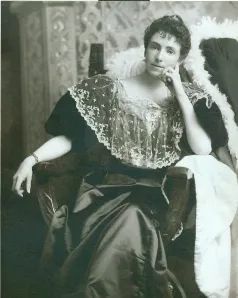
Margaret Maclure is known to have invited First Nations people into her home for portrait sessions and it is reported that she also occasionally traveled to do portrait work. Her husband's family farm was at Matsqui Prairie*, near Abbotsford, B.C. and First Nations would have been the majority population. The entire Maclure family reportedly spoke a Chinookian language, or perhaps the Chinook trade language that originated in the Pacific Northwest. The Maclures may also have understood the local Salish dialect.
*Matsqui Prairie refers to the floodplain surrounding the historic Matsqui Village formerly part of the District Municipality of Matsqui in what is now the City of Abbotsford. The Matsqui people, who are part of the Stó꞉lō group historically known as the Fraser River Salish, remain resident in the area to the west of Matsqui Village.
_________________________
"Unlike the way by which many of us encounter the Chilkat blanket today—spread flat and hanging in a museum case, the Chilkat blanket was conceived to be a royal object in motion: the fringe swirls and sways as the wearer— with the blanket draped over his or her shoulders much akin to a shawl—dances, dipping and turning to a drum beat..."
- Christy Christodoulides "Unpacking a phrase: The Chilkat blanket "(2012). See Web Links
Chilkat weaving is a traditional form of weaving that has been practiced by Tlingit, Haida, Tsimshian, Kwakwakawakw and other Pacific Northwest Coast First Nations peoples of B.C. and Alaska for centuries. Of note, designs on the earlier Chilkat robes were painted. This type of weaving was reportedly first produced by the Coastal Tsimshian on the Skeena River on mainland B.C. However, during the later 19th century, the Tsimshian passed their knowledge on to many peoples and regions in the northwest though marriage and trade, and ultimately, Chilkat weaving came to be most commonly associated with the Tlingit in Alaska. While each of these peoples and cultures has their own particular history with weaving, those who make, use and dance in Chilkat blankets and robes all continue to show and share their family and community traditions and stories.
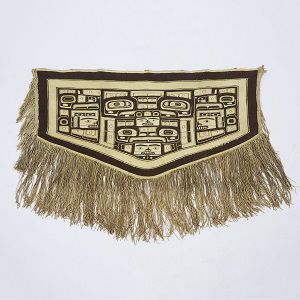
Chilkat weaving can be used for many types of clothing and household items such as blankets, robes, shirts, vests, bags, hats and wall-hangings. The clothing features beautiful and dramatic designs with long wool fringes that sway when the wearer dances, and due to this use the blankets or robes are often called "dancing blankets". Chilkat blankets and robes are worn by high-ranking tribal members on important civic or ceremonial occasions, including potlatches.
These sophisticated and labour-intensive weavings are made with braided mountain goat wool over top of twined cedar bark using various dyes, with an elaborate design including a heavy black border. They feature Pacific Northwest Coast formline design, a traditional aesthetic made up of ovoid, U-form, and S-form elements to create highly stylized, but representational, clan crests and figures from oral histories, often including animals. Yellow, white and black are usually the dominant colours, with blue or blue-green as a secondary colour over the ivory wool. This weaving is traditionally done only by women, following designs painted on boards by men incorporating the formline imagery seen in the Northwest Coast wood carving that is typically created by men. The format of the majority of designs was similarly structured, with a crest animal in the central panel position with two flanking side panels.