Description
Photograph
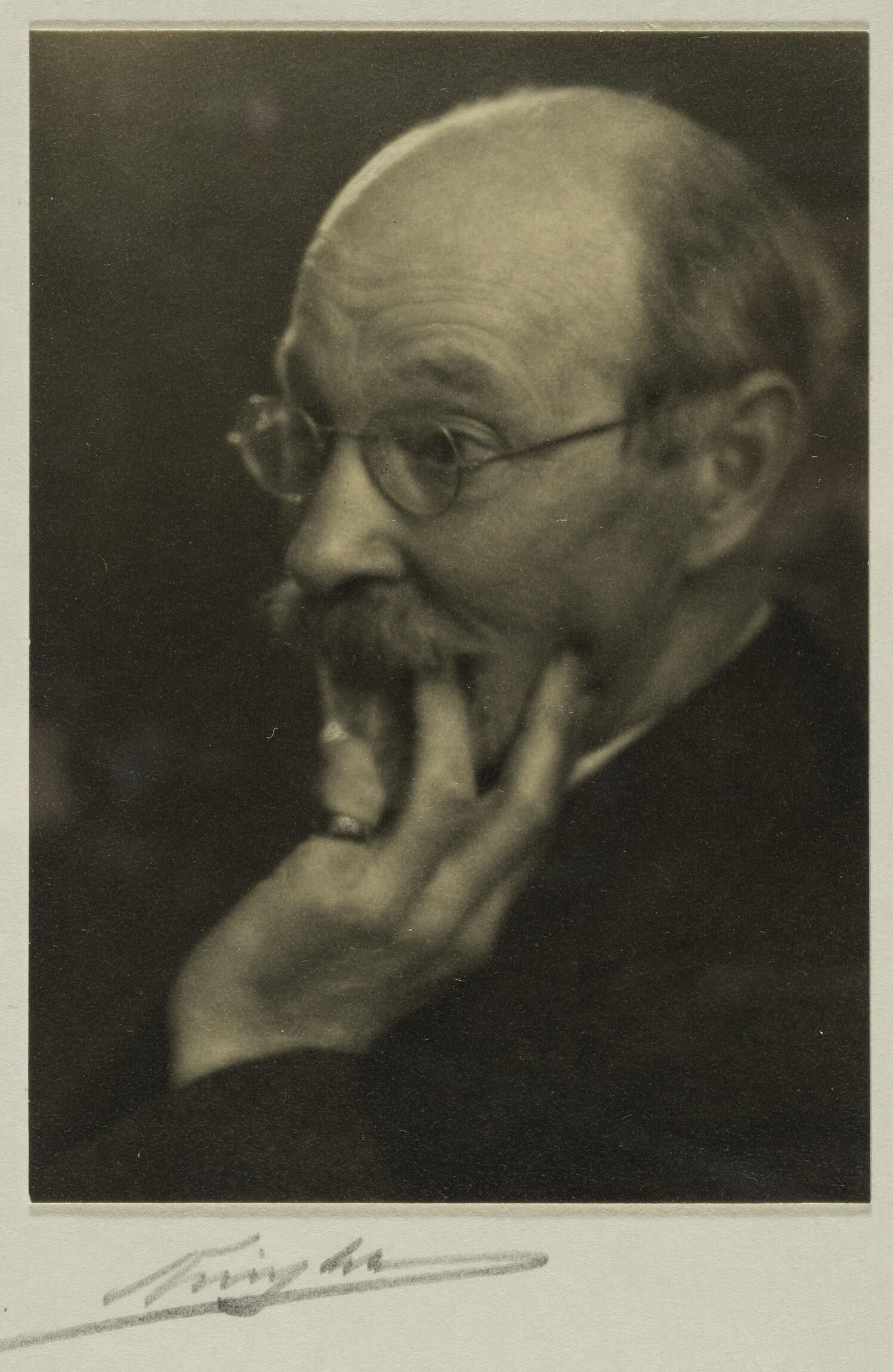
Photographic reproduction (2015) from the undated b/w photograph by Harry Upperton Knight.
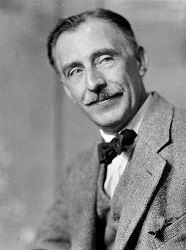
This black and white Pictorial-style portrait is of English-born, Harold Mortimer-Lamb who was, in the early 20th century, the leading artistic photographer in Canada, a proponent of Pictorial photography. He was also a successful mining engineer, journalist and artist perhaps best known for championing the Canadian Modernist Group of Seven in the 1920s. This image of a pensive Mortimer-Lamb, a 3/4 head and shoulders view. He is wearing a dark suit, glasses and is partially leaning on his left hand.Context
For a fuller biography of Mortimer-Lamb, see 2015.04.01 Boy with Lace Collar
____________________
Pictorialism was an international style and the predominant aesthetic movement in photography during the later 19th and early 20th century, and beyond into the 1940s in some areas. It began in response to the advent of the amateur Kodak camera in 1888 and claims that a photograph was easily taken, simply a record of reality, and it later transformed into a movement to advance the status and principals of photography as a true art form. Pictorialists believed that photography should be understood as a means of personal expression and creativity equal to other fine arts like painting and printmaking.
Pictorialism had its roots in England with the establishment in 1892 of the Linked Ring Brotherhood by Henry Peach Robinson (1830-1901), George Davison (1854-1930) and Henry Van Der Weyde (1838-1924). This invitation-only British pictorialist group seceded from the Royal Photographic Society. And similar groups were formed in Paris, Berlin, Hamburg and Brussels. In 1902 Alfred Stieglitz (1864-1946) formed the American Pictorialist photographers group, the Photo Secession movement, with Alvin Langdon Coburn (1882-1966), Frederick Holland Day (1864-1933), Frank Eugene (1865-1936), Gertrude Käsebier (1852-1934), Edward Steichen (1879-1973) and Clarence White (1871-1925). In 1916 Coburn, Käsebier, White and others formed an organization called the Pictorial Photographers of America (PPA) to continue promotion of the pictorial style. A year later Stieglitz formally dissolved the defunct Photo Secession group.
Pictorial photographers were dedicated to conveying an emotion, thought or sentiment through their careful choice of subject matter, composition, tonal balance and technique. There is no standard definition of 'pictorialism', but overall it refers to a style in which the photographer has "created" rather than just accurately "recorded" an image. Typically, such photos have a soft focus, and may be printed in colours such as warm brown or deeper blue, and may have visible surface treatments that were created in the darkroom.