Description
Photograph
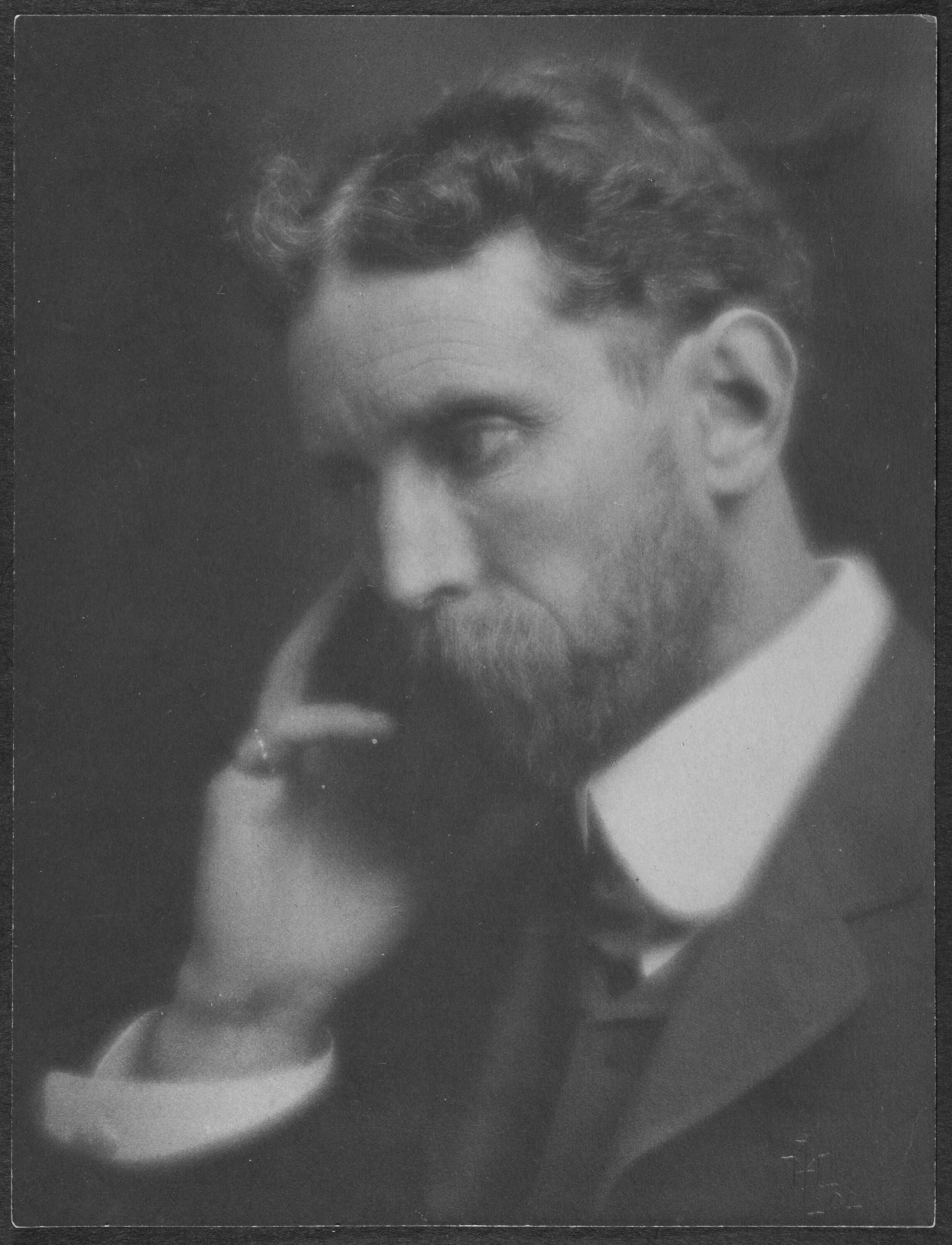
Photographic reproduction (2015) from the 1904 b/w photograph by Harold Mortimer-Lamb.
This black and white Pictorial-style image shows Samuel Maclure (1860-1929), a well-known B.C. architect and painter. He was a self-taught architect of over 450 commissions and is best known for his Tudor Revival and Craftsman style houses. As a painter, he documented local landscapes and did First Nations portraiture in watercolour. This photograph is a head and shoulders 3/4 view. He is pensive, sporting a suit with white shirt and tie and is leaning on his right hand revealing a pinkie ring. Maclure was a member of the Union Club.Context
BIOGRAPHY
Born in Sapperton, New Westminster, British Columbia, Samuel Maclure was a successful and influential Canadian architect and artist. He became the foremost domestic architect in the province from 1890 to 1920 establishing an enduring and distinctive West Coast building style, noted for the quality, ingenuity, and sheer quantity of the work with over 350 documented commissions.
A self-taught architect, he originally wanted to be an artist, and studied painting in Philadelphia from 1884 to 1885. Later he taught himself the profession of architecture. On returning to Victoria, he supported himself as a telegrapher, studied architecture at home, taught painting and produced paintings for sale. Art was always more than a diversion. For his architecture work, he produced meticulous architectural drawings and plans, but throughout his life Maclure also produced impressionistic watercolours featuring Vancouver Island.
In 1891, Maclure partnered with an experienced English architect, Richard P. Sharp (1864-1936), and he learned about the new Arts and Crafts style of architecture, inspired by English artists such as William Morris (1834-1896). The next year, Maclure partnered with Cecil Croker Fox (1879-1916) in Vancouver, initiating the most productive and acclaimed period of his career. Maclure and Fox were commissioned to design numerous Arts and Crafts and Tudor Revival homes for upper class neighbourhoods in Victoria and in Vancouver.
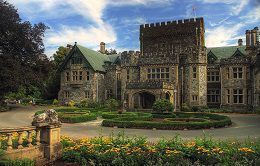
Maclure then returned to Victoria, and in 1908 he landed his most ambitious project, when commissioned to design a massive Gothic Revival estate house and park for James Dunsmuir, former B.C. premier and then Lieutenant Governor. Now known as Hatley Park National Historic Site, the mansion and estate in Greater Victoria have been used for the public Royal Roads University since 1995. From the 1940s to 1995, it was used for the Royal Roads Military College, a naval training facility. Maclure also provided advice to the Butchart family on landscape design and helped redesign and enlarge the family house, 1911 to 1925. The world-renowned Butchart Gardens near Victoria have been designated a National Historic Site of Canada. After 1912, with an economic recession and then the outbreak of World War I, Maclure worked mostly in the Victoria area into the 1920s.
Maclure was active across the arts community. In 1890 he became one of the earliest artists to exhibit in Vancouver, showing a number of paintings in the First Annual Exhibition of the Vancouver Art Association. He exhibited architectural illustrations with the Royal Canadian Academy in 1906, showed with the B.C. Society of Fine Arts in 1909 and 1910. He and his wife, Margaret Catherine (Daisy), a pianist and portrait painter, were founding members of the Vancouver Island Arts and Crafts Society in 1909 and he exhibited work with the group from 1914 to 1916. His work was widely published in Canadian, American and British Journals. He was also a member of the B.C. Society of Fine Arts (now BCSA), the Vancouver Art Association and the Victoria Sketch Club. Most of Maclure’s architectural plans and drawings are held by the University of Victoria. His paintings are held by the Art Gallery of Greater Victoria, the B.C. Museum and Archives and the Maltwood Art Museum and Gallery, University of Victoria.
For further information see -
Martin Segger. "The Buildings of Samuel Maclure: In Search Of Appropriate Form" (Victoria, B.C., Sono Nis Press, 1986), available in the UCBC Library
______________________
Pictorialism was an international style and the predominant aesthetic movement in photography during the later 19th and early 20th century, and beyond into the 1940s in some areas. It began in response to the advent of the amateur Kodak camera in 1888 and claims that a photograph was easily taken, simply a record of reality, and it later transformed into a movement to advance the status and principals of photography as a true art form. Pictorialists believed that photography should be understood as a means of personal expression and creativity equal to other fine arts like painting and printmaking.
Pictorialism had its roots in England with the establishment in 1892 of the Linked Ring Brotherhood by Henry Peach Robinson (1830-1901), George Davison (1854-1930) and Henry Van Der Weyde (1838-1924). This invitation-only British pictorialist group seceded from the Royal Photographic Society. And similar groups were formed in Paris, Berlin, Hamburg and Brussels. In 1902 Alfred Stieglitz (1864-1946) formed the American Pictorialist photographers group, the Photo Secession movement, with Alvin Langdon Coburn (1882-1966), Frederick Holland Day (1864-1933), Frank Eugene (1865-1936), Gertrude Käsebier (1852-1934), Edward Steichen (1879-1973) and Clarence White (1871-1925). In 1916 Coburn, Käsebier, White and others formed an organization called the Pictorial Photographers of America (PPA) to continue promotion of the pictorial style. A year later Stieglitz formally dissolved the defunct Photo Secession group.
Pictorial photographers were dedicated to conveying an emotion, thought or sentiment through their careful choice of subject matter, composition, tonal balance and technique. There is no standard definition of 'pictorialism', but overall it refers to a style in which the photographer has "created" rather than just accurately "recorded" an image. Typically, such photos have a soft focus, and may be printed in colours such as warm brown or deeper blue, and may have visible surface treatments that were created in the darkroom.