Date(s) of Creation
Aug 4, 1859Archive Notes
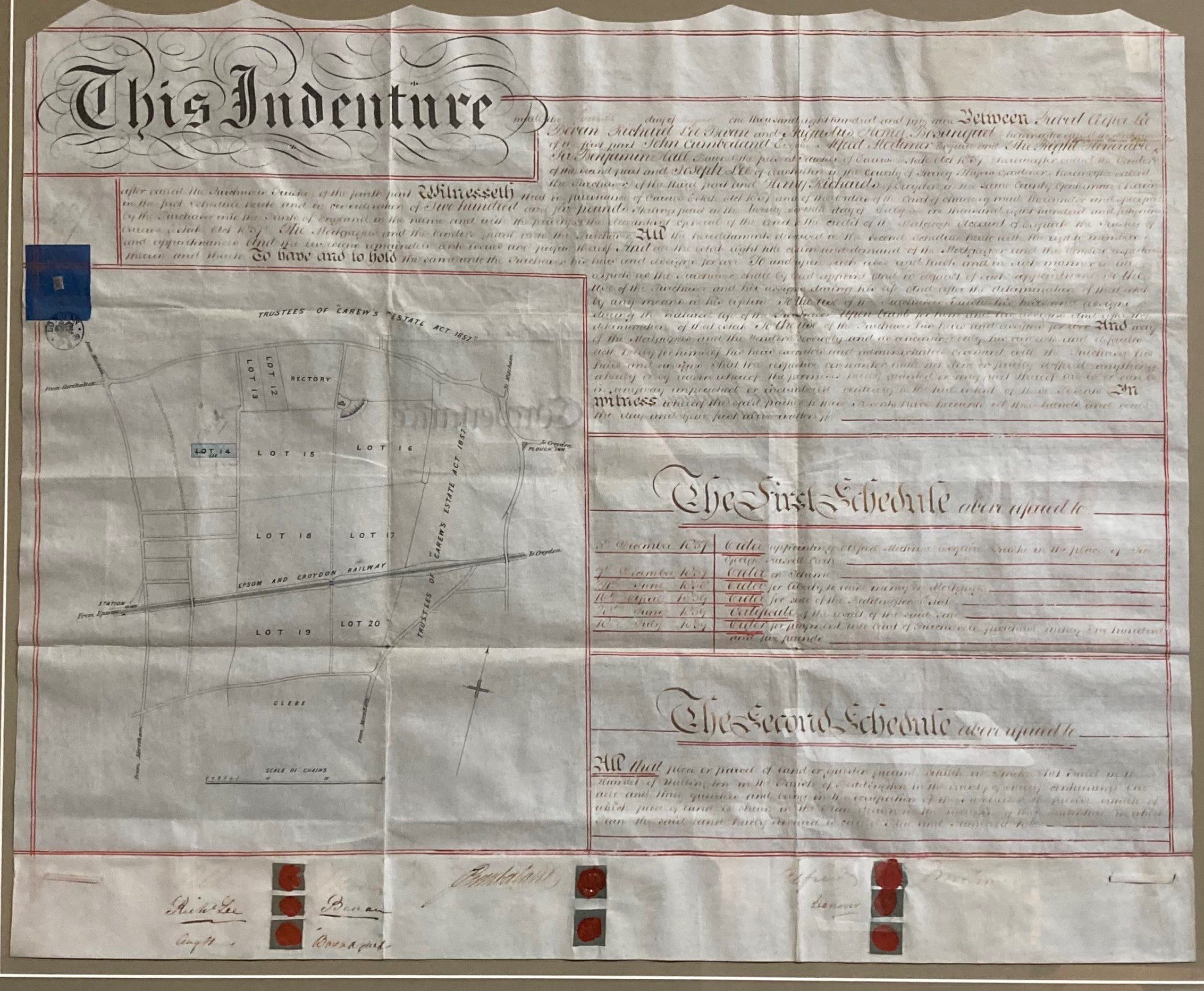
Property indenture document detail re The Carew's Estate
Handwritten in iron gall ink on parchment with unusual red ink border lines, likely red-lead or oxide of iron, previously folded with red wax seals and tax stamp.
The document opens with "This Indenture" in large letters with decorative flourishes and includes introductory and main text (upper left/right) plus a map with scale of chains (lower left, covering nine lots, numbered 12-20 plus surrounding land with text (top and right) - TRUSTEE'S OF "CAREW'S ESTATE ACT 1857 ") and two titled schedules (lower right). There is an embossed blue British Revenue stamp, upper left, on a separate square piece of paper from the parchment, slit twice and a tin band (escutcheon) passed through slits in the stamp and the parchment, plus LONDON stamp beneath. Assumed on the verso of the parchment (not visible) that the ends of the band were folded and secured to the back with a paper seal bearing the monarch's (Queen Victoria) cypher seal. The escutcheon and cypher seal are intended to prevent illegal reuse of the stamp.
On the lower folded margin are eight red wax seals (of the parties' or lawyers' signet rings) over top of paper squares, five with visible signatures. The parchment was folded to form a "gutter" through which a thin cream-coloured ribbon was threaded, partially visible recto left and right sides.
The indenture is...Between Robert Cooper Lee Bevan, Richard Lee Bevan and Augustus Henry Bosanquet...of the first part. John Cumberland Esquire, Alfred Mortimer Esquire and The Right Honorable Sir Benjamin Hall Baronet & the present Trustee of Carew's Estate Oct. 1857....
Signed by Richard Lee [Cooper] Bevan, etc.
Of note, the London, Brighton and South Coast Railway line - Epsom/Croydon is shown traversing the estate (opened to the public in 1847).
__________________
This indenture involved a number of prominent men of the day such as:
- Robert Cooper Lee Bevan (1809-1890), a wealthy and prominent senior partner of Barclays Bank Limited (earlier named Barclay, Bevan, Tritton, Ransom, Bouverie & Co. and Barclay, Bevan & Co.), positioned in the top echelon of Victorian society. Of note, Robert Barclay (1648-90), ancestor of the banking family was the author of the Quaker manifesto "An Apology for the True Christian Divinity".
- Richard Lee Bevan (1811-1900), a Northampton magistrate for over 50 years, elected as Justice to the County's Lunatic Asylums in 1858.
Note: The surname Bevan was first found in Herefordshire, where they held a family seat from ancient times. Welsh counties are found to the west.
- Augustus Henry Bosanquet (1792-1877), brother-in-law of RCL Bevan and nephew of The East India Company's longest-serving director, a wealthy merchant and insurance co. founder.
- The RH Sir Benjamin Hall Baronet (1802-1867) was a Welsh civil engineer and politician who served in various British governments in the 1850s, e.g., First Commissioner of Public Works. He championed the right of people in Wales to have religious services conducted in the Welsh language.